
If you have ever felt overwhelmed by investing, you are not alone. Most people know they should be investing money for their future, but the whole process feels complicated. You hear terms like ETFs, tax loss harvesting, and asset allocation, and it can feel like everyone else already understands what they mean except you.
This is exactly the problem that robo advisors were built to solve.
A robo advisor is basically a service that builds and manages an investment portfolio for you using computer algorithms instead of a human advisor sitting across a desk. You answer a few questions about your goals, your timeline, and how comfortable you are with risk. Then the platform builds you a mix of investments, usually low cost funds, and keeps adjusting it over time so you do not have to.
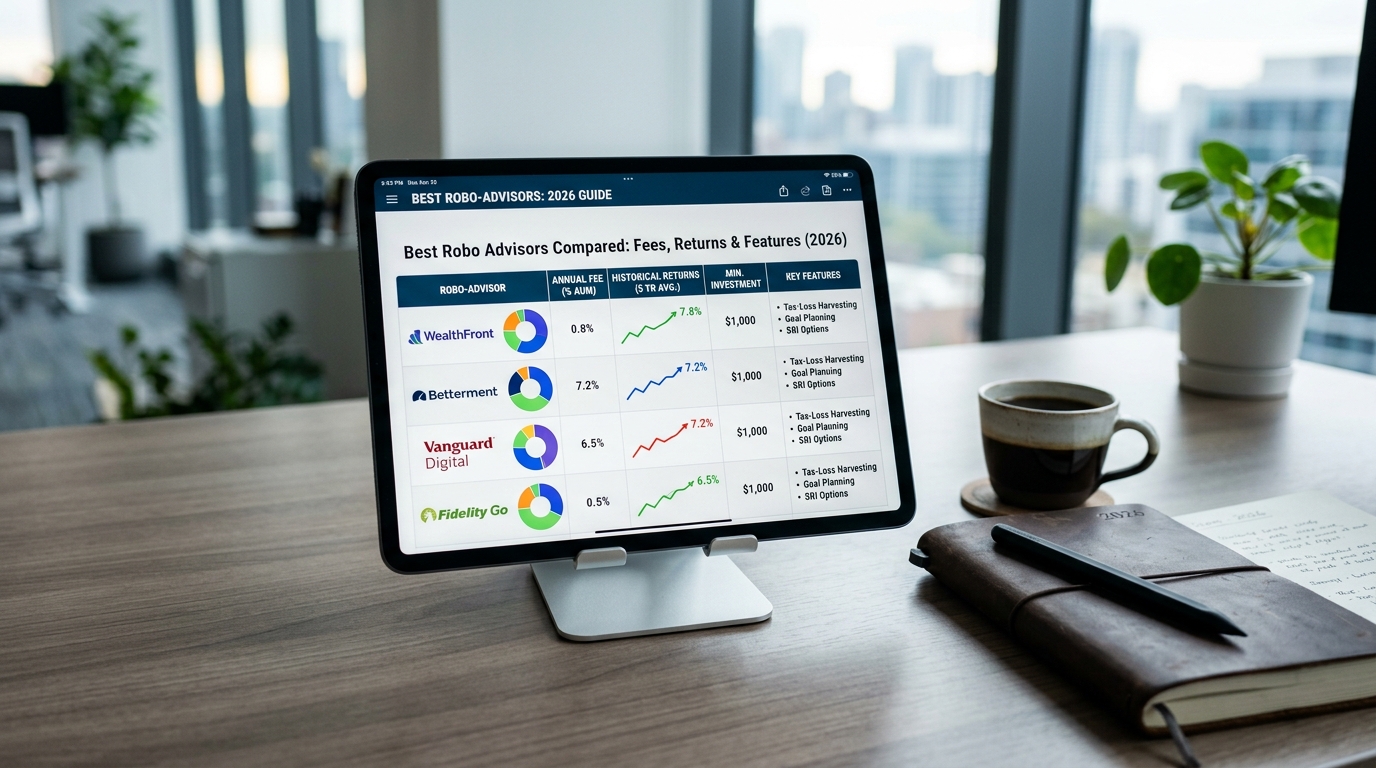
In this guide we are going to walk through the most popular robo advisors used in the United States and the United Kingdom. We will look at what they charge, what they actually offer, and how their returns tend to compare. By the end, you should have a much clearer idea of which one, if any, fits your situation.
A quick note before we start. This article is written to help you understand your options. It is not personal financial advice, and nothing here should be taken as a recommendation to buy any specific product. Always do your own research or speak with a licensed financial advisor before making investment decisions.
What Exactly Is a Robo Advisor?
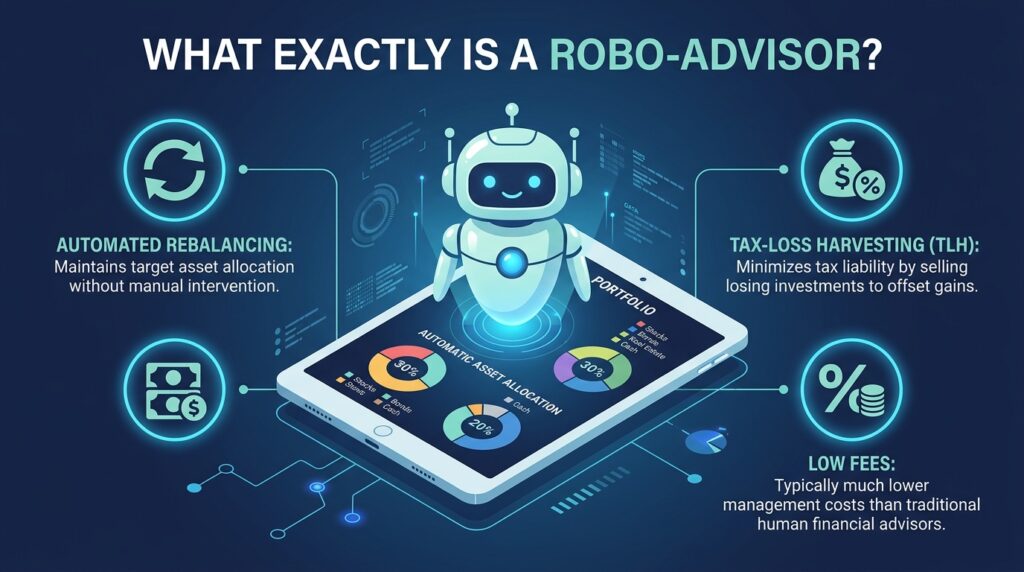
Think of a robo advisor as a very disciplined, very patient investment manager that never gets emotional about the market. When stocks drop and everyone panics, it does not sell out of fear. When stocks are soaring and everyone wants to pile in, it does not get greedy either. It just keeps following the plan you agreed to at the start.
Here is roughly how the process works on almost every platform.
First, you fill out a short questionnaire. It asks about your age, your income, how much you want to invest, what you are investing for, such as retirement or a house deposit, and how you would feel if your account dropped in value for a while.
Second, based on your answers, the platform assigns you a risk level. Someone who is twenty five and investing for retirement forty years away will usually get a portfolio that leans heavily toward stocks. Someone who is sixty and about to retire will usually get a more balanced mix with more bonds.
Third, the platform builds your portfolio out of low cost funds, usually exchange traded funds, sometimes called ETFs. These are baskets of stocks or bonds that spread your money across hundreds or thousands of companies, so you are not betting everything on one business.
Fourth, and this is the part that makes robo advisors genuinely useful, the platform keeps working in the background. It rebalances your portfolio when it drifts away from your target mix. Many platforms also do something called tax loss harvesting, which means selling investments that are temporarily down to lock in a tax benefit, then buying something similar so your overall strategy stays the same.
That is basically it. No phone calls, no meetings in an office, no pressure to buy products you do not understand.
Why Fees Matter So Much More Than People Realize
Before we get into specific platforms, it is worth spending a moment on fees, because this is the single biggest factor that will affect how much money you end up with decades from now.
A fee of half a percent a year might sound tiny. It does not feel like much when you look at your account balance. But over twenty five or thirty years, small differences in fees compound into genuinely large amounts of money.
For example, imagine two people each invest one hundred thousand dollars and both get a seven percent return every year for twenty five years, before fees. One person pays an all in cost of around zero point four percent a year. The other pays around zero point nine percent a year. That half a percent difference might not sound dramatic, but over twenty five years it can end up costing the higher fee investor somewhere in the range of tens of thousands of dollars, purely because of the fee drag on compounding.
This does not mean cheap is always better no matter what. Sometimes a slightly higher fee buys you something genuinely useful, like access to a real human financial planner, or better tax tools that save you more than the extra fee costs. But it does mean you should always ask what you are actually getting for the fee you are paying, rather than just picking whichever app has the flashiest marketing.
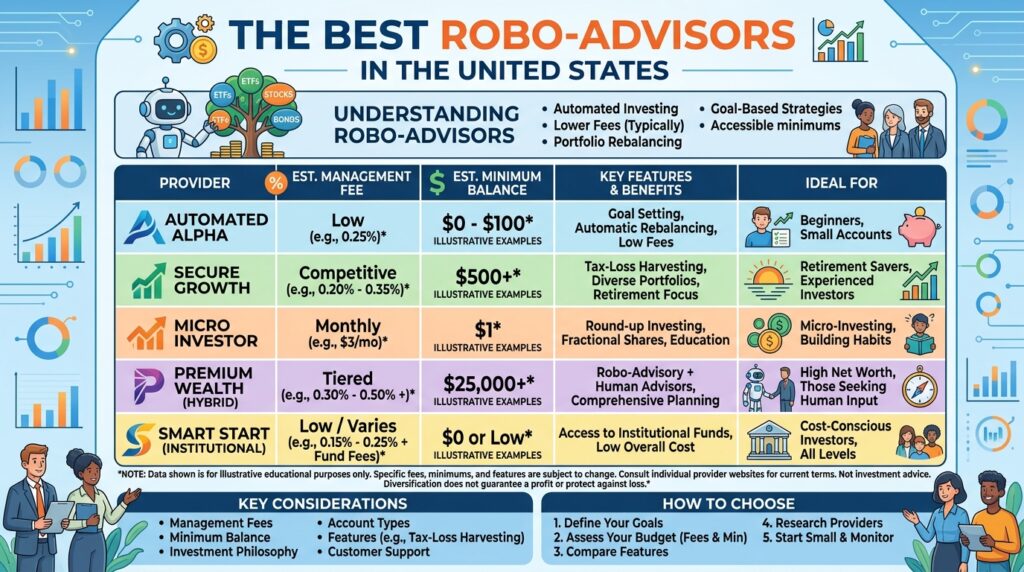
The Best Robo Advisors in the United States
Let us start with the platforms most commonly used by American investors.
Betterment
Betterment is one of the original robo advisors and it remains one of the most popular choices in the US. It has no account minimum, so you can start with almost nothing, and you only need ten dollars to begin investing.
For fees, Betterment charges zero point two five percent a year on your balance once your account passes twenty four thousand dollars, or if you set up regular monthly deposits of at least two hundred and fifty dollars. If you do not meet those conditions, you simply pay five dollars a month instead. On top of that, the underlying funds in your portfolio carry their own small expense ratios, typically somewhere between zero point zero four percent and zero point one one percent.
What makes Betterment stand out is how well rounded it is. You get automatic rebalancing, daily tax loss harvesting, and genuinely useful goal based planning tools that help you track things like retirement, a house deposit, or an emergency fund separately. It also supports a wide range of account types, including retirement accounts, trusts, and even checking and savings accounts, so you can manage a lot of your financial life in one app.
Betterment tends to work best for people who want a hands off, well built experience without needing to think too hard about the details.
Wealthfront
Wealthfront is often mentioned in the same breath as Betterment, and for good reason. It also charges zero point two five percent a year with no account minimum required to open an account, although you need five hundred dollars to actually start investing.
Where Wealthfront really shines is in tax strategy. Its tax loss harvesting is considered among the best in the industry, and if your account grows past one hundred thousand dollars you unlock something called direct indexing, sometimes called stock level tax loss harvesting, which can meaningfully improve your after tax returns if you have a large taxable account.
Wealthfront also lets you customize your portfolio more than most competitors. You can add or remove specific funds, or even build your own portfolio from scratch if you want more control. It has expanded into other asset classes too, including cryptocurrency exposure for those who want it.
If you have a larger taxable investment account and care a lot about minimizing taxes, Wealthfront is usually seen as one of the strongest options available.
Charles Schwab Intelligent Portfolios
Schwab takes a completely different approach to fees. It charges no management fee at all on its base plan. That sounds like an incredible deal, and in some ways it is, but there is an important catch you need to understand.
To make money on the free version, Schwab keeps a chunk of your portfolio, usually somewhere between six and thirty percent, sitting in cash rather than invested in the market. This cash earns interest through Schwab Bank, but often at a lower rate than you could get investing that same money in the market over time. This is sometimes called cash drag, and it means the zero fee is not always as free as it looks. Depending on interest rates and market conditions, this hidden cost can sometimes end up being similar to or even higher than what you would pay a competitor charging zero point two five percent outright.
Schwab also requires a five thousand dollar minimum to open an account, which is higher than most competitors. Tax loss harvesting is only available once your balance reaches fifty thousand dollars.
On the plus side, Schwab has genuinely excellent customer service, a huge selection of low cost funds, and the reassurance of being backed by one of the largest and most established brokerages in the country.
Schwab tends to suit people who already bank or invest with Schwab and want everything under one roof, or people who specifically want to avoid a percentage based fee and are comfortable with the cash allocation trade off.
Vanguard Digital Advisor
Vanguard built its entire reputation on low cost investing, and its robo advisor reflects that. The net advisory fee comes out to roughly zero point one five percent a year after accounting for credits on fund expenses, which makes it one of the cheapest options around. The minimum to get started is just one hundred dollars, which is far lower than it used to be.
The portfolios are built entirely from Vanguard’s own funds, which are known for having some of the lowest expense ratios in the industry. The trade off is that you do not get tax loss harvesting on the standard Digital Advisor plan, and there is no access to a human advisor unless you upgrade to Vanguard’s Personal Advisor Services, which requires a much higher balance and a higher fee.
Vanguard Digital Advisor tends to appeal most to long term, buy and hold investors who mainly care about keeping costs as low as possible and trust Vanguard’s index investing philosophy.
Fidelity Go
Fidelity Go deserves a special mention because of how it prices itself for smaller accounts. If your balance is under twenty five thousand dollars, there is no advisory fee at all. Once you cross that threshold, you start paying zero point three five percent a year, but you also gain access to unlimited calls with financial coaches.
Fidelity Go builds its portfolios using Fidelity’s own zero fee index funds, so even the underlying fund costs are extremely low. This combination makes it one of the most beginner friendly and low cost ways to start investing in the US, especially if you are just getting started and do not have a large balance yet.
The Best Robo Advisors in the United Kingdom
Now let us look at the landscape for UK investors, which works a little differently.
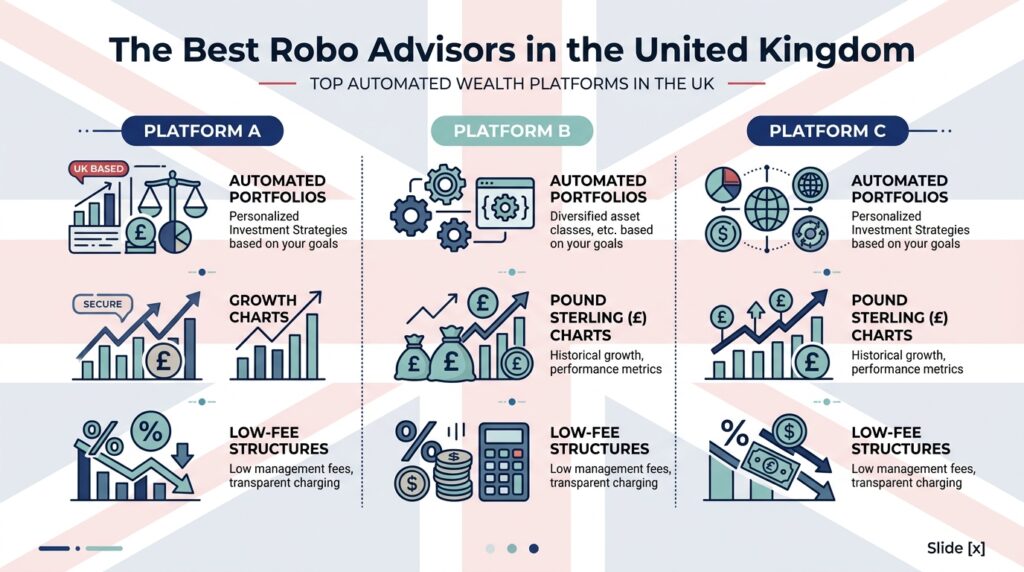
Nutmeg, now known as J.P. Morgan Personal Investing
Nutmeg was one of the pioneers of robo investing in the UK, launching back in 2011. It has since been acquired by J.P. Morgan and rebranded as J.P. Morgan Personal Investing, so if you see that name, it is the same underlying service.
Fees here are generally on the higher end compared to newer competitors, often around zero point seven five percent a year for the fully managed portfolios, plus underlying fund costs on top of that. The minimum investment is typically five hundred pounds, though this drops to just one hundred pounds for Junior ISAs and Lifetime ISAs.
What you get for that fee is a wide range of account types, including stocks and shares ISAs, general investment accounts, Junior ISAs, a Lifetime ISA, and pension options, along with a long track record and a strong brand behind it now.
Moneyfarm
Moneyfarm takes a slightly different approach with seven different risk levels and a choice between actively managed portfolios, fixed allocation portfolios, and ESG focused options for people who want their money invested more responsibly.
Fees are tiered. For actively managed portfolios, you generally pay a platform fee of zero point two five percent plus a management fee starting around zero point four five percent, which falls as your balance grows. The fixed allocation option is cheaper, starting around zero point one five percent for the management portion. Add in underlying fund costs, and your all in cost for a smaller actively managed portfolio often lands somewhere between zero point eight five percent and zero point nine five percent a year.
Moneyfarm’s real selling point is human support. You get access to an investment consultant, and the platform does not charge you to transfer in, transfer out, or close your account, which is a nice touch compared to some competitors.
Wealthify
Wealthify keeps things simple with a flat fee structure rather than the tiered pricing some competitors use. It charges zero point six percent a year on your ISA regardless of your balance, plus an average of around zero point two eight percent in underlying fund charges. The minimum investment is one thousand pounds for its main accounts, though Junior ISAs can be opened from five hundred pounds.
Wealthify is often seen as a good middle ground option in the UK market, sitting between the higher cost of Nutmeg and Moneyfarm and the rock bottom pricing of newer platforms like InvestEngine.
InvestEngine
InvestEngine has become a favorite among cost conscious UK investors because of how cheap it is. For its fully managed portfolios, it charges a flat zero point two five percent a year with no other platform fees, and there are no charges for buying or selling investments. The minimum to get started is just one hundred pounds, which is lower than almost every competitor mentioned here.
You still pay the small expense ratios of the underlying ETFs, typically around zero point two percent, but this is standard across every platform on this list. InvestEngine also lets more confident investors build a self managed portfolio alongside their managed one, which gives you flexibility as your knowledge grows.
If keeping costs as low as possible is your main priority in the UK, InvestEngine is usually the platform that comes up again and again in comparisons.
What About Returns?
You might be wondering why we have spent so much time talking about fees and features but not much about actual investment returns. This is intentional, and here is why.
Almost every robo advisor on this list invests your money in similar underlying assets, mostly diversified index funds tracking the broader stock and bond markets. Because of that, their raw investment returns tend to track each other fairly closely over the long run. The real differences between platforms come from three things: how much you pay in fees, how well they manage taxes on your behalf, and how appropriate your chosen risk level is for your actual goals.
Two people using two different robo advisors with the same risk level will usually end up with very similar gross returns before fees. The person paying lower fees, or the person benefiting more from tax loss harvesting, is the one who tends to end up ahead after several years, not because their platform picked better investments, but because less of their money was quietly eaten away by costs.
This is also why past performance numbers you see advertised on comparison websites can be a little misleading. A robo advisor showing a great return last year might simply have had clients in a higher risk allocation during a year the market went up strongly. That same allocation would look painful during a downturn. What actually matters for you is choosing a risk level that matches your own timeline and comfort with volatility, then sticking with it for years, not chasing whichever platform had the best headline number recently.
How to Actually Choose Between Them
With all of that information, here is a simple way to think through your decision.
If you want the lowest possible fees and do not need a human advisor, look at Vanguard Digital Advisor or InvestEngine in the UK.
If you have a larger taxable account and taxes are a real concern for you, Wealthfront in the US is usually seen as the strongest choice because of its advanced tax tools.
If you are just starting out with a small amount of money and want to avoid fees while you build up your balance, Fidelity Go in the US is hard to beat below twenty five thousand dollars.
If you want a well rounded, all around solid experience without much thinking involved, Betterment in the US does a good job of covering most bases.
If you value having a real person to talk to and do not mind paying a bit more for it, Moneyfarm in the UK or Schwab’s premium tier in the US might suit you better.
If you already bank with a big institution and like the idea of everything being in one place, Schwab or J.P. Morgan Personal Investing might feel more comfortable, even if they are not always the cheapest option on paper.
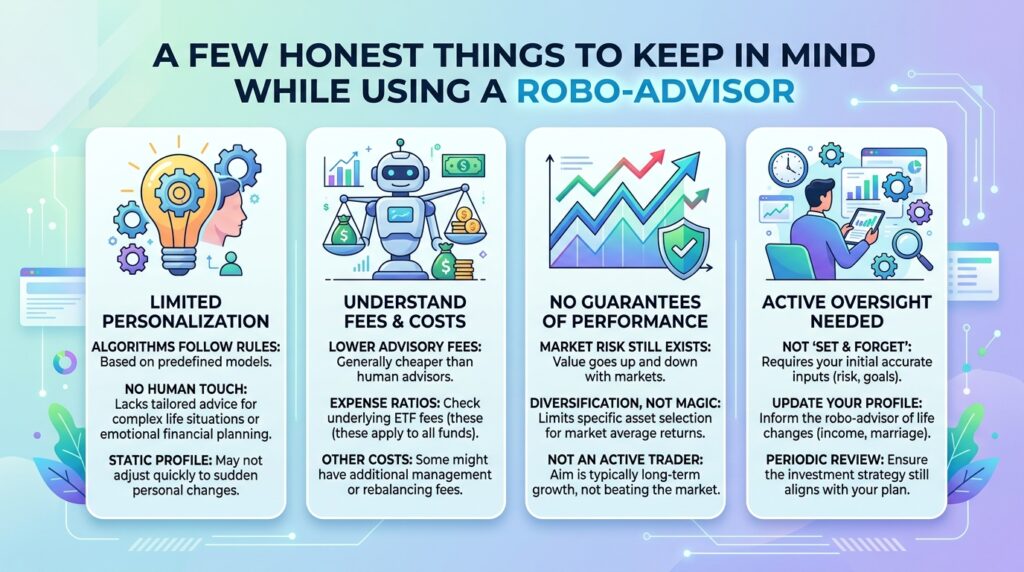
A Few Honest Things to Keep in Mind
Robo advisors are genuinely useful tools, but they are not magic. They will not outperform the market in some special way, and they should not be expected to. What they are good at is removing emotion and effort from ordinary investing, keeping your costs reasonably low compared to traditional financial advisors, and helping you stay consistent over time, which is honestly one of the most important parts of successful investing anyway.
It is also worth remembering that some newer platforms and comparison articles online are written by companies that earn a commission when you sign up through their links. That does not automatically mean the information is wrong, but it is a good reason to double check fee numbers directly on each provider’s own website before you commit any money, since fees and minimums do change over time.
Finally, no robo advisor can tell you things like how much you should really be saving each month, whether investing makes sense given your specific debts, or how your investments fit into your broader financial picture. For bigger, more personal decisions like that, it is worth talking to a qualified, ideally fee only, financial advisor who has no incentive to push you toward any particular product.
Final Thoughts
Choosing a robo advisor does not need to be a huge decision that keeps you up at night. Most of the platforms covered here are run by reputable, well regulated companies, and the differences between them, while real, are usually a matter of degree rather than night and day.
Start by figuring out roughly how much you have to invest, whether you care more about the lowest possible fees or extra features like tax tools and human support, and then pick the platform that lines up best with that. The most important step is simply getting started and staying consistent, since time in the market tends to matter far more than which specific robo advisor you choose.
This article is for general information only and is not personal financial, tax, or investment advice. Fees, minimums, and features change over time, so always confirm current details directly with each provider before opening an account.