
There is a persistent idea floating around that investing is something you do once you already have money. That you need thousands of dollars or pounds sitting around, a finance degree, or a relationship with a broker before you can meaningfully participate in the stock market. None of that is true anymore, and honestly, it has not been true for years.
Thanks to fractional shares, zero commission trading, and platforms with no minimum balance requirements, you can genuinely start investing with 500 dollars, 500 pounds, or even far less. The bigger barrier for most people is not the amount of money they have. It is simply not knowing where to start, what account to use, or which investment actually makes sense for a beginner.
This guide walks through exactly how to get started with a modest amount of money, covering both the US and UK markets, the account types available in each, what to actually invest in, and the habits that matter far more than the size of your first deposit.
Why Starting Small Still Works
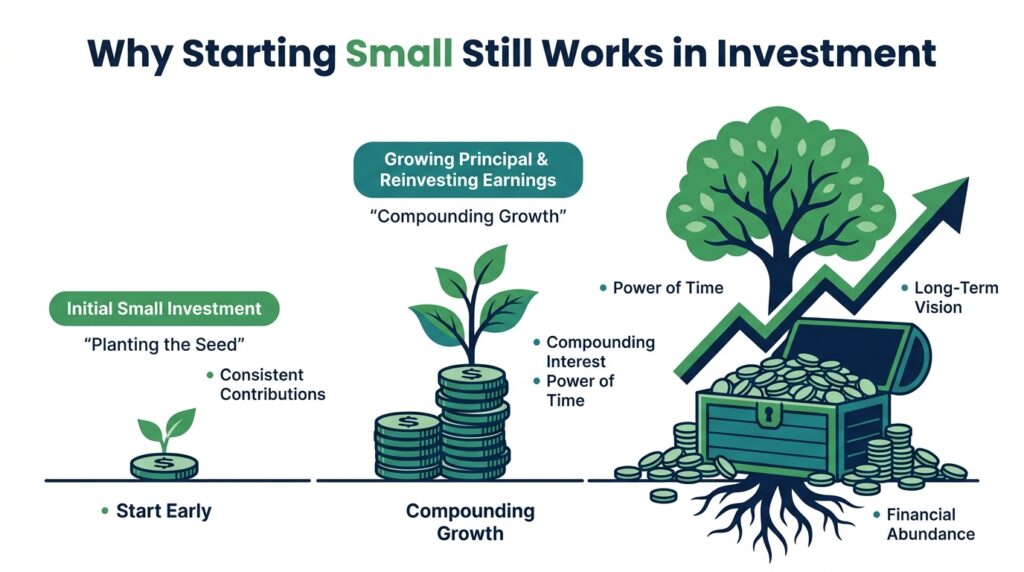
The single most important idea in investing is that time matters more than the amount you start with. Money invested today has decades to benefit from compound growth, where your returns generate their own returns, which then generate further returns on top of that. A smaller amount invested consistently over a long period will very often outperform a larger amount invested for a shorter period, simply because time is doing so much of the work.
To put a number on it, investing 100 dollars a month consistently for 30 years at an average annual return of around 10 percent could grow to somewhere in the region of 225,000 dollars, even though the total amount actually contributed over that period is only 36,000 dollars. The rest comes purely from growth compounding on itself, year after year. The same logic applies in the UK. Investing 50 to 100 pounds a month consistently over 20 years at an average annual return of around 7 percent could grow to over 50,000 pounds.
None of this requires picking winning stocks or timing the market perfectly. It requires starting, staying consistent, and giving your money time to work.
Before You Invest a Single Dollar or Pound
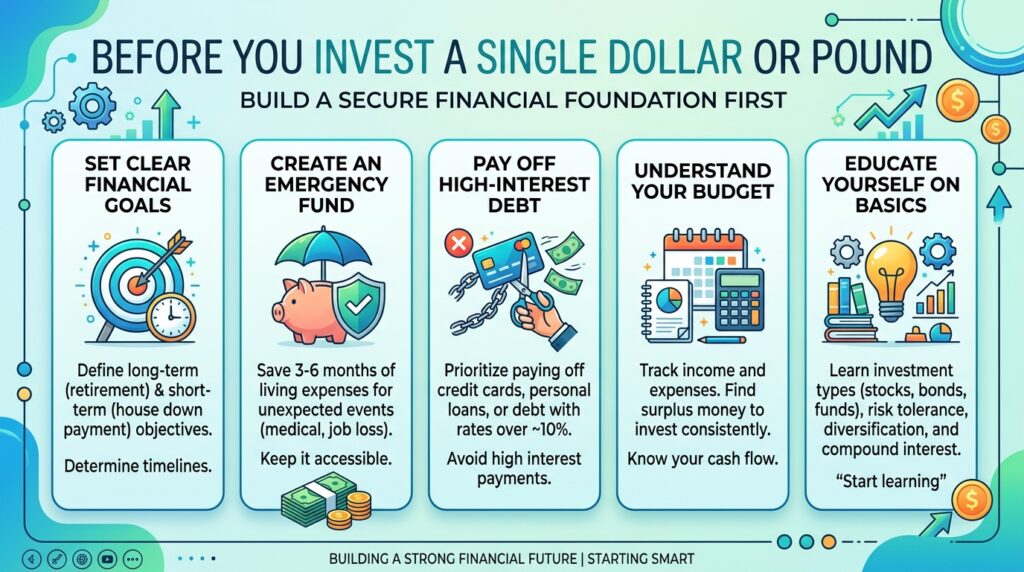
It is worth pausing here, because investing 500 dollars is not always the right first move for everyone, and a responsible guide has to say so.
Before putting money into the market, it is generally recommended to have a small emergency fund set aside in an easily accessible savings account, ideally covering a few months of essential expenses. Investing is meant for money you will not need for at least five years, since markets can and do drop in value over shorter periods, and selling investments during a downturn locks in a loss that patience would otherwise have recovered from. Keeping short term savings separate in cash, rather than invested, protects you from being forced to sell at a bad time.
If you are also carrying high interest debt, such as credit card balances charging 20 percent or more in interest, it is often worth paying that down first, or at least alongside investing, since guaranteed interest savings on debt frequently outweigh the expected returns from investing the same money.
Step One: Choose the Right Account
The account you invest through matters just as much as what you actually buy inside it, because the account type determines how your money is taxed both while it grows and when you eventually withdraw it.
In the US
For most beginners, a Roth IRA is the recommended starting point. Contributions go in after tax, but the money then grows completely tax free, and withdrawals in retirement are not taxed either. Fidelity, Schwab, and Vanguard all offer Roth IRAs with no account minimum, meaning you can open one and fund it with whatever amount you have, including well under 500 dollars.
If your employer offers a 401k with any kind of matching contribution, it is generally worth contributing at least enough to capture the full match before anything else, since that match is essentially free money added on top of your own contribution. Typical employer matches range from around 3 to 6 percent of salary.
Once you have captured any available employer match and are contributing to a Roth IRA, a standard taxable brokerage account is the next option for any additional investing, though this account does not carry the same tax advantages.
In the UK
The equivalent starting point for most UK investors is a Stocks and Shares ISA. Every UK adult has an annual ISA allowance, currently set at 20,000 pounds for the current tax year, and any growth or income inside the ISA is completely free from both capital gains tax and dividend tax. You can open a Stocks and Shares ISA with some providers for as little as 25 pounds a month, and there is no legal minimum contribution required to open one at all with several platforms.
For retirement specific saving, a Self Invested Personal Pension, commonly called a SIPP, offers a different kind of tax advantage. The government automatically tops up your contributions with tax relief at your rate, meaning basic rate taxpayers effectively get a 20 percent boost added to whatever they contribute, with higher rate taxpayers able to claim back further relief through their tax return. The trade off is that money inside a pension is locked away until a set retirement age, which is currently rising toward the late fifties, so it suits money you genuinely will not need until then.
For most people just starting out with a modest amount, the Stocks and Shares ISA is the simpler and more flexible starting point, since it offers tax free growth without locking your money away for decades.
Step Two: Choose a Low Cost Platform
Once you have decided on the account type, the next decision is which platform or broker to actually open it with. A few things are worth comparing before you commit.
Account minimums. Most major platforms in both the US and UK now have no minimum balance requirement at all, meaning you can open an account and fund it with any amount, including well under 500.
Fees. Look closely at both the platform fee, sometimes charged as a small percentage of your total balance each year, and any trading commissions charged per transaction. Many platforms now charge zero commission on trades and either no platform fee or a very small one, which matters enormously over time since fees compound against you the same way returns compound for you.
Fractional shares. This feature allows you to buy a small dollar or pound amount of an expensive stock or fund rather than needing to afford a full share. Many well known funds and individual stocks trade for hundreds of dollars per share, which used to lock out smaller investors entirely. Fractional shares solve this, letting you invest 10 dollars into a fund that costs 300 dollars per full share and simply own a proportional slice of it.
In the US, Fidelity, Charles Schwab, and Vanguard are all commonly recommended for beginners, each offering no account minimums, no trading commissions on US listed stocks and ETFs, and fractional share investing.
In the UK, platforms such as Vanguard, Trading 212, and InvestEngine are frequently highlighted for low or zero fees and fractional share access starting from as little as 1 pound, while providers like Hargreaves Lansdown offer a wider range of investment choices and additional guidance, generally at a slightly higher fee.
Step Three: Choose What to Actually Invest In
This is the part that intimidates most beginners the most, and it is genuinely the simplest step once you understand the basic idea.
Why Index Funds Make Sense for Beginners
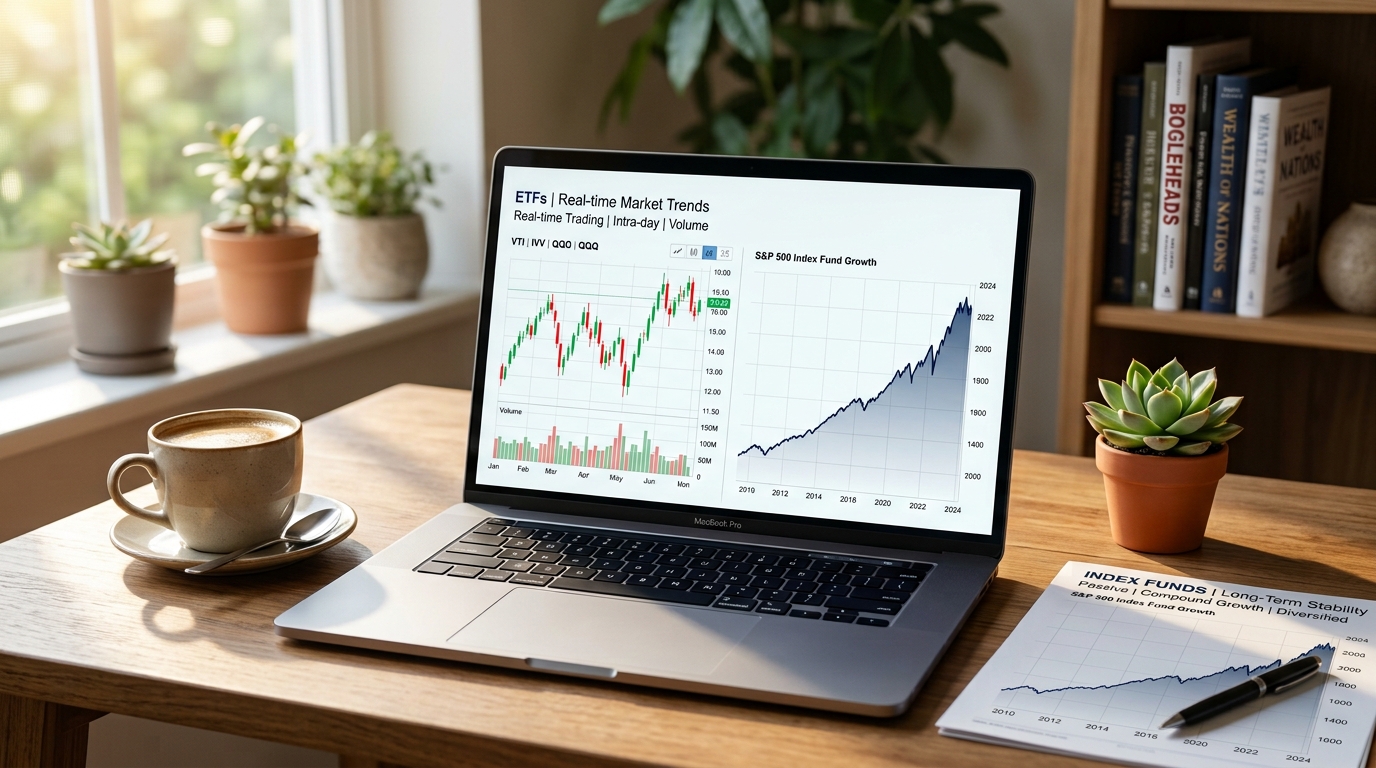
An index fund, or an exchange traded fund tracking a broad index, holds a small slice of hundreds or even thousands of different companies within a single investment. Rather than trying to pick individual winning stocks, which is extremely difficult to do consistently well even for professional investors, an index fund simply owns a representative slice of the entire market, or a large section of it.
This gives you instant diversification. If one company within the fund performs poorly, it is offset by hundreds of others, smoothing out much of the risk that comes with betting on any single company. Index funds also tend to charge extremely low fees, often a fraction of a percent per year, since there is no expensive research team trying to pick stocks, just a fund that mechanically tracks the market.
Historically, broad market index funds tracking something like the S&P 500 in the US have returned an average of around 10 percent annually before inflation over long stretches of many decades, though past performance is never a guarantee of future results, and any given year, or even several years in a row, can look very different from that long term average.
Common Beginner Friendly Funds
In the US, widely used total market or S&P 500 tracking funds include options such as VOO, VTI, and similarly structured funds from Fidelity and Schwab, many of which carry annual fees as low as a few dollars per 10,000 invested.
In the UK, a globally diversified fund such as the Vanguard FTSE Global All Cap Index Fund is commonly recommended as a single fund solution, since it spreads money across both developed and emerging markets worldwide in one purchase, removing the need to pick individual countries or regions yourself.
One Fund Is Genuinely Enough to Start
A common mistake among new investors is trying to build a complicated portfolio of many different individual stocks with a small amount of money, spreading 500 dollars across fifteen or twenty different companies. This creates the appearance of diversification without actually achieving it in any meaningful way, and it becomes difficult to track and manage. A single, broad index fund achieves genuine diversification in one purchase and is widely considered sufficient for the vast majority of beginner investors, with additional complexity only worth adding later as your knowledge and portfolio grow.
Step Four: Set Up Automatic, Regular Contributions
Once your account is open and you have chosen a fund, the single most valuable habit you can build is automating regular contributions rather than relying on remembering to invest manually.
This approach, commonly called dollar cost averaging in the US or pound cost averaging in the UK, means investing a fixed amount on a set schedule, regardless of whether the market is up or down that particular week or month. This naturally buys more shares when prices are lower and fewer when prices are higher, removing the temptation and the risk of trying to time the market, which even experienced professional investors consistently struggle to do well.
Setting up a direct debit or automatic transfer of even a modest amount each month, paired with an instruction to automatically invest that money into your chosen fund, means the entire process runs in the background without requiring ongoing effort or decision making from you.
Robo Advisors and Micro Investing Apps
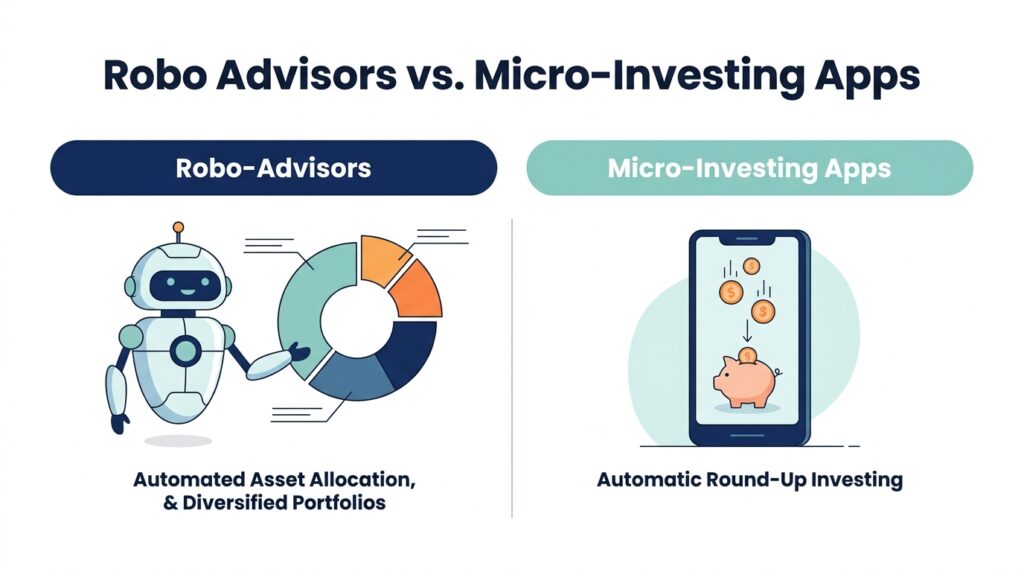
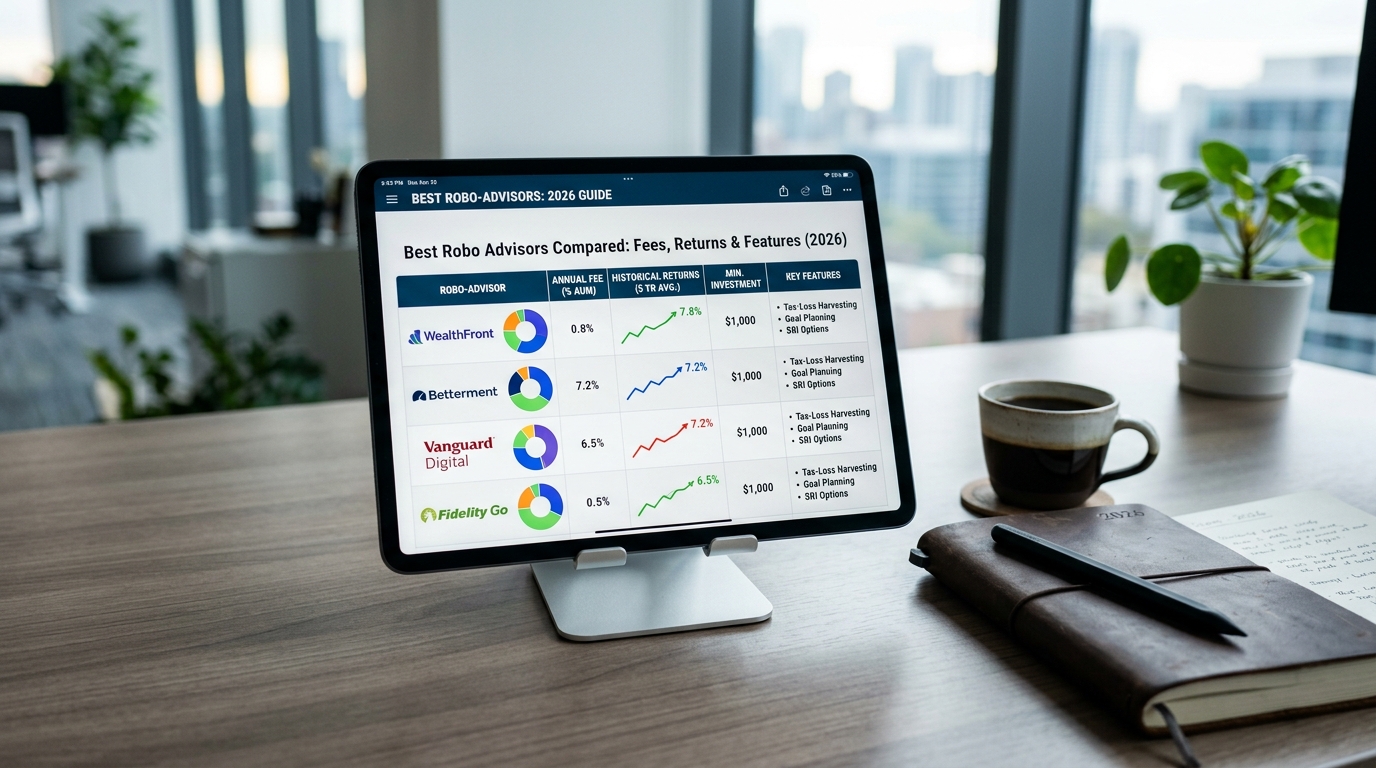
For anyone who wants a more hands off approach than picking their own single index fund, robo advisors are worth understanding as an alternative path. These are automated investing services that ask you a handful of questions about your goals, timeline, and comfort with risk, then build and manage a diversified portfolio on your behalf, automatically rebalancing it over time. Many robo advisors have no minimum balance requirement and charge a small annual management fee, often somewhere in the range of 0.25 to 0.5 percent, in exchange for handling the fund selection and ongoing adjustments for you.
Micro investing apps take a slightly different approach, often built around the idea of investing spare change. These apps round up your everyday purchases to the nearest dollar or pound and automatically invest the difference into a diversified portfolio. While the amounts involved are usually small, this can be a genuinely useful way to build the habit of investing without it feeling like a deliberate, ongoing decision each time.
Neither of these options is strictly necessary if you are comfortable choosing a single low cost index fund yourself, since that approach is generally cheaper and just as effective for most beginners. But if the idea of choosing your own fund feels intimidating enough that it might stop you from starting at all, a robo advisor or micro investing app can be a reasonable way to get money into the market while you build confidence and knowledge over time.
Understanding Risk Without Overthinking It
New investors often worry a great deal about risk, and it is worth addressing directly rather than glossing over it. Investing in the stock market means your balance will go up and down, sometimes significantly, over any given week, month, or year. There is no way around this, and any investment claiming otherwise should be treated with real suspicion.
What matters far more than short term fluctuation is your actual time horizon. Money invested for retirement decades away can comfortably ride out even a serious market downturn, since history shows that broad markets have eventually recovered and gone on to new highs after every past decline, though of course future performance is never guaranteed to follow the same pattern. Money you might need within the next year or two should generally not be in the stock market at all, regardless of how confident you feel, simply because there may not be enough time for a downturn to recover before you need the cash.
A helpful way to think about risk tolerance practically is to ask yourself how you would feel, and more importantly what you would actually do, if your investment dropped by 20 or 30 percent shortly after you put money in. If the honest answer is that you would panic and sell, that is useful information about how much of your money should currently be in the market at all, and it may be worth starting with a smaller amount while you build comfort with these normal ups and downs.
Reinvesting Dividends
Many index funds and individual stocks pay out dividends periodically, which are essentially a small cash payment representing your share of a company’s profits. Most brokerage platforms in both the US and UK offer an option to automatically reinvest these dividends back into more shares of the same fund, rather than paying them out to you as cash sitting idle in your account.
Choosing to automatically reinvest dividends is a small setting that most beginners overlook, yet it meaningfully boosts long term growth, since those reinvested amounts then go on to earn their own returns over time, adding another quiet layer to the compounding effect that drives long term investment growth.
A Simple Starting Plan With 500 Dollars or Pounds
Putting all of this together, a straightforward approach for someone starting with 500 dollars or 500 pounds might look something like this.
First, confirm you have a basic emergency fund in place and are not carrying high interest debt that would be better paid down first. Second, open a tax advantaged account, a Roth IRA in the US or a Stocks and Shares ISA in the UK, with a low cost provider that has no account minimum. Third, transfer your initial 500 into the account. Fourth, use that money to buy a single, broad, low cost index fund rather than spreading it thin across many individual stocks. Fifth, set up an automatic monthly contribution of whatever amount you can comfortably afford going forward, even if that is a modest sum, so your investment continues to grow beyond the initial 500. Sixth, leave it alone. Check in occasionally, perhaps once or twice a year, rather than watching the balance daily, since short term market swings are normal and checking too often tends to encourage emotional decisions that work against you.
Common Mistakes New Investors Make
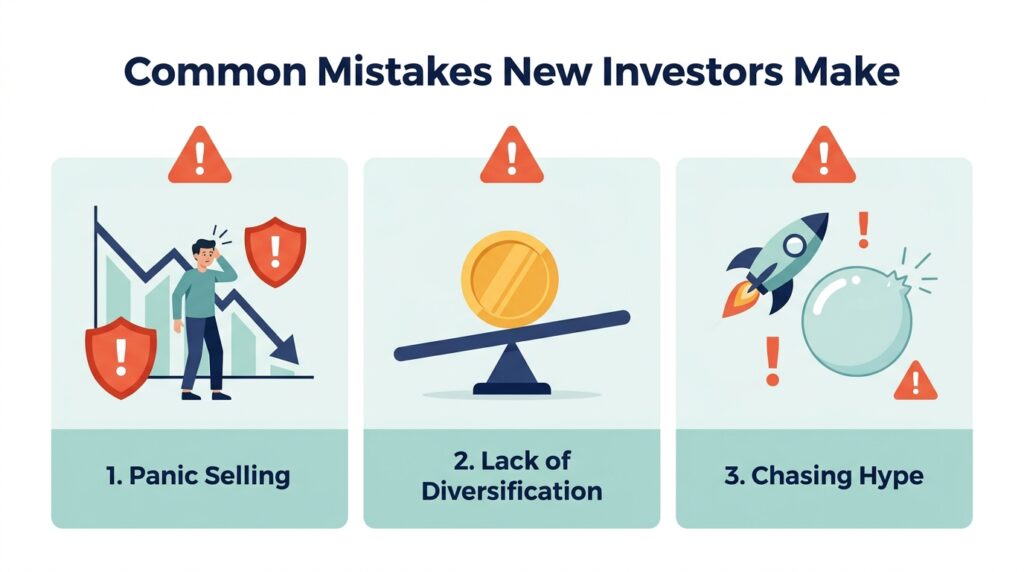
Waiting for the perfect moment to start. There is no reliable way to predict short term market movements, and waiting for a dip or for more money to accumulate before starting often means missing years of potential compound growth. Starting now with a modest amount consistently outperforms waiting to start later with more.
Overcomplicating the portfolio too early. Buying many individual stocks with a small amount of money, chasing trending investments, or constantly rearranging your holdings usually adds risk and complexity without meaningfully improving returns. A single broad index fund, added to consistently, is a genuinely strong starting strategy.
Investing money you will need soon. Markets fluctuate, sometimes significantly, over short periods. Money you might need within the next few years for a house deposit, a wedding, or any other near term goal is generally better kept in cash savings rather than invested, since being forced to sell during a downturn can lock in losses that patience would otherwise have avoided.
Ignoring fees. A platform fee or fund expense ratio that looks small on paper, such as 0.5 or 1 percent a year, can meaningfully erode your returns over decades when compounded. Comparing costs across providers before committing is well worth the time.
Checking the balance too often. Markets move up and down constantly in the short term, and checking daily or weekly tends to trigger emotional reactions, whether that is panic during a downturn or overconfidence during a rally. Checking in occasionally, rather than obsessively, tends to lead to better long term decision making.
Not using available tax advantages. In the US, failing to use a Roth IRA or capture an employer 401k match means leaving valuable tax benefits and free matching contributions on the table. In the UK, holding investments outside of a Stocks and Shares ISA when ISA allowance is still available means paying tax on gains and dividends unnecessarily.
Final Thoughts
Five hundred dollars or five hundred pounds is genuinely enough to start investing properly today, thanks to no minimum accounts, fractional shares, and low cost index funds that used to be far less accessible to smaller investors. The steps themselves are refreshingly simple. Choose a tax advantaged account, pick a low cost broad index fund, automate regular contributions, and then leave it alone to grow over time.
What actually determines your long term outcome is rarely the size of that first deposit. It is whether you start now rather than waiting, whether you stay consistent with contributions over months and years, and whether you resist the urge to constantly tinker, chase trends, or check the balance too often. The mechanics are simple enough that anyone can genuinely do this without a finance background or a large financial advisor bill. The hardest part, as it turns out for most people, is not the money itself. It is simply making the decision to begin.
This article is for general informational purposes and is not financial advice. Investing involves risk, including the potential loss of the money you invest, and past performance is not a guarantee of future results. Account rules, tax treatment, and contribution limits vary by country and change over time, so it is worth checking current details directly with a regulated platform or speaking with a qualified financial adviser before making investment decisions specific to your situation.