


Nobody really wants to sit down and think about what would happen to their family if they were no longer around. It is an uncomfortable topic, and it is easy to keep putting it off. But if you have young kids, a mortgage, or a partner who depends on your income, life insurance is one of those things that quietly protects everyone you love, and it is usually far cheaper than people expect, especially while you are young and healthy.
This guide walks through how life insurance actually works, how much coverage a young family typically needs, and which providers tend to come out on top in the United States and the United Kingdom in 2026. We will keep the language simple and skip the jargon wherever we can.
One important note before we get started. This article is meant to help you understand your options and ask better questions. It is general information, not personal financial or insurance advice. Your own health, age, income, and family situation will affect what makes sense for you, so it is worth speaking with a licensed insurance broker or financial adviser before you buy a policy.
Why Life Insurance Matters So Much More When You Have Young Kids

When you are single with no dependents, life insurance is nice to have but not urgent. The moment you have children, a partner who relies on your income, or a mortgage with both your names on it, the picture changes completely.
Think about what your family would actually need to keep going if your income disappeared tomorrow. The mortgage or rent still needs paying. Childcare costs do not go away. If you are a stay at home parent, your partner would suddenly need to pay for childcare, cooking, and everything else you currently handle for free, which often costs more than people assume. College savings, everyday bills, and even something as simple as a family holiday all depend on steady income.
Life insurance exists to replace that income, or to cover a specific need like paying off the mortgage, so your family is not left scrambling during an already devastating time. It is not about you. It is entirely about giving the people you love breathing room.
Term Life Insurance vs Whole Life Insurance
Before comparing specific companies, it helps to understand the two main types of life insurance you will come across.
Term life insurance covers you for a set period, usually somewhere between ten and forty years. If you pass away during that term, your family receives the payout, known as the death benefit. If the term ends and you are still alive, the coverage simply ends, unless you renew or convert it. Term life is generally the cheapest option by a wide margin, and for most young families it is exactly what you need, because the whole point is to cover the years when your kids are financially dependent on you and your mortgage is still outstanding.
Whole life insurance, sometimes called permanent life insurance, covers you for your entire life as long as you keep paying the premiums. It also builds up a cash value over time that you can sometimes borrow against. This sounds appealing, but it usually costs five to fifteen times more than term life insurance for the same amount of coverage. For most young families, that extra cost is better spent paying down debt, contributing to retirement accounts, or investing, rather than tied up in a life insurance policy.
There are exceptions. Families with a child who has special needs that will require lifelong financial support sometimes use permanent life insurance for that specific purpose. But for the vast majority of young families, term life insurance is simply the more sensible choice, and it is what almost every insurance expert recommends as the default starting point.
How Much Coverage Does a Young Family Actually Need
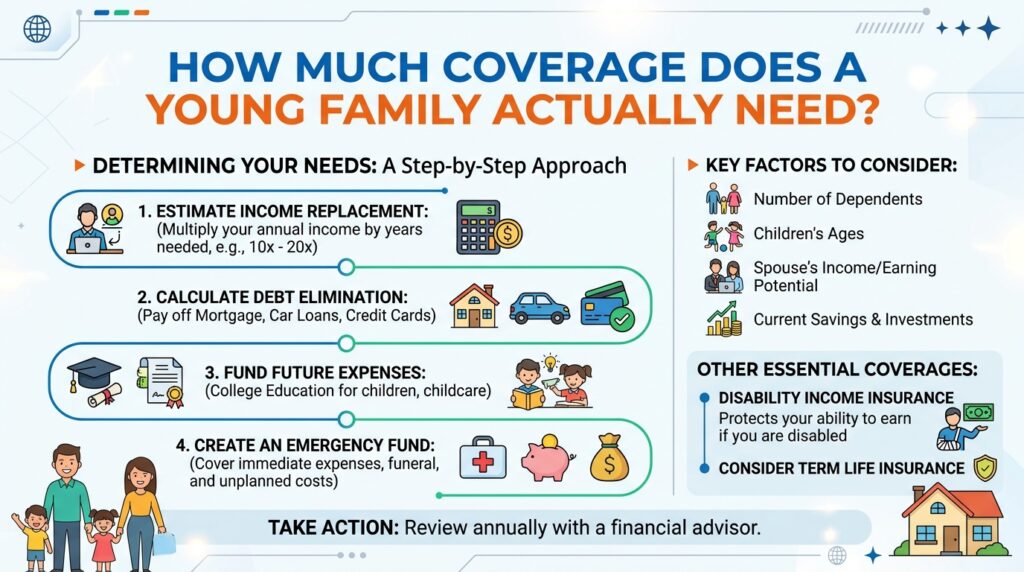
This is usually the hardest question people struggle with, and there is no single correct number. That said, a common and fairly reliable approach is to add up your outstanding debts, such as your remaining mortgage balance, then add somewhere between five and ten years of your income on top of that, to give your family a real cushion.
For example, a couple with two young children and a two hundred and fifty thousand pound mortgage might reasonably look at four hundred thousand to five hundred thousand pounds of coverage, which would clear the mortgage and leave several years of income behind for the surviving parent. In the US, using dollars instead of pounds, the same rough logic applies. A family earning eighty thousand dollars a year with a similar mortgage might look at somewhere between five hundred thousand and one million dollars in coverage, depending on how many years of income replacement they want to provide.
It is also worth thinking about whether you want a simple lump sum payout or something called family income benefit, which pays out a regular monthly amount instead, similar to a replacement salary, rather than a single large sum that the surviving parent has to manage and invest carefully during an already difficult time. Some families like the simplicity of a monthly income policy, since it behaves more like the paycheck that stopped coming in.
Both parents should generally have coverage, even if one parent does not bring in a salary. A stay at home parent provides real economic value through childcare, and replacing that with paid help after a loss can be surprisingly expensive, so it is a mistake to only insure the parent with the paycheck.
Riders Worth Knowing About
A rider is basically an add on to your base policy that gives you extra protection for a small additional cost. A few are especially relevant for young families.
A child rider adds a modest amount of coverage for your children, usually somewhere between ten thousand and twenty five thousand dollars in the US, or a similarly modest sum in the UK, often for one flat additional premium that covers every child in the family rather than charging separately per child. This is not meant to replace savings, but it can help cover funeral costs and give the family space to grieve without financial pressure, in the rare and painful case something happens to a child.
A waiver of premium rider means that if you become seriously ill or disabled and cannot work, your premiums are waived so your coverage does not lapse right when you need it most.
Critical illness cover, more common and more heavily marketed in the UK, pays out a lump sum if you are diagnosed with a serious illness such as cancer, a heart attack, or a stroke, even if you survive. This is different from life insurance, since it pays out while you are alive, and it can be added alongside your life cover or bought separately as its own policy.
A conversion option lets you convert some or all of your term policy into a permanent policy later without a new medical exam, which can be valuable if your health changes and you are worried about being able to get affordable coverage again down the road.
None of these riders are mandatory, and adding too many can push your premium up unnecessarily. But it is worth at least understanding what each one does so you can decide deliberately rather than simply accepting whatever the sales quote defaults to.
The Best Life Insurance Companies for Young Families in the US
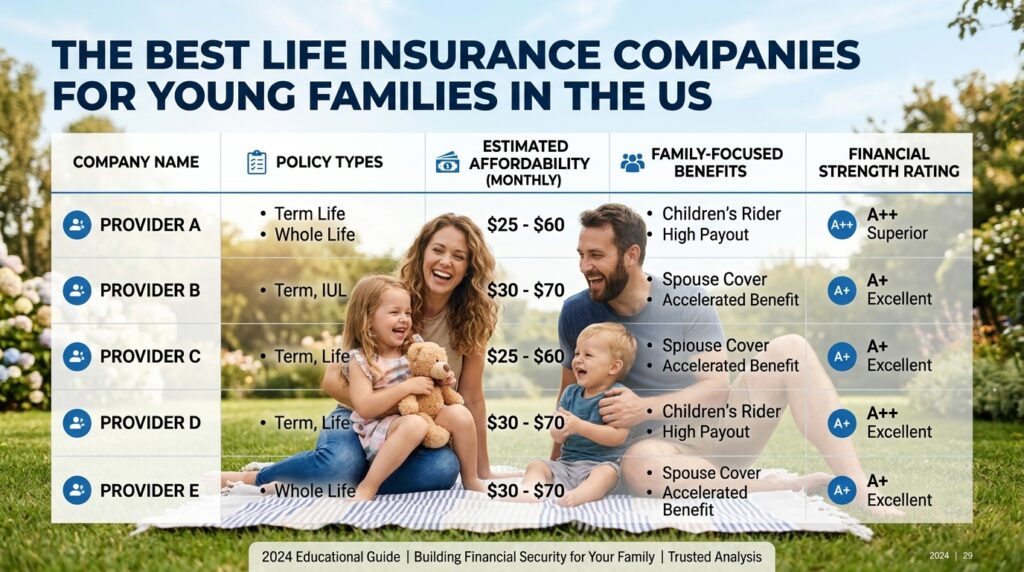
Now let us look at specific providers. Keep in mind that your actual quote will depend heavily on your age, health, and where you live, so the cheapest company for one family might not be the cheapest for another.
Ethos
Ethos has become popular for young families mainly because of how fast and simple the application process is. Rather than being an insurer itself, Ethos connects you to multiple highly rated carriers through one digital application, and many applicants can get covered without a medical exam at all. This makes it a strong option if you want to get a policy in place quickly without waiting weeks for underwriting.
Banner Life
Banner Life stands out for offering term lengths up to forty years, which is unusually long. Most insurers cap out around thirty years. This makes Banner Life a strong fit for younger families with a long mortgage timeline, or parents who want coverage to last until their youngest child is fully grown and financially independent.
State Farm
State Farm is a good option for families who like the idea of working with a local agent rather than doing everything online, and who want to bundle their life insurance with existing auto or home insurance under one company. It also tends to offer competitive rates for smokers compared to some digital only competitors, which is worth knowing if that applies to your household.
Guardian Life
Guardian offers a solid mix of term and permanent policies at fair rates, and it stands out for being more accommodating toward applicants with certain health conditions, including some who are living with HIV, where many other insurers are far more restrictive. If someone in your family has a health condition that has made getting quotes difficult elsewhere, Guardian is worth putting on your list.
Penn Mutual
Penn Mutual offers strong, flexible term policies with useful riders like living benefits, which allow you to access part of your death benefit early if you are diagnosed with a qualifying serious illness, and waiver of premium for disability. It also has a genuinely strong permanent life portfolio if you ever want to convert part of your coverage later.
Pacific Life
Pacific Life is frequently recommended for young families because of its flexibility. It offers high coverage amounts, up to ten million dollars on some policies, along with competitive term rates and useful features on its universal life products, such as a no lapse guarantee. It suits families who might want very high coverage amounts or who expect their insurance needs to grow over time.
Corebridge Financial and Mutual of Omaha
These two are worth mentioning together because they both focus heavily on affordability. Corebridge often has some of the lowest average premiums in the industry, while Mutual of Omaha is known for simple, predictable policies and a long standing reputation for reliable customer service. Both are solid, no frills choices if your main priority is keeping monthly costs down while still getting meaningful coverage from a financially strong company.
Lemonade
Lemonade has built a reputation for a fast, fully digital, no exam application process, and it has repeatedly won awards for same day term life coverage. This makes it appealing for busy young parents who want to get covered quickly without a lot of paperwork, and it can issue meaningful coverage amounts entirely online.
The Best Life Insurance Companies for Young Families in the UK
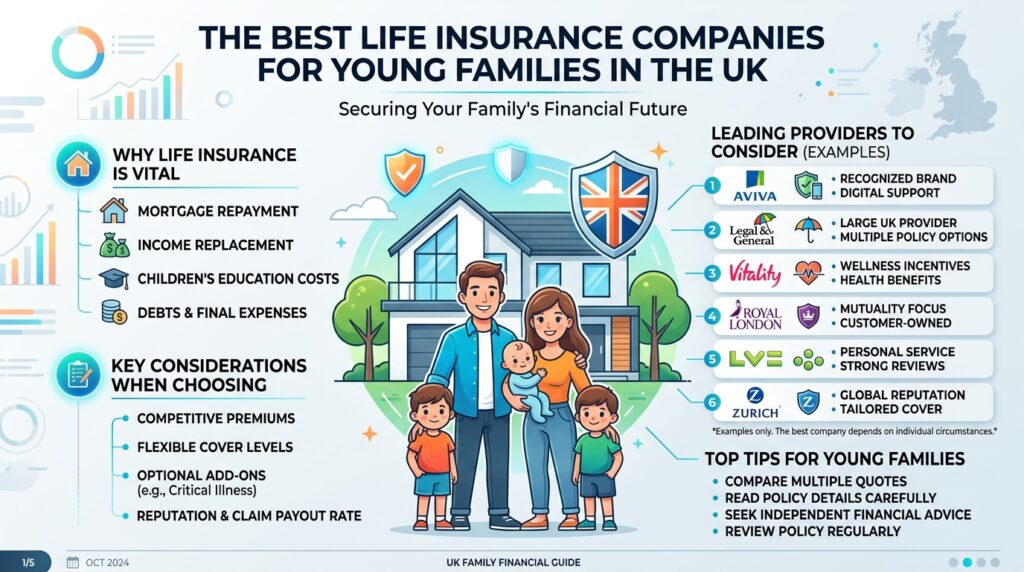
The UK market works a little differently, with most policies sold as level term or decreasing term cover, often tied specifically to a mortgage.
Legal and General
Legal and General is consistently one of the cheapest options in the UK for healthy, non smoking applicants, and it holds the largest market share of any life insurer in the country. It also offers strong free childhood conditions cover as standard on many family policies, and it has a reputation for a fast, straightforward application process. If your main priority is getting solid coverage at the lowest possible price, Legal and General is almost always worth getting a quote from.
Aviva
Aviva is the largest general insurer in the UK and offers one of the broadest critical illness definitions in the market, covering a large number of conditions at full payment. It also includes the free DigiCare Plus wellbeing app with many of its policies, giving policyholders access to virtual GP appointments and mental health support. Families who want strong critical illness protection alongside their life cover often find Aviva to be one of the best all around choices.
Vitality
Vitality takes a unique approach by linking your premium to a healthy lifestyle programme. If you and your partner are willing to actively engage with things like exercise tracking and health checks, your premiums can drop meaningfully over the life of the policy. It also offers very broad serious illness cover, spanning well over a hundred conditions. This suits families who are already fairly active and do not mind engaging with an app to reduce their costs over time.
Royal London
Royal London is a mutual insurer, meaning it is owned by its policyholders rather than shareholders, and it consistently ranks near the top of independent customer reviews. Its standout feature is the Helping Hand service, which gives policyholders access to a personal nurse, second medical opinions, and mental health counselling completely free, even if you never make a claim. For families who value genuine ongoing support rather than just a payout at the end, Royal London is frequently highlighted as one of the best choices available.
Beagle Street
Beagle Street is a purely online insurer known for offering some of the cheapest headline prices in the market, particularly for healthy applicants under forty. It keeps things simple with a straightforward digital application and no unnecessary extras, which makes it appealing for younger families who want low cost, uncomplicated cover without a lot of add ons.
Zurich and Scottish Widows
Zurich stands out for offering one of the highest maximum coverage amounts in the UK market, up to ten million pounds, which makes it a strong option for higher earning families who need substantial cover. Scottish Widows is another well established, reliable name in the market with strong claims payment rates, and it is often considered alongside Aviva and Legal and General as a dependable, mainstream choice.
How to Actually Compare Quotes

Whichever country you are in, the process of shopping for life insurance works best when you follow a similar approach.
Start by figuring out roughly how much coverage you need and for how long, using your mortgage balance and years of income replacement as your starting point. Then get quotes from at least three or four different providers, since prices for identical coverage can vary surprisingly widely between insurers based on how each one assesses your specific health profile. Do not automatically assume the cheapest quote is the best one. Look at the insurer’s financial strength rating, its claims payment record, and what extra support or benefits are included, since these things matter far more if your family ever actually needs to use the policy.
Be completely honest on your application about your health, your smoking status, and your lifestyle. It might feel tempting to leave out a detail to get a cheaper premium, but non disclosure is the single most common reason claims get declined. It is simply not worth the risk when your family’s financial security is what is on the line.
Finally, revisit your coverage every few years, especially after major life events like having another child, moving to a bigger mortgage, or a significant change in income. A policy that made sense five years ago might not be enough today.
A Few Honest Things Worth Knowing
Life insurance can feel like a strange thing to shop for, since you are essentially trying to plan for the worst outcome imaginable. It helps to remember that you are not buying it for yourself. You are buying it so that the people who depend on you never have to face a financial crisis on top of an emotional one.
It is also worth knowing that many comparison websites earn a commission when you buy through their links. That does not necessarily mean their information is wrong, but it is a good reason to compare quotes directly through a few different sources, including independent brokers, rather than relying on a single site’s ranking.
Term life insurance is genuinely one of the most affordable types of financial protection you can buy, especially while you are young and in good health. Premiums for a healthy person in their twenties or thirties are often surprisingly low, sometimes just a few pounds or dollars a month for a meaningful amount of coverage. Waiting even a few years can mean paying noticeably more, since premiums generally rise with age and any new health issues that come up along the way.
Final Thoughts
Choosing life insurance as a young family does not need to be complicated. Figure out roughly how much coverage you need based on your debts and years of income replacement, decide whether term life or a combination with critical illness cover fits your situation, and then compare quotes from a handful of reputable, financially strong insurers rather than settling for the very first quote you see.
The most important step is simply getting a policy in place while you and your family are young and healthy, since that is when coverage tends to be at its most affordable. A policy sitting unused for decades is a genuinely good outcome. It means your family never needed to rely on it, which is exactly the point.
This article is for general information only and is not personal financial or insurance advice. Premiums, coverage amounts, and provider rankings can change over time, so always confirm current details directly with each provider or a licensed broker before purchasing a policy.