

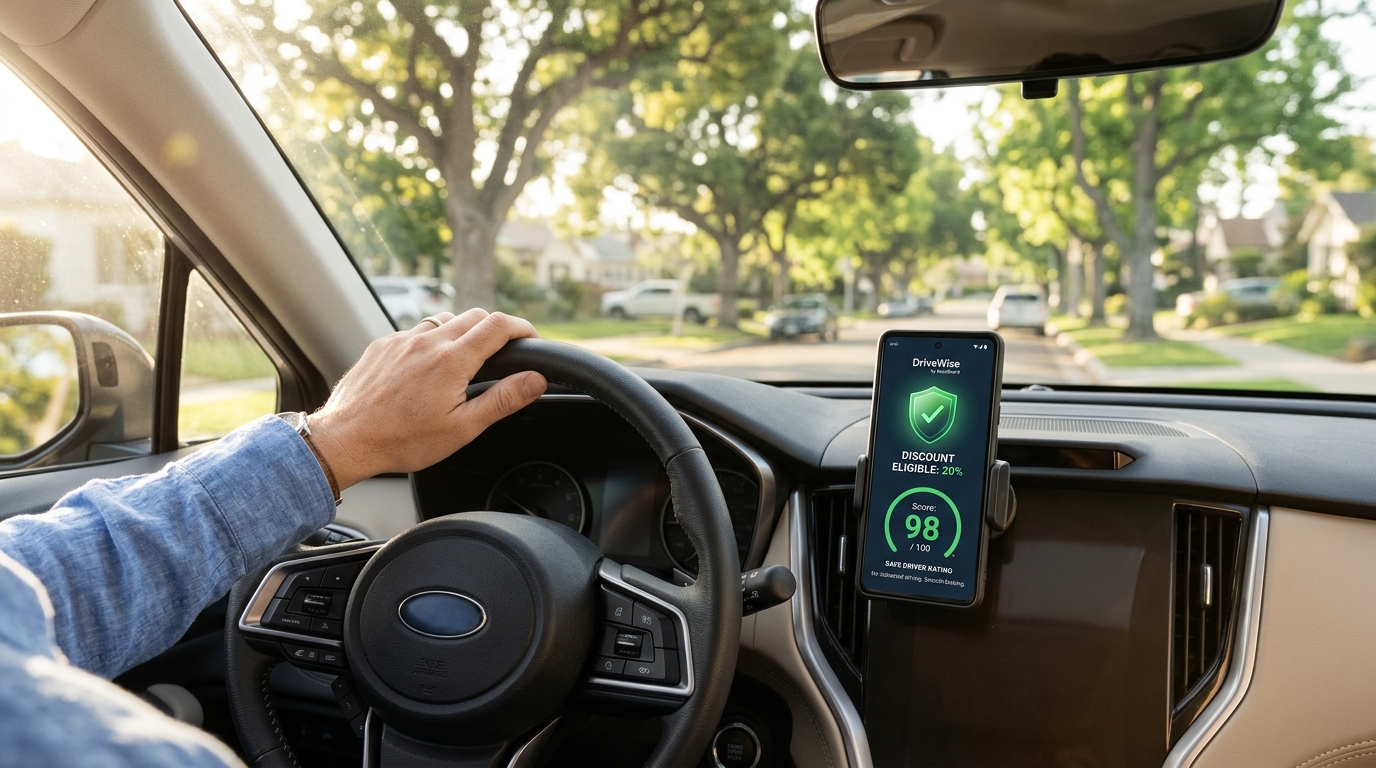
Car insurance is one of those bills that almost everyone pays without really questioning it. You renew, the price goes up a bit most years, and life moves on. But tucked inside nearly every insurer’s pricing structure is a long list of discounts that many drivers never actually claim, simply because nobody asked, nobody mentioned it, or the driver assumed they would not qualify.
Insurers rarely advertise every discount they offer. Some are buried in the fine print, others require you to specifically ask, and a few are only available if you belong to a particular group or complete a specific action, like a driving course. The result is that a meaningful number of drivers are quietly paying more than they need to, year after year.
This article walks through the most commonly missed discounts in both the US and UK markets, how much they can realistically save you, and the simple habits that tend to unlock the biggest savings without requiring you to change insurers every year.
Why So Many Discounts Go Unclaimed
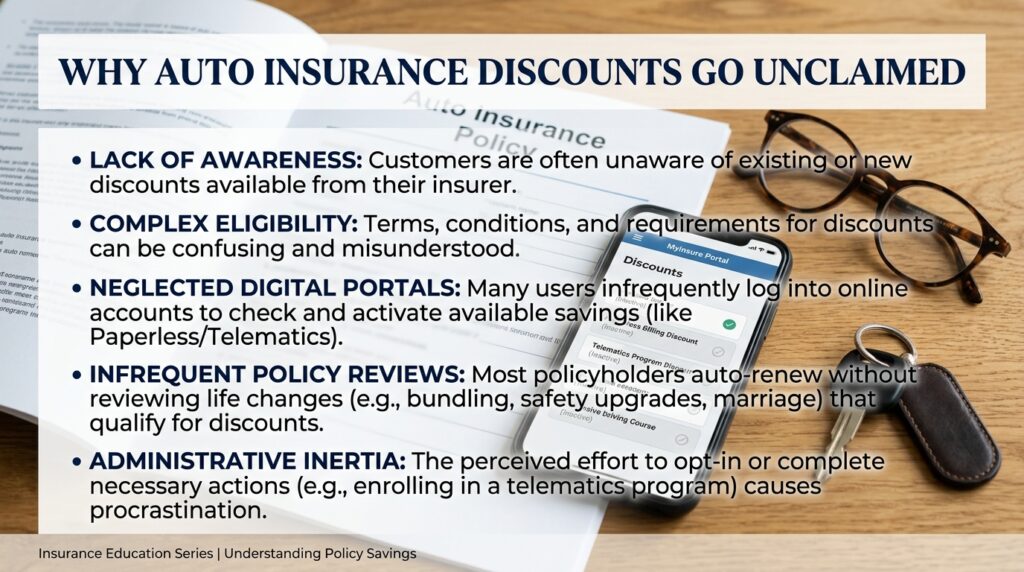
Most insurers offer discounts across a handful of categories, covering how you set up your policy, how you actually drive, who you are as a driver, what safety features your car has, and any groups or affiliations you belong to. Most major insurers offer some version of all of these, yet research consistently shows that most drivers qualify for more discounts than they are currently receiving.
Part of the problem is that insurers are not required to proactively apply every discount you are eligible for. Many require you to ask directly or fill out a specific form, and if you never bring it up at renewal time, the discount simply goes unclaimed year after year.
Discounts US Drivers Commonly Miss
The Good Driver Discount
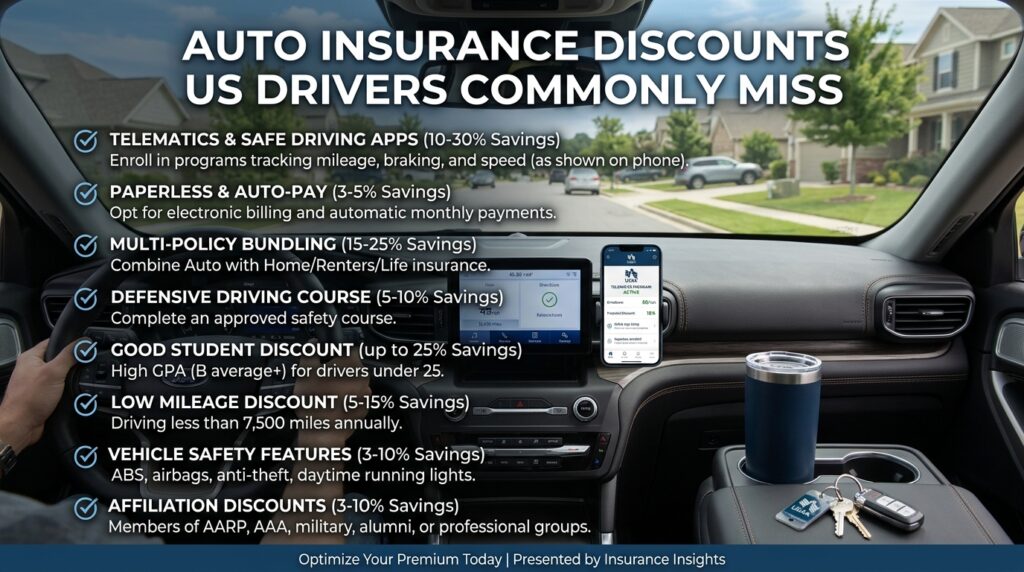
A clean driving record with no accidents or violations is one of the most valuable discounts available, often reducing your premium by a significant amount, with some insurers offering reductions as high as 30 percent for drivers with a strong history. The catch is that this discount is not always applied automatically, particularly if you have recently switched insurers and your new provider has not yet pulled your full driving history.
Bundling Policies
Combining your auto insurance with your home or renters insurance under the same company is one of the most reliable ways to save, commonly reducing premiums on both policies by somewhere in the range of 15 to 25 percent. Despite how widely available this discount is, many drivers keep their policies split across different companies simply out of habit, without ever comparing what a bundled quote would look like.
Usage Based or Telematics Programs
Many insurers now offer programs that track your actual driving habits through a mobile app or a small plug in device, rewarding safe driving with a lower premium. These programs can reduce premiums by anywhere from 10 to 40 percent depending on the provider and how safely you actually drive. It is worth noting that these programs are not risk free for everyone. Some drivers have reported their rates increasing rather than decreasing, since ordinary defensive braking can sometimes be misread by the algorithm as harsh or aggressive driving. It is worth weighing the potential savings against the fact that your driving, location, and timing are being actively monitored.
Good Student Discounts
Students who maintain a strong grade average, commonly a B average or better, can often qualify for a discount in the range of 10 to 25 percent. This is frequently overlooked by parents who assume the discount is minor or automatically applied, when in most cases it requires proactively submitting a transcript or report card to the insurer.
Low Mileage Discounts
If you drive significantly less than the average driver, whether because you work from home, use public transit for your commute, or simply do not drive much, you may qualify for a low mileage discount that many drivers never think to ask about because it is not something insurers typically volunteer.
Defensive Driving Course Discounts
Completing an approved defensive driving course can lower your premium by roughly 5 to 15 percent in many cases, and this discount is particularly common among senior drivers, though it is generally available to drivers of any age depending on the insurer and state.
Affiliation and Membership Discounts
Some insurers offer discounts, occasionally reaching as high as 25 percent, tied to membership in a particular group, alumni association, professional organization, or employer. These discounts are frequently unpublished or only mentioned if you specifically ask, so it is worth checking whether any organization you belong to has a partnership with your insurer.
Military and Homeowner Discounts
Active duty and former military members, along with their spouses, can often access particularly competitive rates through insurers that specialize in serving the military community. Separately, simply owning a home, even without insuring it through the same company, can sometimes unlock a modest discount that many renters turned homeowners never think to mention when they update their policy.
Policy Setup Discounts
A handful of smaller discounts often go completely unnoticed because they relate to how you manage the policy rather than how you drive. These include discounts for setting up automatic payments, choosing paperless billing and correspondence, paying your premium in full annually rather than monthly, and signing up before your previous policy expires rather than allowing any lapse in coverage.
The Cost of Not Shopping Around
Perhaps the single biggest missed saving is not tied to a specific discount at all, but simply to loyalty. Research has found that drivers who do not regularly shop around for a new quote forfeit a meaningful amount in potential annual savings, often reaching several hundred dollars a year, simply by staying with the same insurer out of habit rather than comparing what else is available.
Discounts UK Drivers Commonly Miss
The No Claims Discount
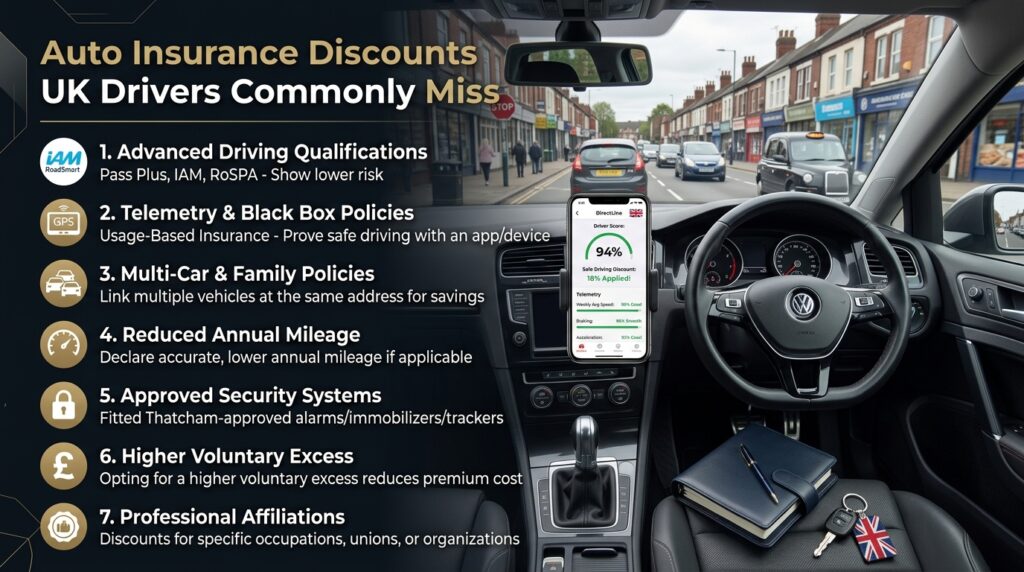
This is, without question, the single most powerful lever UK drivers have to reduce their premium, and it accumulates for every consecutive year you go without making a claim. The reduction builds year on year and can eventually reach as much as 60 percent off your premium after five or more claim free years. Many drivers do not realize this discount can often be protected even after a claim, for a modest additional cost, which prevents years of accumulated savings from being wiped out by a single incident.
It is also worth knowing that being added as a named driver on someone else’s policy, such as a parent’s, does not build your own no claims discount in your name. Only holding a personal annual policy actually starts that clock, which surprises many new drivers who assumed being a named driver for a few years would count toward their own record.
Black Box or Telematics Insurance
Telematics insurance, where a small device or app tracks driving behavior such as speed, braking, acceleration, and the time of day you drive, can produce a substantial saving, particularly for younger and newer drivers. Some research has found that a significant majority of drivers aged 17 to 19 found telematics to be their most affordable option, with the price difference compared to a non telematics policy sometimes running into the thousands of pounds annually for this age group.
That said, the savings are not equally large for everyone. For drivers over 25 with an established driving history, the gap between a telematics policy and a standard one tends to be much smaller, since the insurer already has other reliable ways to assess risk, such as an established no claims discount.
Low Mileage and Honest Declarations
Drivers who honestly declare a lower annual mileage, combined with a long no claims discount and a sensible voluntary excess, often land below the national average premium without needing telematics at all. This is frequently overlooked simply because it requires actively updating your mileage estimate at renewal rather than accepting whatever figure was carried over from the previous year.
Choosing a Lower Insurance Group Vehicle
The insurance group your car falls into has a significant effect on your premium, particularly for younger drivers. Choosing a car in a lower insurance group, rather than a car with a more powerful engine or a higher performance reputation, can meaningfully reduce quotes without needing any additional discount at all.
Voluntary Excess Adjustments
Agreeing to pay a higher voluntary excess, meaning the amount you contribute toward a claim before the insurer pays the rest, in exchange for a lower premium is a straightforward way to reduce your monthly cost, provided you genuinely have the funds set aside to cover that excess if you ever need to make a claim.
Renewal Autopilot
Just as in the US market, simply allowing a policy to renew automatically year after year without shopping around is one of the most common ways UK drivers overpay. A policy left on autopilot can drift noticeably above what a fresh comparison would find, sometimes by a meaningful margin, purely because the insurer is relying on the fact that most customers do not bother to check.
Practical Steps to Actually Claim These Discounts
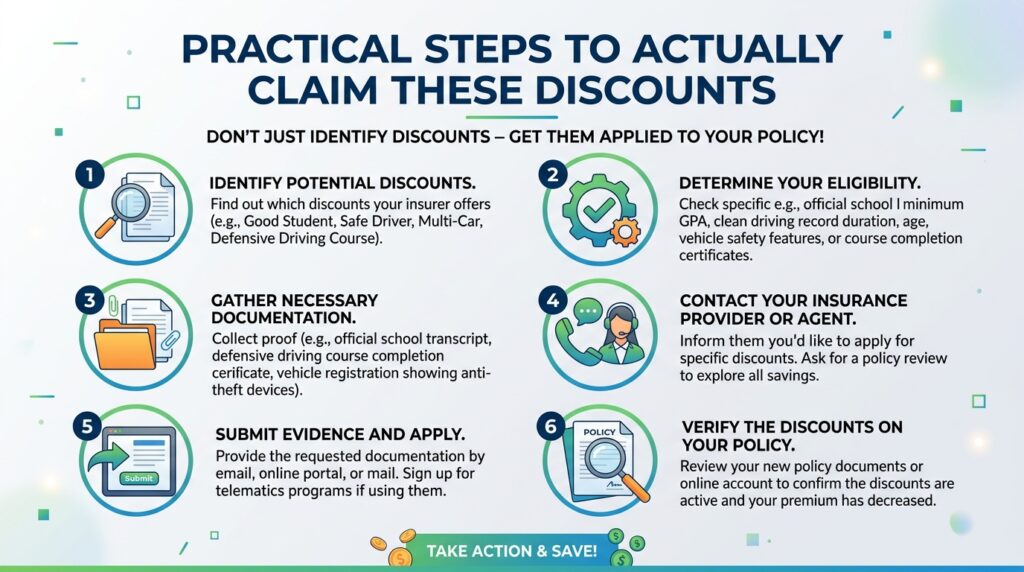
Knowing these discounts exist is only half the job. Actually getting them usually requires a bit of proactive effort.
Ask directly, every time you get a quote. Do not assume a discount will be applied automatically. Ask your insurer or broker for a full list of every discount you might qualify for, including ones tied to your employer, education, memberships, or driving habits.
Review your policy at every renewal, not just when something changes. Life circumstances shift constantly, and insurance needs shift along with them. Getting married, moving house, changing jobs, or your children finishing school can all open up new discounts or make previous ones no longer necessary.
Compare quotes annually, even if you plan to stay with your current insurer. Many discounts are only visible when you actively request a new quote rather than passively renewing, and even loyal customers often find a better rate elsewhere once they actually look.
Weigh telematics carefully rather than assuming it always helps. For some drivers, particularly younger or newer drivers, telematics can produce dramatic savings. For others, particularly those with an already strong driving record, the benefit may be minimal, or in rare cases the policy could even increase in cost. Get quotes both with and without telematics before committing.
Keep a record of anything that might qualify you for a discount. Completed driving courses, safety features fitted to your vehicle, memberships, and academic transcripts should all be kept on hand so you can provide proof the moment an insurer asks for it.
Final Thoughts
Car insurance discounts are rarely handed to you without asking, and the responsibility largely falls on the driver to know what exists and actively request it. Whether you are in the US comparing bundling, good student, and usage based discounts, or in the UK weighing the value of your no claims discount against a telematics policy, the common thread is the same. Insurers reward specific behaviors and circumstances, but they very rarely go out of their way to make sure you are getting every discount you are entitled to.
Taking twenty minutes once a year to ask your insurer directly what discounts you currently have, what you might be missing, and how your quote compares to the wider market is one of the simplest financial habits that consistently pays off, often saving hundreds of dollars or pounds annually for very little effort.
This article is for general informational purposes and is not financial advice. Insurance discounts, eligibility criteria, and savings vary by provider, location, and individual circumstances, so always confirm current discount availability directly with your insurer or broker before making decisions about your coverage.