


Picking a health insurance plan can feel like trying to solve a puzzle where half the pieces are missing. You get a wall of numbers, deductibles, premiums, copays, coinsurance, out of pocket maximums, and you are supposed to somehow know which combination is right for you and your family. Most people just guess, pick whatever seems cheapest each month, and hope for the best.
There is a better way to think about this. In this guide we will break down exactly what each of these terms actually means, walk through how much coverage makes sense at different stages of life, and cover the situation in both the United States, where health insurance works very differently from almost anywhere else in the world, and the United Kingdom, where most people rely on the NHS and use private health insurance as a top up rather than a replacement.
Before we dive in, one honest note. This article explains how coverage works so you can make a more informed decision. It is not personal medical, financial, or insurance advice. Your own health history, income, and family situation matter a lot here, so it is worth talking to a licensed insurance broker, your employer’s benefits team, or a financial adviser before choosing a specific plan.
Why This Question Does Not Have One Simple Answer
The honest truth is that there is no single amount of coverage that is right for everyone. A healthy twenty five year old with no ongoing medical needs has very different priorities than a family with young kids, or someone managing a chronic condition like diabetes. The right amount of coverage depends on how much risk you can comfortably absorb yourself, versus how much you want to hand off to an insurance company in exchange for a higher monthly premium.
Think of health insurance as a trade off between two numbers. The first is your premium, which is what you pay every month no matter what. The second is your potential out of pocket cost, which is what you might have to pay if you actually get sick or injured during the year. Lower premium plans generally shift more risk onto you if something happens. Higher premium plans shift more of that risk onto the insurer. Neither one is automatically the right choice. It depends entirely on your own circumstances and how much financial shock you could handle in a bad year.
Understanding the Key Terms in US Health Insurance
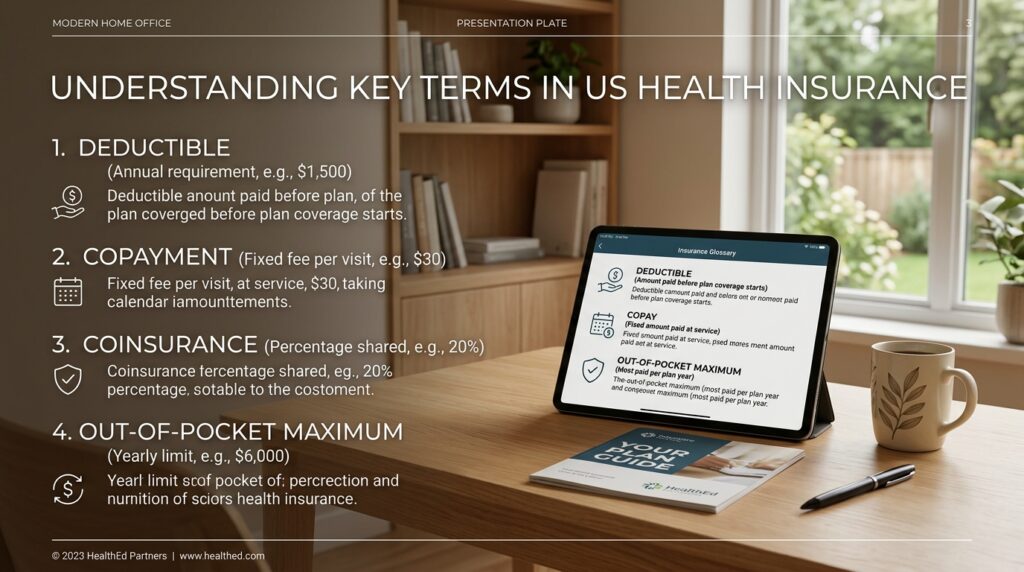
If you are shopping for health insurance in the United States, whether through your employer or through the marketplace at healthcare.gov, you will run into the same handful of terms again and again. Getting comfortable with what they actually mean makes the whole decision much easier.
Your premium is the amount you pay every month just to have the insurance, regardless of whether you use any healthcare services that month.
Your deductible is the amount you have to pay out of your own pocket before your insurance starts sharing costs with you. If your plan has a two thousand dollar deductible, you generally pay the first two thousand dollars of your covered medical costs yourself each year before the insurance company starts contributing.
Copays and coinsurance kick in after you have met your deductible. A copay is a flat fee, for example thirty dollars for a doctor visit. Coinsurance is a percentage, for example you pay twenty percent of the cost of a procedure while your insurer pays the other eighty percent.
Your out of pocket maximum is the most important number many people overlook. This is the absolute most you could possibly pay in a single year for covered, in network care, combining your deductible, copays, and coinsurance together. Once you hit that number, your insurance covers one hundred percent of your remaining covered costs for the rest of the year. For 2026, federal rules cap this at ten thousand six hundred dollars for an individual and twenty one thousand two hundred dollars for a family on ACA compliant plans. High deductible health plans paired with a health savings account have a slightly lower required cap, at eight thousand five hundred dollars for an individual and seventeen thousand dollars for a family.
It genuinely helps to think of your out of pocket maximum as the real worst case number for the year, since your premiums do not count toward it and neither does out of network care in most cases. This is the figure you should look at closely when comparing plans, not just the monthly premium.
How Much Coverage Makes Sense for Different Situations in the US

Now let us get practical. Here is how different types of people and families typically approach this decision.
Young, single, and generally healthy
If you rarely go to the doctor and do not take regular prescriptions, a high deductible health plan paired with a health savings account is often the most cost effective choice. You will pay a lower monthly premium, and the money you save can go into your health savings account, which grows tax free and can be used for medical expenses now or even saved for retirement later, since unused funds simply roll over year after year. The risk is that if something unexpected happens, like an accident or a surprise diagnosis, you could be on the hook for several thousand dollars before your coverage really kicks in. For most healthy young people, this trade off makes sense, since serious unexpected costs are relatively rare at that age and the savings add up over time.
Families with young children
Families tend to use healthcare more often, simply because kids get sick, need checkups, and occasionally end up in urgent care or the emergency room. For most families, a mid range plan, often labeled Silver on the marketplace, strikes a reasonable balance between monthly cost and protection if something goes wrong. Silver plans on the 2026 marketplace average around five thousand three hundred dollars in combined medical and prescription deductibles without cost sharing reductions, though many families actually qualify for reduced deductibles based on income, which can bring that number down significantly.
If your family has predictable, ongoing healthcare needs, such as a child with asthma or a parent managing a chronic condition, it is often worth paying a slightly higher premium for a Gold plan, which typically has a much lower deductible, since you know you will be using the plan regularly throughout the year anyway.
People managing a chronic illness or expecting a major medical event
If you know you are facing a surgery, ongoing treatment, or you manage a condition that requires frequent specialist visits and medications, this is exactly the situation where a lower deductible plan usually saves you money overall, even though the monthly premium is higher. You will hit your out of pocket maximum faster, and after that everything covered is free for the rest of the year. Running the actual numbers based on your expected usage, rather than just comparing premiums side by side, is genuinely worth the time here.
People getting coverage through an employer
If your health insurance comes through work, the good news is that employer sponsored plans tend to have noticeably lower deductibles on average than marketplace plans, often around one thousand nine hundred dollars for a single employee. Many employers also offer more than one plan option, so it is worth actually comparing them each year during open enrollment rather than automatically re selecting whatever you had before. Your needs, and sometimes your employer’s plan options, can change from year to year.
A Simple Way to Think About It
A helpful mental exercise is to ask yourself this question. If I had a genuinely bad year, an unexpected surgery, a serious illness, or a bad accident, could I comfortably pay the full out of pocket maximum for this plan without it derailing my finances. If the answer is yes, a lower premium, higher deductible plan is probably the smarter choice for you, since you are unlikely to hit that maximum most years anyway, and the monthly savings add up. If the answer is no, meaning that number would genuinely be a financial emergency for your household, then it is worth paying more each month for a plan with a lower out of pocket maximum, purely for the peace of mind and protection it buys you.
How Health Insurance Works Differently in the UK
If you are in the UK, the starting point looks completely different, and it is worth understanding why before comparing plans at all.
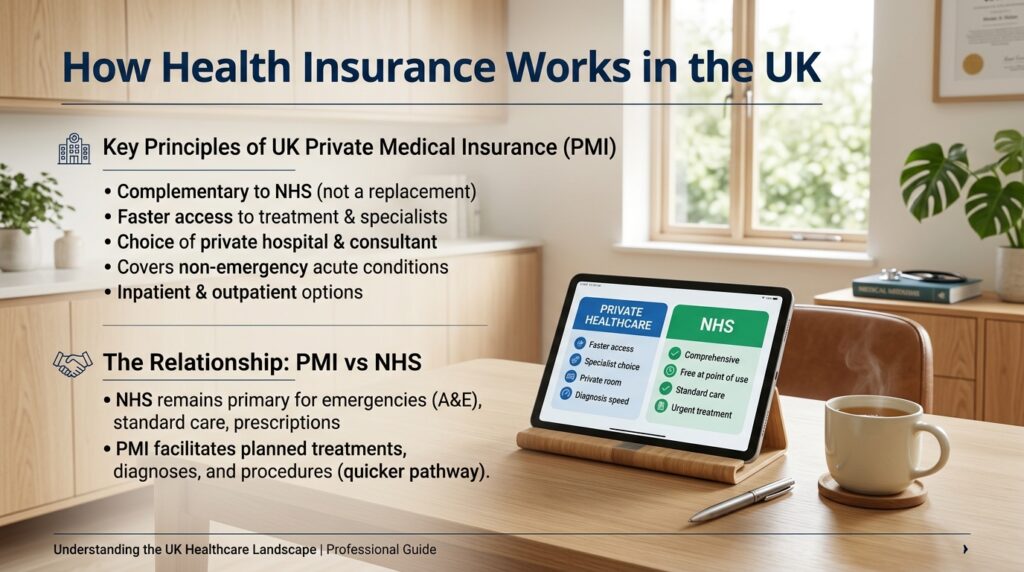
The National Health Service provides free healthcare at the point of use to everyone living in the UK, funded through general taxation. This includes GP visits, emergency care, hospital treatment, surgery, cancer care, and maternity care, all without a bill at the end. This is a fundamentally different starting position compared to the US, where health insurance is the thing standing between you and potentially enormous medical bills.
Because of this, private health insurance in the UK, usually called private medical insurance or PMI, is not something you need to survive a medical emergency. Emergency care is always handled by the NHS regardless of whether you have private insurance. Instead, private medical insurance exists to buy faster access to non emergency treatment, private hospital rooms, a wider choice of specialists, and to skip NHS waiting lists, which have grown fairly long in recent years. As of mid 2026, NHS England’s waiting list has been sitting above seven million incomplete treatment pathways, with a significant portion of patients waiting more than eighteen weeks for non urgent treatment.
How Much Private Medical Insurance Coverage Makes Sense in the UK
Since private medical insurance is supplementary rather than essential, the question becomes less about avoiding catastrophic bills and more about how much convenience and speed you are willing to pay for.
Basic or treatment only cover
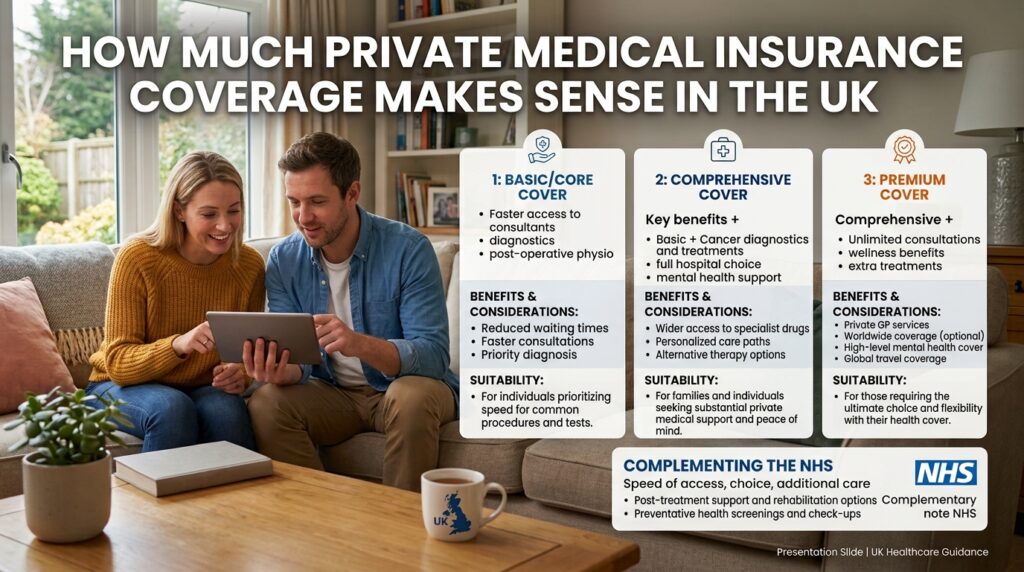
The most affordable option covers inpatient and day patient treatment, meaning surgery and hospital stays, but usually requires you to get a diagnosis first, either through the NHS or by paying for it yourself. Average basic policies cost around sixty five pounds a month in 2026, though this varies a lot by age, ranging from around sixteen pounds a month for someone in their twenties up to well over one hundred pounds a month for someone in their sixties or seventies. This level of cover suits people who mainly want to avoid a long wait for surgery once a condition has already been identified, but who are comfortable using the NHS for diagnosis and routine care.
Comprehensive cover
Comprehensive plans add outpatient cover, meaning consultations, diagnostic scans, and physiotherapy, on top of inpatient treatment. This means you can go straight to a private specialist for an assessment without waiting for an NHS referral first. Average comprehensive cover runs around ninety eight pounds a month, again varying significantly by age. This tends to suit people who want to skip NHS waiting times at every stage, not just for the treatment itself but for getting diagnosed in the first place.
Family cover
A UK family of four, generally two adults in their early forties and two children, pays around one hundred and sixty six pounds a month on average for private medical insurance in 2026. Adding children to a policy does increase the premium, but children are generally cheaper to insure than older adults, so a family plan is not simply four times the cost of an individual one.
Adjusting your excess
Just like a deductible in the US, your excess is the amount you pay yourself before the insurer contributes toward a claim. Choosing a higher excess, moving from no excess up to two hundred fifty or five hundred pounds, can lower your premium noticeably, often by fifteen to twenty five percent. Many UK policies also offer a six week wait option, sometimes called an NHS overlay, where you agree to use the NHS if it can treat you within six weeks, and only claim privately if it cannot. This single choice alone can cut your premium by twenty to thirty percent, since it shifts a meaningful amount of routine, non urgent treatment back onto the NHS.
Choosing Between Basic and Comprehensive Cover in the UK
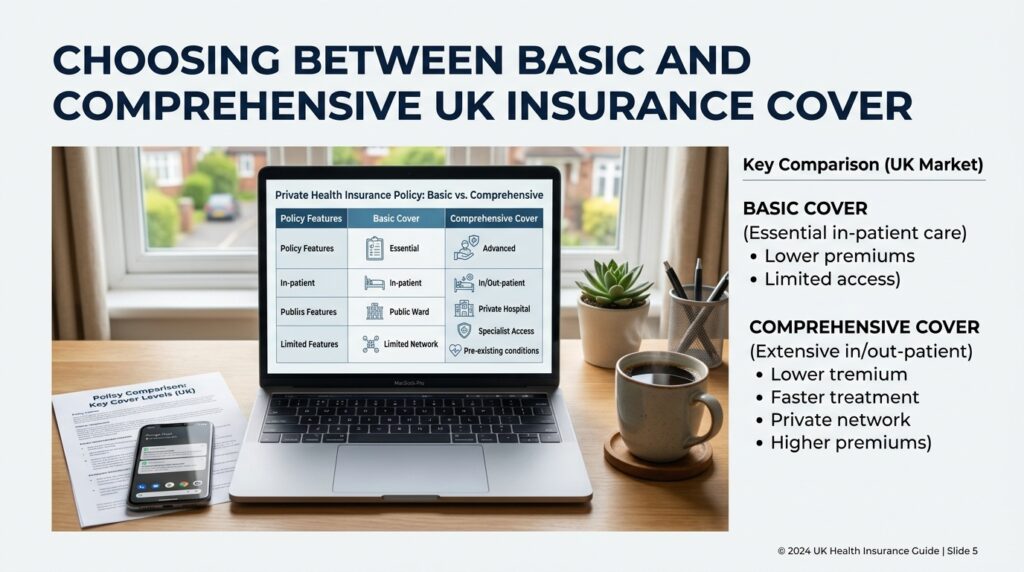
A good way to think about this is to consider what actually frustrates you about relying purely on the NHS. If your main concern is waiting a long time for a specialist opinion or a diagnostic scan, comprehensive cover with outpatient benefits is where the real value sits, since that is exactly the part of the process that tends to have the longest waits. If you are mainly worried about waiting for surgery once you already know what is wrong, a basic inpatient only plan combined with a six week NHS overlay might give you almost all of the benefit at a noticeably lower monthly cost.
It is also worth knowing that private medical insurance in the UK generally does not cover pre existing conditions, at least not for the first two to five years of a new policy, and it typically excludes chronic condition management, emergency care, and routine GP visits, since these are all already covered by the NHS. Private insurance here is genuinely a top up product, not a replacement for the safety net you already have.
If You Are Self Employed or Buying Your Own Coverage in the US
If you do not have an employer plan, you are likely shopping directly on the healthcare.gov marketplace or a state exchange, and the same logic applies, just with a bit more responsibility on your end since there is no employer narrowing down the options for you. It is worth checking whether you qualify for a subsidy based on your income, since many people underestimate how much these can reduce the actual cost of a Silver or Gold plan. Cost sharing reductions in particular can dramatically lower your deductible if you qualify, sometimes bringing a Silver plan’s deductible down close to what a Gold plan would normally cost, which makes Silver plans a far better deal for eligible households than the headline numbers suggest. It is worth running your numbers through the marketplace calculator each year rather than assuming your subsidy eligibility has stayed the same, since it changes with your income and household size.
A Note for Those Approaching Medicare Age in the US
If you are getting closer to sixty five, the whole framework shifts again. Original Medicare covers a large portion of hospital and medical costs, but it does not cap your out of pocket spending the way ACA marketplace plans do, which is why many people choose to pair it with either a Medicare Advantage plan or a Medigap supplemental policy. Medigap plans in particular vary in how much out of pocket protection they offer. For example, Plan K carries a 2026 out of pocket maximum of eight thousand dollars, while Plan L caps out at four thousand dollars, giving you a real, defined ceiling on your annual costs similar in spirit to the marketplace out of pocket maximum discussed earlier. If this applies to you, it is worth speaking with your State Health Insurance Assistance Program, which offers free, unbiased guidance on comparing Medicare options based on your specific health needs and budget.
A Few Practical Tips for Both Countries
Whichever country you are in, a few habits make this whole process easier every year.
Re check your coverage annually rather than automatically renewing. In the US, this usually happens during open enrollment. In the UK, insurers quietly raise premiums by five to ten percent a year on average, so comparing quotes every couple of years can meaningfully reduce your costs without lowering your actual protection.
Look past the headline premium and actually think through the worst case cost. In the US, that means checking the out of pocket maximum. In the UK, that means understanding exactly what is and is not covered, and whether an excess or NHS overlay option would suit your situation.
If your family’s health needs change, a new diagnosis, a pregnancy, or a child with a health condition, revisit your coverage rather than assuming your existing plan still fits. What made sense last year is not guaranteed to make sense this year.
Do not be afraid to ask for help. Insurance brokers in both countries generally do not charge you directly for comparing options across multiple insurers, and a good one can save you real money by pointing out details in the fine print that are easy to miss on your own.
Final Thoughts
There is no universal right answer to how much health insurance coverage you need. It comes down to how much risk you personally want to carry versus how much you are willing to pay each month to hand that risk over to an insurer. A healthy young adult in the US might reasonably choose a high deductible plan and lean on a health savings account. A family managing a chronic condition might reasonably pay more each month for a lower deductible and genuine peace of mind. In the UK, the NHS already provides a strong safety net, so private medical insurance becomes a personal choice about convenience and speed rather than a matter of financial survival.
The best approach is simply being honest with yourself about your actual health needs, your family’s situation, and how much of a financial shock you could realistically absorb in a bad year. Once you know that, comparing specific plans becomes a much simpler exercise.
This article is for general information only and is not personal medical, financial, or insurance advice. Coverage limits, premiums, and plan rules change over time and vary by provider, so always confirm current details directly with your insurer, employer, or a licensed broker before choosing a plan.