


A mortgage is one of the biggest financial commitments most people ever make, and the interest rate attached to it quietly determines an enormous amount over the life of the loan. A difference of even half a percentage point can add up to tens of thousands of dollars or pounds over twenty five or thirty years, yet a lot of buyers spend more time picking out paint colors for their new home than they spend actually shopping for their mortgage rate.
This guide walks through exactly what actually moves the needle on your mortgage rate, and what steps genuinely help you land the lowest one available to you, whether you are buying in the United States or the United Kingdom. The two systems work a little differently, so we will cover both separately where it matters.
One honest note before we start. Mortgage rates and lending criteria change constantly, and your own rate will always depend on your personal financial situation. This article explains the factors that influence your rate and the practical steps that help, but it is not personal financial advice. It is always worth speaking with a mortgage broker or lender directly about your specific circumstances.
Why Your Mortgage Rate Matters So Much
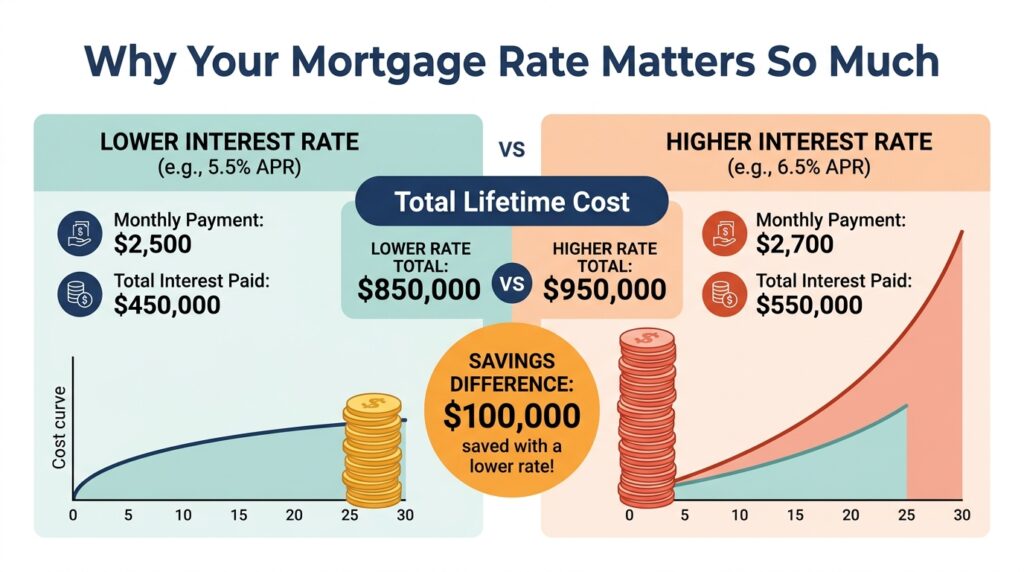
It helps to see the actual numbers before diving into strategy, since the scale of what is at stake is easy to underestimate. On a three hundred thousand dollar thirty year fixed mortgage, a rate difference of just one quarter of one percent works out to roughly twenty five dollars a month, which sounds small until you multiply it across three hundred and sixty monthly payments, at which point it becomes around nine thousand dollars over the life of the loan. Move a full percentage point, and you are looking at tens of thousands of dollars in additional interest paid over time.
In the UK, the math works out similarly. On a three hundred thousand pound mortgage over twenty five years, a one percent difference in rate adds roughly one hundred fifty to one hundred sixty pounds to your monthly payment, which comes to around nine thousand pounds over just a five year fixed term, long before you even reach the end of the full mortgage.
This is exactly why it is worth spending real time and effort getting your rate as low as possible before you sign anything. A few hours of preparation and comparison shopping can genuinely be worth thousands.
The Factors That Actually Determine Your Rate
Before getting into specific tactics, it helps to understand what lenders are actually looking at when they price your loan. Almost everything comes down to how much risk the lender believes you represent, and every factor below exists to answer that question in one way or another.
Your credit score is one of the single biggest factors in both countries. Lenders price mortgages in tiers, and moving from one tier to the next can shift your rate noticeably, sometimes by a quarter of a percentage point or more per tier, with the cumulative effect across several tiers adding up to a full percentage point or beyond.
Your deposit or down payment size matters enormously as well. A larger deposit reduces what is called your loan to value ratio, often shortened to LTV, which is simply the size of your loan compared to the value of the property. The lower your LTV, meaning the bigger your deposit relative to the home’s value, the less risk the lender is taking on, and the better your rate tends to be.
Your debt to income ratio, meaning how much of your monthly income already goes toward existing debt payments, also plays a real role. A lower ratio signals to lenders that you have more breathing room to comfortably handle a new mortgage payment.
The type of loan you choose, the length of the fixed period, and even which specific lender you approach can all shift your rate, sometimes by a surprising amount, since different lenders are often trying to attract slightly different types of borrowers at any given time.
Building Your Credit Before You Apply in the US
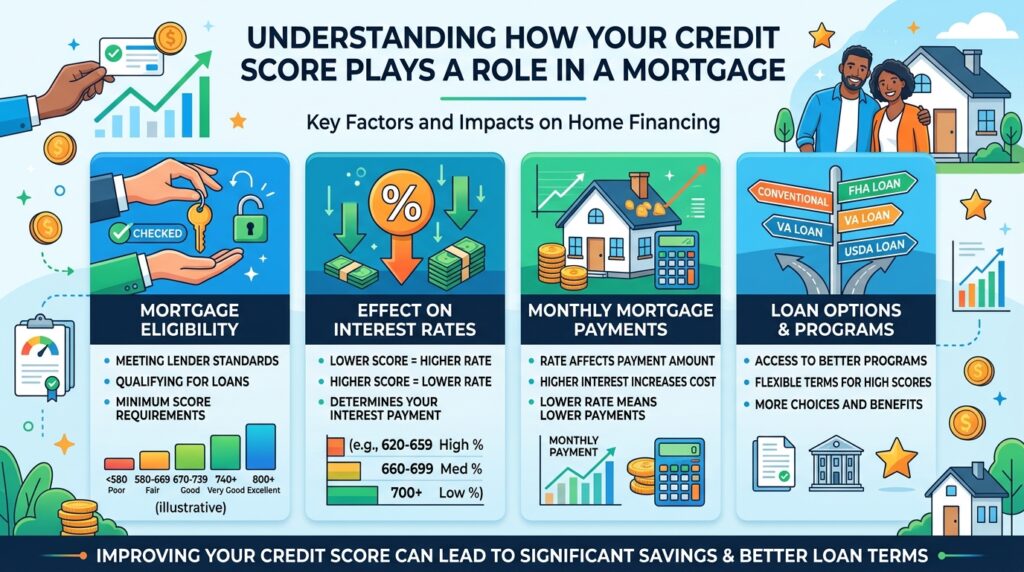
If you are in the US, your credit score is genuinely one of the most powerful levers you have, and the good news is that it is entirely within your control, at least given enough time.
Lenders generally reserve their best pricing for borrowers with credit scores in the mid seven hundreds and above. Moving up through the credit score tiers, say from the low six hundreds into the high six hundreds, and eventually into the seven hundreds, can steadily shave meaningful amounts off your rate at each step, with the gap between the lowest and highest tiers sometimes adding up to a full percentage point or more.
The good news is that raising your score before applying is genuinely achievable in the months leading up to a mortgage application. Pay every bill on time without exception, since payment history carries the most weight of any factor in your score. Bring your credit card balances down to thirty percent or less of your available limit, and ideally well below that if you can manage it. Avoid opening new credit cards or taking out new loans in the months before you apply, since new credit inquiries and new accounts can temporarily ding your score right when you need it at its strongest. Pull your own credit report and check it carefully for errors, since mistakes are more common than people expect and correcting them can sometimes produce a quick, meaningful improvement.
Managing Your Debt to Income Ratio in the US
Your debt to income ratio, often shortened to DTI, is calculated by dividing your total monthly debt payments by your gross monthly income. Lenders generally reward borrowers who keep this ratio low, since it shows you have real capacity to take on a mortgage payment without being financially stretched. Aiming for a DTI of around twenty five percent or lower puts you in a genuinely strong position for the best available pricing, though many loans allow for higher ratios if other parts of your profile are strong.
If your DTI is higher than you would like heading into a mortgage application, paying down existing debt, particularly high monthly payment debts like car loans or credit cards, in the months before you apply can make a real difference. It is often more effective to focus on paying off one or two smaller debts entirely, rather than making small payments across several accounts, since eliminating a monthly payment entirely has a bigger impact on your ratio than simply reducing several balances slightly.
Saving a Larger Down Payment in the US
A larger down payment reduces your loan to value ratio and generally earns you a better rate, along with the added benefit of avoiding private mortgage insurance altogether once you reach twenty percent down on a conventional loan. Even if you cannot reach twenty percent, moving from a smaller down payment to a somewhat larger one can still meaningfully improve your pricing, since lenders view every additional bit of buyer equity as reduced risk on their end.
That said, it is worth balancing this against your overall financial picture. Draining your entire savings for the largest possible down payment can leave you without a cushion for closing costs, moving expenses, or unexpected repairs right after you move in, so this is a genuine trade off worth thinking through carefully rather than an automatic decision to put down as much as physically possible.
Comparing Loan Types in the US
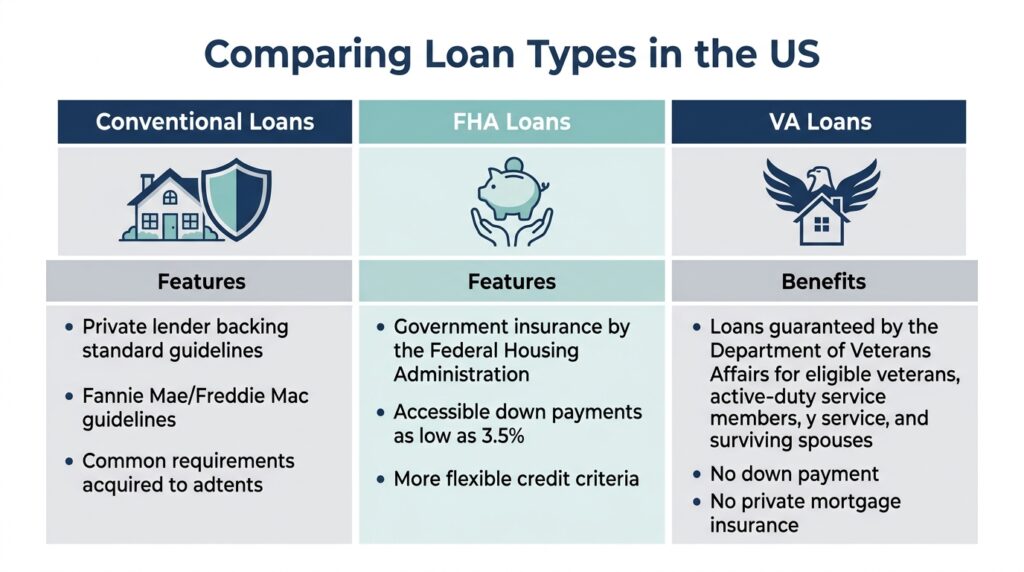
Different loan types come with genuinely different rate structures, and it is worth understanding your options rather than assuming a conventional thirty year fixed loan is automatically your best choice.
FHA loans, backed by the Federal Housing Administration, generally have less sensitive credit score pricing tiers than conventional loans, which can make them a genuinely better deal for borrowers with credit scores in the roughly five hundred eighty to six hundred sixty range, since a conventional loan for someone in that range often comes stacked with rate add ons that an FHA loan avoids. VA loans, available to eligible veterans and service members, often come with some of the lowest rates in the entire market and typically do not require a down payment at all. A fifteen year fixed loan generally carries a noticeably lower rate than a thirty year fixed loan, though your monthly payment will be higher since you are paying off the balance in half the time.
Adjustable rate mortgages, often called ARMs, can also offer a lower initial rate than a fixed loan, though the rate can rise after the initial fixed period ends, which is a real risk worth weighing carefully against your plans for how long you intend to stay in the home.
Buying Down Your Rate With Points
A discount point is an upfront fee, generally equal to one percent of your loan amount, that you pay at closing in exchange for a lower interest rate, often around a quarter of a percentage point lower per point purchased. Whether this trade is worth it depends heavily on how long you plan to stay in the home. If you plan to stay for many years, the math often works out in your favor, since the ongoing monthly savings eventually exceed what you paid upfront. Most calculations put the breakeven point somewhere around five to seven years, meaning if you sell or refinance before then, you may end up worse off having paid for the points in the first place. It is worth asking your lender directly for the specific breakeven calculation on any points they offer, rather than assuming they are automatically worth buying.
Shopping Multiple Lenders in the US
This might be the single highest impact thing you can do, and it is genuinely underused. Borrowers who collect quotes from several lenders tend to secure noticeably better average rates than those who simply go with the first lender they speak to, sometimes saving around half a percentage point simply by comparing offers.
To do this properly, contact several lenders, ideally five or more, on the same day, since mortgage rates shift daily and sometimes multiple times within a single day, which makes quotes gathered days apart genuinely difficult to compare fairly. Give every lender the exact same information, your credit score, loan amount, property type, down payment percentage, and target closing date, so the quotes you get back are actually comparable to one another. Ask each lender for their rate, any points required to achieve that rate, any lender credits available, and critically, the APR, which bundles in fees and gives you a more complete picture of the true cost of the loan rather than just the headline interest rate. Request a formal Loan Estimate from each lender, since this standardized document lets you compare offers on a true like for like basis, rather than relying on verbal quotes that can be structured very differently behind the scenes.
Getting Pre-Approved
Getting pre-approved, rather than simply pre-qualified, involves a lender actually verifying your income, assets, and credit, and it gives you a much clearer, more reliable sense of what rate and loan amount you can genuinely expect. It also strengthens your position as a buyer, since sellers tend to take pre-approved offers more seriously than ones without any lender verification behind them.
How the UK Mortgage Market Works Differently
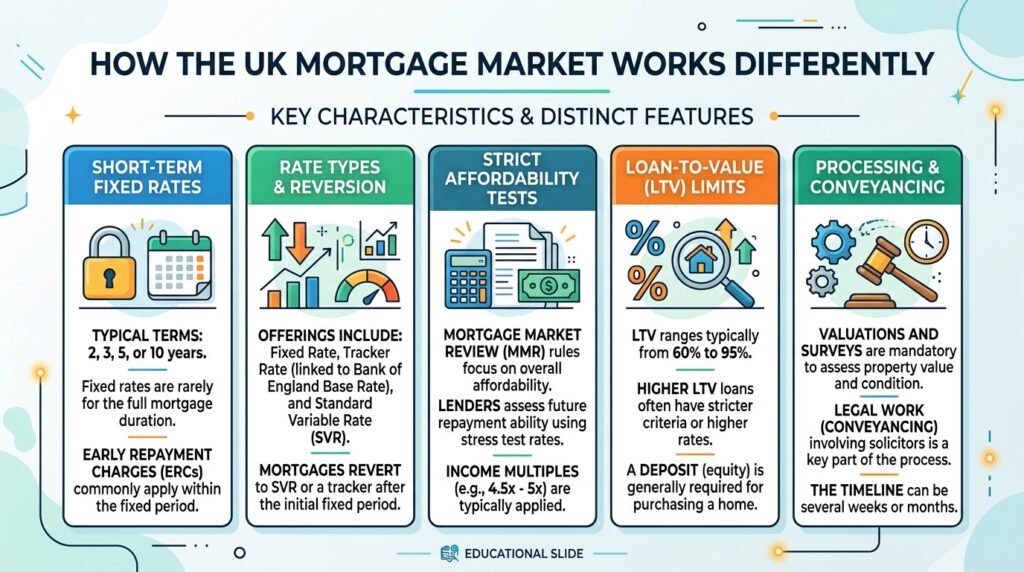
The UK system is structured a bit differently, and it is worth understanding the key differences before applying.
UK mortgages are almost always priced in loan to value bands rather than continuous credit score tiers the way US mortgages are. As of 2026, ninety six percent of new UK mortgage lending is on a fixed rate deal, and pricing tends to improve step by step as your deposit grows. The sharpest rates in the market generally sit at sixty percent loan to value or below, meaning a deposit or existing equity stake of at least forty percent of the property’s value. Each band above that, sixty five percent, seventy percent, seventy five percent, and upward, tends to price a little higher, with the most noticeable jumps appearing above eighty five percent loan to value.
This means that even a relatively modest increase in your deposit, say moving from a ten percent deposit to a fifteen percent deposit, can shift you into a meaningfully better pricing band, even if it does not feel like a large change on its own.
Fixed Rate vs Tracker Mortgages in the UK
UK borrowers generally choose between fixed rate and tracker, or variable rate, mortgages. A fixed rate mortgage locks your payment for a set period, usually two or five years, regardless of what happens to the Bank of England base rate during that time. A tracker mortgage moves up or down in line with the base rate, meaning your payment can change during the term.
As of mid 2026, average two year and five year fixed rates in the UK have been sitting in a fairly similar range to one another, often somewhere around five and a half percent, though the very best available deals for borrowers with strong deposits and clean credit profiles have been available meaningfully lower than that average, sometimes in the low four percent range at the lowest loan to value bands. Most UK buyers currently choose a fixed rate deal, largely for the predictability it offers, though a tracker can occasionally make sense for borrowers who are comfortable with some payment uncertainty in exchange for potentially lower rates if the base rate falls during their term.
Practical Steps to Get the Best UK Mortgage Rate
Save the largest deposit you realistically can, since reaching key loan to value thresholds, particularly the sixty percent band, unlocks meaningfully better pricing than what is available at ninety or ninety five percent loan to value.
Check your credit file with all three UK credit reference agencies well before applying, and fix any errors you find. Registering on the electoral roll, keeping credit card balances low relative to your limits, and avoiding new credit applications in the months before you apply all genuinely help here, in much the same way they do in the US.
Use a whole of market mortgage broker rather than relying purely on your own bank or a single comparison website. A genuinely independent broker can access deals across dozens of lenders, some of which are not available directly to the public at all, and can often identify which specific lenders are most likely to offer you their best pricing given your particular financial profile. Many brokers do not charge you directly for this service, since they are compensated by the lender instead, which makes it a genuinely low risk step worth taking.
Compare both the headline rate and the arrangement fee together, since a mortgage with a slightly higher rate but a much lower fee can sometimes work out cheaper overall, particularly on smaller loan amounts, while a lower rate with a larger fee can work out better value on bigger loans. Ask your broker or lender to show you the true total cost over your chosen fixed term, not just the headline rate in isolation.
If you are remortgaging rather than buying for the first time, compare your existing lender’s product transfer offer against the wider market rather than assuming staying put is automatically the easiest or cheapest option. A product transfer can sometimes be quicker, but switching lenders entirely often opens up a meaningfully wider range of deals.
Timing Considerations Worth Knowing
In both countries, it is worth understanding that mortgage rates move with broader economic conditions, including central bank policy, inflation data, and bond market movements, none of which you can control or reliably predict. Trying to perfectly time the market by waiting for rates to fall further is rarely a winning strategy, since rates can just as easily move against you while you wait. A more reliable approach is to focus on the factors that are actually within your control, your credit profile, your deposit size, and how thoroughly you shop around, rather than trying to guess where rates are headed next.
That said, once you have found a rate you are comfortable with, most lenders in both countries offer a rate lock or a similar reservation option that protects your quoted rate for a set period while your application and paperwork are finalized, which protects you from rates rising during the closing process.
A Few Honest Things Worth Knowing
The lowest advertised rate you see online is not necessarily the rate you will actually be offered, since headline rates are often reserved for borrowers with the strongest possible credit profiles and largest deposits. It is worth treating advertised rates as a general benchmark rather than a guarantee, and getting an actual personalized quote before assuming any specific number applies to you.
It is also worth remembering that the lowest rate is not always the same thing as the lowest overall cost. Fees, points, and the length of the fixed period all factor into your true cost of borrowing, and a slightly higher rate with lower fees can sometimes genuinely work out cheaper depending on how long you plan to keep the loan.
Finally, comparison shopping takes a bit of extra effort upfront, filling out multiple applications, gathering multiple quotes, and comparing paperwork carefully, but the potential savings, often in the thousands of dollars or pounds over the life of the loan, make this one of the more clearly worthwhile uses of your time during the home buying process.
Final Thoughts
Getting the lowest possible mortgage rate mostly comes down to a handful of things fully within your control. Strengthen your credit profile well before you apply, save as large a deposit as realistically makes sense for your situation, keep your existing debt manageable, and then genuinely shop around rather than accepting the first offer you receive. None of these steps require any special insider knowledge, just a bit of preparation and patience in the months leading up to your application.
A mortgage is a long term commitment, often spanning decades, which means even a modest improvement in your rate compounds into real, meaningful savings over time. Taking the extra time to get this part right, before you sign anything, is genuinely one of the most valuable financial moves you can make as a homebuyer.
This article is for general information only and is not personal financial or mortgage advice. Mortgage rates, lending criteria, and specific product terms change frequently and vary by lender, so always get a personalized quote and consider speaking with a licensed mortgage broker or adviser before committing to a loan.