


Once you decide it is time to get serious about consolidating debt, you are usually left choosing between two main tools. A personal loan, which pays off your existing balances and replaces them with a single fixed monthly payment, or a balance transfer credit card, which moves your existing balances onto a new card that charges little or no interest for a limited period.
Both approaches genuinely work. Both can save you real money and simplify your finances. But they work in fundamentally different ways, they suit different situations, and choosing the wrong one for your circumstances can leave you paying more than you needed to, or worse, stuck with a plan that quietly falls apart before your debt is actually cleared.
This guide walks through exactly how each option works, what they cost in practice, who qualifies for what, and the specific situations where one clearly beats the other, covering both the US and UK markets along the way.
The Basic Mechanics of Each Option
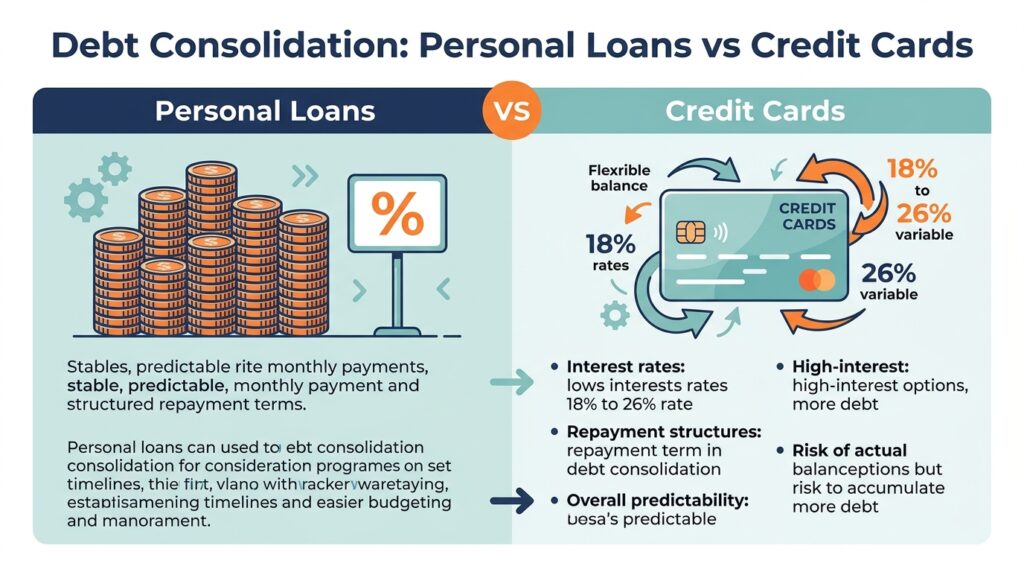
Personal Loans for Debt Consolidation
A personal loan used for debt consolidation is a type of installment loan. You borrow a lump sum from a bank, credit union, or online lender, use that money to pay off your existing credit card balances immediately, and then repay the new loan through fixed monthly payments over a set term, commonly anywhere from one to seven years depending on the lender and loan size.
The interest rate on a personal loan is typically fixed for the life of the loan, meaning your payment amount does not change from month to month. You know exactly what you will pay and exactly when the loan will be fully repaid, right from the day you sign the agreement.
Balance Transfer Credit Cards
A balance transfer card works differently. Instead of a lump sum loan, you are moving your existing credit card debt onto a new card that offers a low or 0 percent introductory interest rate for a limited promotional period, commonly somewhere between six and 21 months in the US, and sometimes stretching considerably longer in the UK, occasionally reaching up to three years with certain providers.
During that promotional period, you pay little or no interest on the transferred balance, meaning nearly every payment you make goes directly toward reducing what you owe rather than covering interest charges. Once the promotional period ends, any remaining balance reverts to the card’s standard interest rate, which is often just as high as the rate you were trying to escape in the first place.
What Each Option Actually Costs
Interest Rates
Interest rates for both products vary considerably based on your credit profile, but some general patterns hold true in both countries.
In the US, average personal loan rates have recently sat somewhere around 11 to 13 percent for typical borrowers, though those with excellent credit can sometimes qualify for rates as low as around 6.5 percent. This compares favorably against average credit card interest rates on balances that carry over month to month, which have commonly exceeded 20 percent in recent years, and the standard rate that balance transfer cards revert to once their promotional period ends often lands in a similar range, sometimes averaging around 21 percent.
In the UK, the picture is broadly similar in shape even if the specific numbers differ. Standard credit card interest rates commonly sit well above 20 percent, while personal loan rates for consolidation purposes are frequently lower, though the exact rate you are offered depends heavily on your credit history, the loan amount, and the lender you approach.
The key point in both markets is that a balance transfer card is not competing with a personal loan on interest rate during its promotional window, since 0 percent obviously beats any positive interest rate. The real competition happens after that promotional window ends, which is where personal loans tend to hold a structural advantage.
Fees
Both products come with fees that are worth factoring into any comparison, since the headline rate alone does not tell the full story.
Personal loans often carry an origination fee, deducted upfront from the loan proceeds before the money reaches you. This means if you borrow 10,000 dollars or pounds with a 3 percent origination fee, you might actually receive 9,700, while still owing repayment on the full 10,000. It is important to borrow enough to cover this shortfall if you need the full amount to clear your existing balances.
Balance transfer cards typically charge a balance transfer fee, commonly somewhere between 3 and 5 percent of the amount you move over. Unlike a loan origination fee, this fee is usually added directly onto your new card balance rather than deducted upfront, meaning you end up owing slightly more than the amount you originally transferred.
Neither fee structure is automatically better or worse. It depends on the specific percentages being charged and how they interact with your repayment plan, so it is always worth calculating the total cost, fees included, rather than comparing headline rates or promotional periods alone.
Which Product You Actually Qualify For
Credit requirements differ meaningfully between the two options, and this alone can narrow down your realistic choices before cost even enters the conversation.
Balance transfer cards with genuinely competitive 0 percent offers are generally reserved for borrowers with good to excellent credit. In the US, this commonly means a credit score of around 690 or higher, though the exact threshold varies by issuer. If your score falls below that range, you may still find balance transfer offers available, but the promotional period is likely to be shorter and the ongoing rate less competitive.
Personal loans, by contrast, are available across a much wider credit spectrum. Borrowers with fair or even poor credit can often still qualify for a personal loan, though naturally at a higher interest rate than someone with excellent credit would receive. This makes personal loans meaningfully more accessible if your credit score has already taken a hit, whether from the same debt you are now trying to consolidate or from other financial setbacks.
In the UK, the same general pattern holds. Lenders will assess your credit history and affordability for either product, but personal loans, including options through credit unions which often offer more competitive rates than mainstream banks, tend to be available to a broader range of applicants than the most competitive 0 percent balance transfer deals.
The Type and Amount of Debt Matters
One structural limitation of balance transfer cards is worth flagging clearly. They are generally restricted to consolidating existing credit card debt, since you are literally transferring a balance from one card to another. If you also have other forms of unsecured debt, such as a store card, an overdraft, or a smaller personal loan, a balance transfer card typically will not accommodate rolling those in.
Personal loans, on the other hand, can typically be used to pay off a wider mix of debt types in one go, since you are simply borrowing a lump sum and using it however you choose, including paying off multiple different creditors at once. If your debt is spread across several different products rather than sitting entirely on one or two credit cards, a personal loan is usually the more practical tool.
There is also a size consideration. Balance transfer cards are subject to a credit limit, and that limit may not be large enough to absorb your full existing balance, particularly if you are consolidating a substantial amount of debt across multiple cards. Personal loans, particularly from lenders who specialize in debt consolidation, can often accommodate significantly larger amounts in a single loan.
How Quickly You Can Realistically Pay It Off
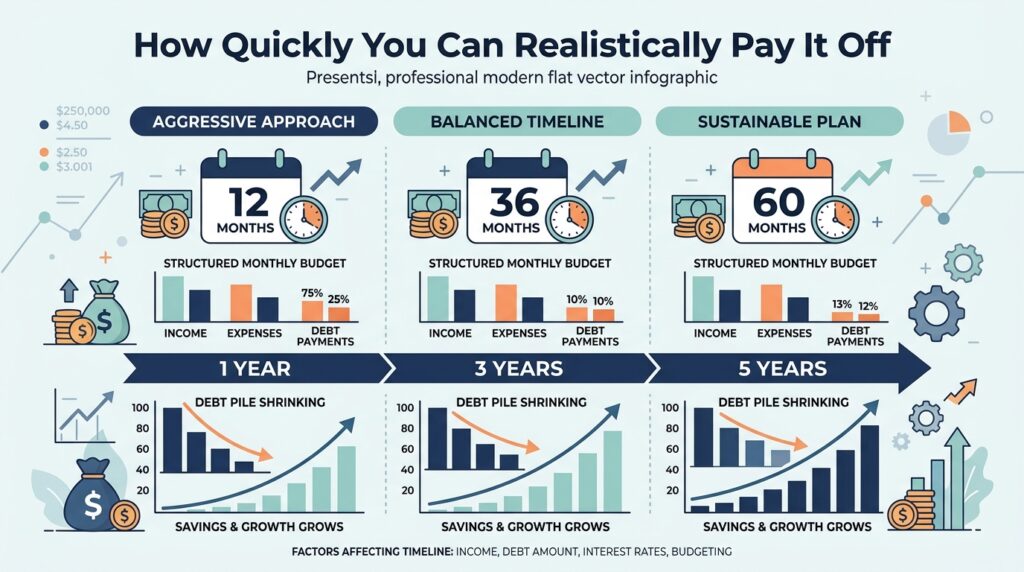
This is one of the most important practical questions to ask yourself honestly before choosing between the two options.
A balance transfer card only delivers real savings if you can pay off the transferred balance, or close to all of it, before the promotional period ends. If you can comfortably calculate a monthly payment that clears the debt within that window, and that payment fits your budget, a balance transfer card can be the cheaper option overall, since you are paying little to no interest during that entire period.
If, however, your debt is large enough or your monthly budget tight enough that you would need considerably longer than the promotional period to pay it off, a personal loan is usually the safer and more genuinely cost effective choice. Personal loan terms commonly stretch anywhere from one to seven years in the US, and often offer similarly flexible terms in the UK, giving you a realistic, fixed timeline that does not rely on beating a countdown clock. Getting this calculation wrong with a balance transfer card, and still carrying a meaningful balance when the promotional rate expires, can mean paying a high standard interest rate on whatever is left, sometimes for longer and at greater total cost than a personal loan would have involved from the start.
Predictability and Structure
Personal loans offer a level of structural certainty that balance transfer cards simply cannot match. The interest rate is fixed. The monthly payment is fixed. The final payoff date is known from day one. This predictability matters a great deal for anyone who wants a clear, contained plan rather than an open ended situation that depends on their own future discipline.
Balance transfer cards, being revolving credit rather than an installment loan, retain more flexibility, but that flexibility cuts both ways. You can typically make just the minimum payment in any given month if your circumstances require it, which offers short term breathing room a fixed personal loan payment does not. On the other hand, this same flexibility means it is entirely possible to keep making only minimum payments, watch the promotional period quietly expire, and end up back on a high interest rate with a stubborn remaining balance, particularly without the discipline of a fixed repayment structure pushing you forward.
The Behavioral Risk Worth Being Honest About
Both consolidation methods share a well documented behavioral risk that is worth addressing directly rather than glossing over. Consolidating debt, whether through a loan or a balance transfer, frees up your existing credit cards, since their balances are now paid off. This creates a real temptation to start using those cards again, sometimes without fully realizing it, which can leave you with both the new consolidation debt and a fresh round of credit card balances building up in parallel.
Research following borrowers who took out a personal loan specifically for debt consolidation has found that a meaningful share saw their credit card balances climb back toward pre consolidation levels within roughly a year and a half. This is not a reason to avoid consolidation. It is a reason to pair consolidation with a genuine change in spending habits, whether that means closing or freezing the paid off cards, setting a firm budget, or simply being deliberate about not treating newly available credit as extra spending power.
When a Balance Transfer Card Tends to Make More Sense
A balance transfer card is generally the stronger option when your credit score is good to excellent, your debt sits entirely or mostly on existing credit cards rather than other loan types, you have a realistic, calculated plan to pay off the balance within the promotional period, and you want to retain the flexibility of an open line of credit once the debt is cleared, since a credit card remains available for future use in a way a closed personal loan does not.
It also tends to suit people who are consolidating a relatively modest amount of debt, since the credit limit on a new card may not stretch to accommodate a very large balance, and people who are confident in their ability to avoid running the card back up once it has room again.
When a Personal Loan Tends to Make More Sense
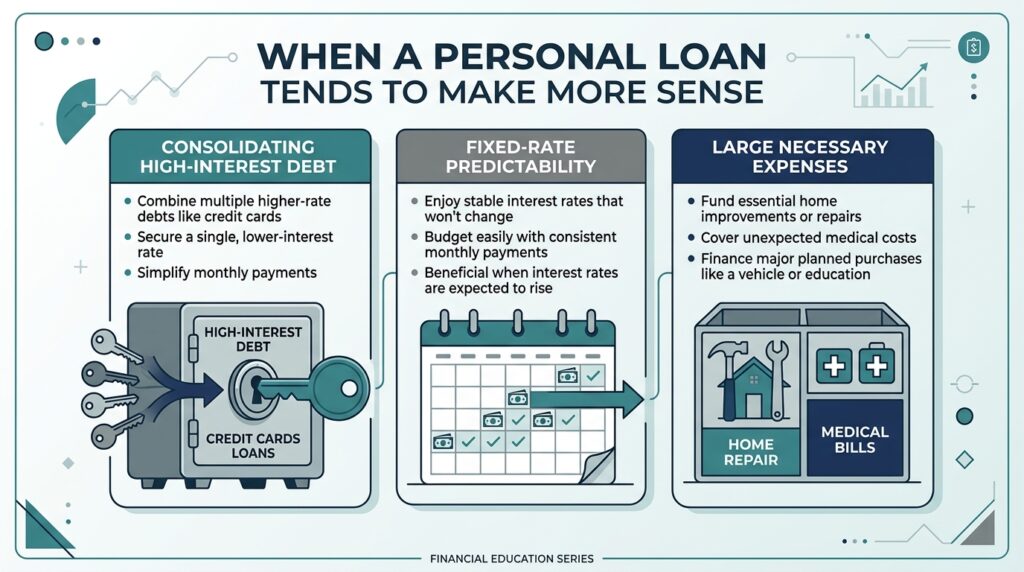
A personal loan is generally the stronger option when you want a predictable, fixed payment and a definite payoff date rather than a countdown against a promotional clock, when your debt is spread across multiple types of credit rather than sitting entirely on credit cards, when the total amount you need to consolidate is larger than a realistic credit card limit could absorb, and when your credit score is not strong enough to access the most competitive balance transfer offers.
It is also often the better fit for anyone who has tried a more informal, do it yourself approach to managing multiple balances, such as shifting payments between cards or timing them around income, and found that approach difficult to sustain as the total debt grew. A personal loan replaces that ongoing juggling act with a single, contained monthly obligation.
A Practical Way to Decide
Rather than choosing based on gut feeling or which option sounds more appealing on paper, it helps to work through a short, honest checklist.
First, check your actual credit score, since this alone may determine which options are realistically available to you. Second, add up the total amount of debt you need to consolidate and compare it against typical credit limits for balance transfer cards versus typical loan amounts available to you. Third, calculate a realistic monthly payment for both options, factoring in fees, and see which one you could genuinely sustain without stretching your budget uncomfortably thin. Fourth, be honest about your own discipline. If a countdown clock and revolving credit feels risky for your situation, the fixed structure of a personal loan may suit you better, even if the headline numbers look similar. Fifth, consider whether your debt is concentrated on credit cards alone or spread across other unsecured debt types, since this alone can rule out a balance transfer card as a workable option.
A Worked Example
To make the comparison concrete, consider someone carrying 8,000 dollars or pounds across a couple of credit cards at an average interest rate above 20 percent.
Using a balance transfer card with an 18 month 0 percent promotional period and a 3 percent transfer fee, the upfront fee adds 240 to the balance, bringing the total to 8,240. Spread evenly, that requires a payment of a little under 458 a month to clear the balance entirely before the promotional rate expires, with no interest paid at all during that period beyond the initial fee.
Using a personal loan instead, at a fixed rate of around 11 percent over a four year term, the monthly payment would land somewhere in the range of 207 a month, a considerably smaller monthly commitment, though spread over a much longer period and with total interest paid over the life of the loan adding up to a more noticeable amount compared to the balance transfer scenario, assuming the balance transfer plan is actually followed through to completion.
This example illustrates the core trade off clearly. The balance transfer route can be cheaper overall if the higher monthly payment is genuinely affordable and the full balance is cleared in time. The personal loan route offers a smaller, more manageable monthly payment and complete certainty, at the cost of paying more in total interest over a longer period.
Final Thoughts
Neither personal loans nor balance transfer credit cards are universally better for debt consolidation. Each serves a different situation well. A balance transfer card rewards strong credit, disciplined repayment, and a manageable debt load concentrated on credit cards, offering genuine interest savings if you can hit the promotional deadline. A personal loan offers structure, predictability, and broader accessibility, particularly for larger balances, mixed debt types, or less than perfect credit, at the cost of a longer repayment period and more total interest paid along the way.
The right choice comes down to an honest look at your credit score, the size and type of debt you are carrying, how quickly you can realistically pay it down, and how much you value the certainty of a fixed payment versus the potential savings of an interest free window. Whichever option you choose, the consolidation itself is only half the job. Making sure old habits do not quietly rebuild new debt alongside it is what actually determines whether the plan succeeds in the long run.
This article is for general informational purposes and is not financial advice. Interest rates, fees, and eligibility requirements for personal loans and balance transfer credit cards vary by lender, provider, and individual circumstances, and change over time, so always check current terms directly with the lender or card issuer, and consider speaking with a qualified financial adviser or a free debt advice service before making decisions about consolidating your debt.