


If you are carrying a credit card balance at a high interest rate, a 0 percent APR balance transfer card can feel like a lifeline. Move your existing debt onto a new card, pay no interest for a set period, and suddenly every dollar or pound you put toward the balance actually reduces what you owe instead of disappearing into interest charges.
Used well, this is genuinely one of the most effective tools available for clearing credit card debt faster. Used carelessly, it can leave you right back where you started, or worse, with a fresh balance sitting on a card whose promotional period has quietly expired. This guide covers exactly how these cards work, what current offers look like in both the US and UK, and the practical steps that separate people who successfully clear their debt from people who end up paying just as much interest as before.
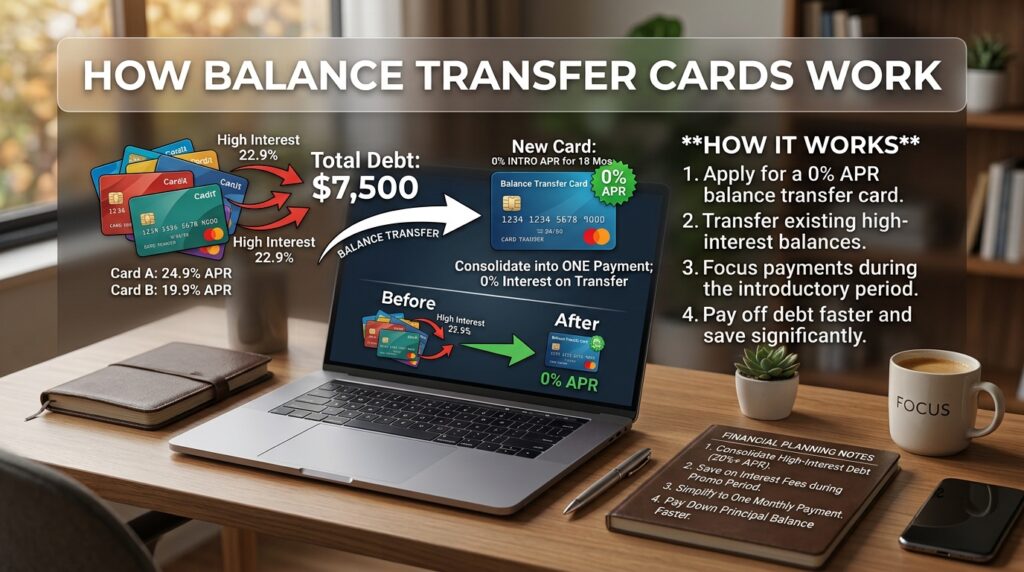
How Balance Transfer Cards Actually Work
A balance transfer card lets you move debt from one or more existing credit cards onto a new card that charges 0 percent interest for a promotional period. Instead of continuing to pay a high standard interest rate on your old cards, you transfer that balance to the new card and stop accruing interest for the length of the introductory offer, which can run anywhere from around a year to nearly three years depending on the card and country.
In exchange, most cards charge a one time transfer fee, calculated as a percentage of the balance you move over, typically somewhere between 1 and 5 percent. You usually need to complete the transfer within a specific window after opening the account, commonly 60 to 120 days, in order to qualify for the promotional rate.
The key thing to understand is that a balance transfer card does not erase your debt. It simply pauses the interest, giving you a window of time to pay down what you owe without new charges piling on top. If the 0 percent period ends and you still have a balance remaining, that balance reverts to the card’s standard interest rate, which is often just as high, or sometimes higher, than the rate on the card you originally transferred from.
Current Balance Transfer Offers in the US
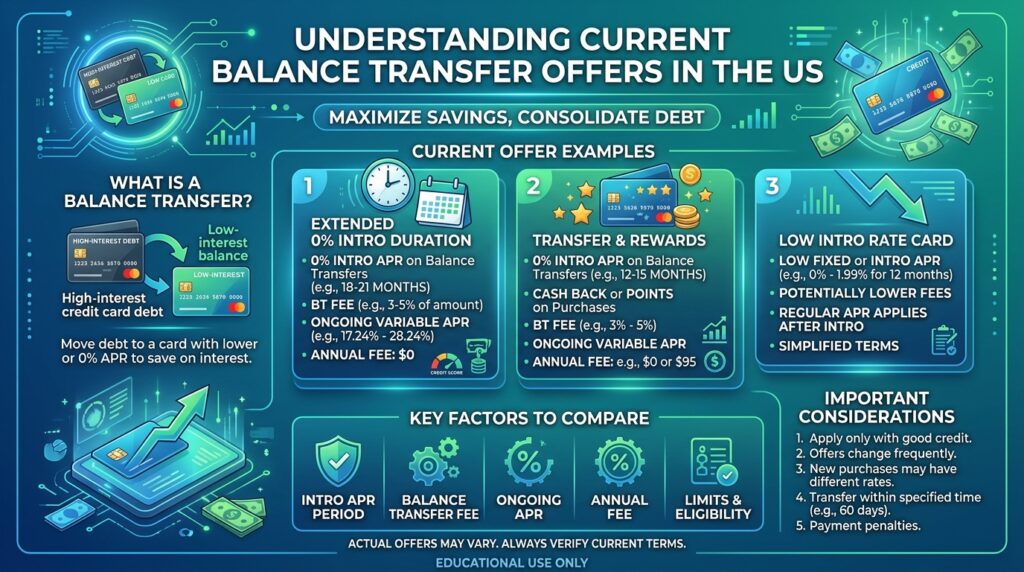
The US market currently has several standout cards, each with a slightly different combination of introductory length, ongoing rate, and transfer fee.
Some of the longest introductory periods on the market right now run in the range of 18 to 21 months for balance transfers, with the standard variable APR after that period typically landing somewhere between roughly 15 and 28 percent, depending on the specific card and your creditworthiness. Certain cards also extend an equally long 0 percent window to new purchases made on the card, not just transferred balances, which can be useful if you also want to make a large purchase without accruing interest while you pay down transferred debt at the same time.
Transfer fees on US cards commonly range from around 3 to 5 percent of the amount moved, and some cards offer a lower introductory fee, often around 3 percent, if the transfer is completed within the first few months of opening the account, with the fee rising afterward.
A few features are worth watching for specifically. Some cards drop the penalty APR entirely, meaning a late or returned payment will not automatically spike your interest rate the way it does on many standard cards. Others are built around simplicity and forgiveness, waiving late fees altogether, which can offer peace of mind if you are worried about occasionally missing a payment date during the repayment period.
Current Balance Transfer Offers in the UK
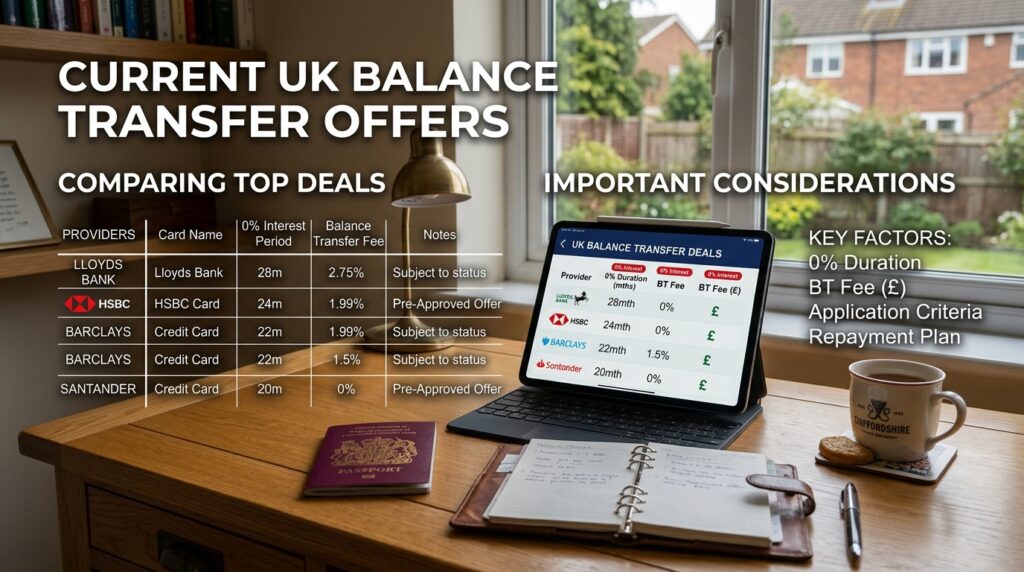
The UK market works a little differently, with several major banks currently offering some of the longest interest free periods seen in recent years, commonly reaching up to 36 months on selected cards.
As of the middle of 2026, the broad picture across the market looks roughly like this. The longest promotional periods available currently stretch to around 36 months, offered by several well established providers, generally with a transfer fee somewhere in the range of 3 to 3.5 percent of the balance moved. Shorter promotional periods, sometimes under a year, are occasionally available with a 0 percent transfer fee instead, which can work out cheaper overall if you are confident you can clear the balance quickly.
Once the promotional period ends, the ongoing representative APR on most UK balance transfer cards currently sits around 24.9 percent, though this varies by provider and by individual circumstances, since the rate you are offered depends on your credit profile.
It is worth noting an important UK specific restriction. Most providers will not allow you to transfer a balance from one card to another card issued by the same bank, or by a different brand within the same banking group. This means you generally need to move your balance to a genuinely different lender in order to qualify for a new promotional rate.
Given how quickly current UK interest rates make ordinary credit card debt expensive, the potential savings from a well timed transfer can be substantial. Moving a balance of a few thousand pounds onto a 0 percent card for roughly two years can realistically save several hundred pounds in interest compared to leaving that same balance on a standard rate card.
Who Balance Transfer Cards Work Best For

These cards tend to work best for people who have a clear, realistic plan to pay off the transferred balance before the promotional period ends. If you can calculate roughly how much you need to pay each month to clear the debt within the interest free window, and that monthly amount is genuinely affordable within your budget, a balance transfer card can meaningfully speed up how quickly you become debt free.
They are less suited to situations where the underlying spending habit that created the debt has not changed. Moving debt to a new card without addressing why the balance built up in the first place often just delays the problem, and in some cases leads to accumulating a second balance on the original card once it has some room again.
How to Calculate Whether the Math Works
Before applying for any balance transfer card, it helps to run through the actual numbers rather than just applying based on the length of the 0 percent offer alone.
Start with the total balance you plan to transfer. Calculate the transfer fee you will be charged upfront, since this is a real cost even though no interest accrues during the promotional period. Then divide your balance, including that fee, by the number of months in the promotional period to see what monthly payment you would need to make to clear it entirely before interest kicks in.
For example, transferring 3,000 pounds onto a card with a 24 month 0 percent period and a 3 percent transfer fee means an upfront fee of 90 pounds, bringing your total to 3,090 pounds. Divide that by 24 months and you get a required payment of a little under 129 pounds a month to clear the balance in time. If that monthly figure is not realistic for your budget, it is worth looking at a card with a longer promotional period instead, even if the transfer fee is slightly higher, since a longer runway with a manageable payment is generally more useful than a shorter one that sets you up to fail.
Common Mistakes That Undo the Savings
Not paying off the balance before the promotional period ends. This is by far the most common and costly mistake. Once the 0 percent window closes, any remaining balance starts accruing interest at the card’s standard rate, sometimes wiping out most or all of the savings you had built up.
Missing minimum payments during the promotional period. Even though you are not being charged interest, you are still required to make at least the minimum payment each month. Missing a payment can, on some cards, end the promotional rate early or trigger fees, so treating the minimum payment as non negotiable matters just as much as it would on a standard card.
Using the new card for regular spending as well. If the card’s 0 percent offer only applies to the transferred balance and not to new purchases, any everyday spending you put on the card can start accruing interest immediately, and in many cases, payments are applied to the lowest interest portion of the balance first, meaning your interest free transferred balance sits untouched while new purchases quietly rack up interest.
Transferring within the same banking group in the UK. As mentioned earlier, many UK providers will not permit a transfer between cards issued by the same bank or group, so it is worth checking this before assuming a lower cost internal transfer is available.
Missing the transfer deadline. Most cards only apply the 0 percent rate to transfers completed within a specific window after account opening, commonly 60 to 120 days. Waiting too long to actually initiate the transfer after being approved can mean missing out on the promotional rate entirely.
Not accounting for the transfer fee in your total cost calculation. The transfer fee is a real, upfront cost, and while it is usually far smaller than the interest you would otherwise pay, forgetting to include it when comparing offers can lead to a slightly misleading picture of which card actually saves the most money.
A Simple Way to Approach It
Set a diary reminder for a month or two before your promotional period ends, regardless of how confident you feel about paying it off. This gives you a buffer to either make a final push to clear the remaining balance, transfer the remainder to a new promotional card if one is available and it makes sense to do so, or plan around paying the standard rate on whatever is left.
Automating your monthly payment based on the calculation above, rather than relying on remembering to pay manually, removes much of the risk of missing a payment or falling behind on the schedule you need to clear the balance in time.
If you have savings sitting in an account earning less interest than your card would charge once the promotional period ends, it is often worth using some of those savings to clear the remaining balance directly rather than continuing to carry debt at a much higher rate than your savings are earning.
Final Thoughts
A 0 percent balance transfer card can be one of the most effective tools available for clearing credit card debt faster, but only if you go in with a clear plan for paying off the balance before the promotional period ends. The offers available right now in both the US and UK markets are genuinely competitive, with some UK cards stretching to nearly three years interest free and several strong US options offering well over a year, but the length of the promotional period only matters if you actually use that time to pay the balance down rather than treating it as a pause button.
Before applying, calculate the real monthly payment you would need to clear your balance within the promotional window, compare that against your actual budget, and only proceed if the numbers genuinely work. Done this way, a balance transfer card can save you a meaningful amount of money. Done without a plan, it often just delays the same problem to a later date.
This article is for general informational purposes and is not financial advice. Credit card offers, interest rates, and fees change frequently and vary by provider and individual circumstances, so always check the current terms directly with the card issuer before applying, and consider speaking with a free debt advice service if you are struggling with existing credit card debt.