


Life insurance is one of those financial products that most people know they should probably have, but very few people actually enjoy shopping for. Part of the confusion comes down to the sheer number of options available, and the biggest fork in the road usually comes down to one basic question: term or whole life.
These two types of policies look similar on the surface, since both promise to pay out a lump sum when you die, but the way they are priced, structured, and used financially could not be more different. One is built to be cheap and temporary. The other is built to last your entire life, at a much higher cost. Understanding the actual math behind each option, rather than just the sales pitch, is the key to figuring out which one genuinely saves you money and which one might be quietly draining it.
This article breaks down how each type works, what they actually cost using real world figures from both the US and UK markets, and the specific situations where each one tends to make financial sense.
What Term Life Insurance Actually Is

Term life insurance covers you for a fixed period of time, commonly 10, 20, 25, or 30 years. You pay a premium throughout that period, and if you die while the policy is active, your beneficiaries receive the death benefit. If you outlive the term, the policy simply ends. There is no payout, and in most cases no refund of premiums paid.
This structure is exactly why term life is so affordable. The insurance company is essentially betting that most people will outlive their term, and pricing the product accordingly. A healthy 30 year old buying a 25 year term policy has a very high chance of outliving that policy, so the insurer only expects to pay out in a small percentage of cases.
Because term insurance is temporary and has no savings or investment component, the premium goes entirely toward the cost of the coverage itself, which keeps prices low relative to the amount of protection you get.
What Whole Life Insurance Actually Is
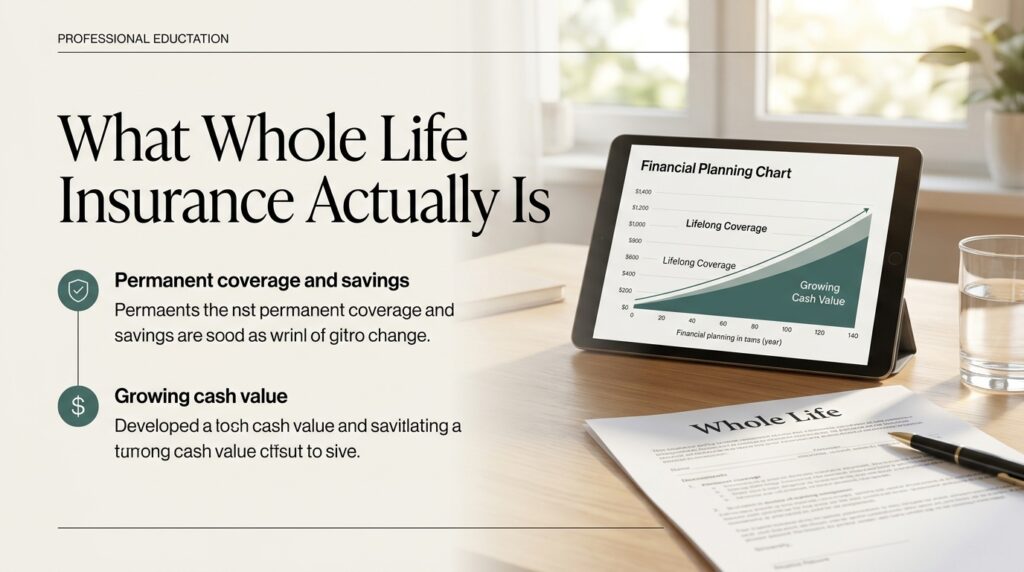
Whole life insurance, sometimes called whole of life insurance in the UK, works completely differently. Instead of covering you for a set number of years, it covers you for your entire life, as long as you keep paying the premiums. Because the insurer knows with certainty that they will eventually have to pay out, the pricing logic flips entirely. There is no bet on whether you will outlive the policy, since you never can.
On top of the guaranteed payout, most whole life policies also include a cash value component. A portion of every premium you pay goes into this cash value, which grows over time on a tax deferred basis and can, in many policies, be borrowed against or withdrawn later in life.
This combination, guaranteed lifelong coverage plus a built in savings element, is exactly why whole life insurance costs so much more than term.
The Actual Cost Difference
This is where the numbers really matter, and where the gap tends to surprise people who have not shopped for life insurance before.
In the US
For a healthy 35 year old non smoker looking for 500,000 dollars in coverage, a 20 year term policy commonly runs somewhere in the range of 25 to 40 dollars a month for men and slightly less for women. A whole life policy offering the same 500,000 dollars of coverage for the same person can run anywhere from roughly 400 to over 500 dollars a month, depending on the insurer and the specifics of the policy.
That works out to whole life premiums being somewhere between eight and fifteen times higher than an equivalent term policy for the same death benefit. As people age, the gap in dollar terms narrows somewhat because term premiums rise sharply for older applicants, but whole life still typically remains many times more expensive.
In the UK
The pattern looks very similar, even though the terminology and currency differ. For a healthy 30 year old non smoker, 250,000 pounds of level term cover over 25 years might cost somewhere around 10 to 15 pounds a month, which is a remarkably small amount for that level of protection.
A whole of life policy offering a comparable payout for the same person could easily run into the hundreds of pounds per month. As a general rule of thumb, whole of life insurance in the UK tends to cost somewhere between five and fifteen times more than an equivalent term policy, with the exact multiple depending heavily on the age at which the policy is purchased. The gap tends to narrow for older buyers simply because there is less time left before the insurer expects to pay out.
Where the Extra Money Actually Goes
It is worth understanding exactly what you are paying for with that higher whole life premium, because it is not simply a markup for the same protection.
Guaranteed payout. With term insurance, there is a real possibility the policy will expire with no payout at all if you outlive it. With whole life, the payout is essentially guaranteed as long as premiums continue, which is a fundamentally different and more valuable promise from the insurer’s perspective, and therefore priced accordingly.
Cash value growth. Part of every whole life premium builds up inside the policy as cash value, growing on a tax deferred basis. This can later be borrowed against, sometimes without the loan being treated as taxable income as long as the policy stays in force, or withdrawn up to the amount you have paid in.
Ongoing lifelong administration. Because whole life policies are designed to be managed for decades, sometimes a full lifetime, the insurer builds in costs for managing the policy over that entire period, not just a fixed term.
The trade off is straightforward in theory. You are paying substantially more for certainty and a savings component, versus paying much less for pure, temporary protection with nothing built in beyond the death benefit itself.
The Buy Term and Invest the Difference Strategy
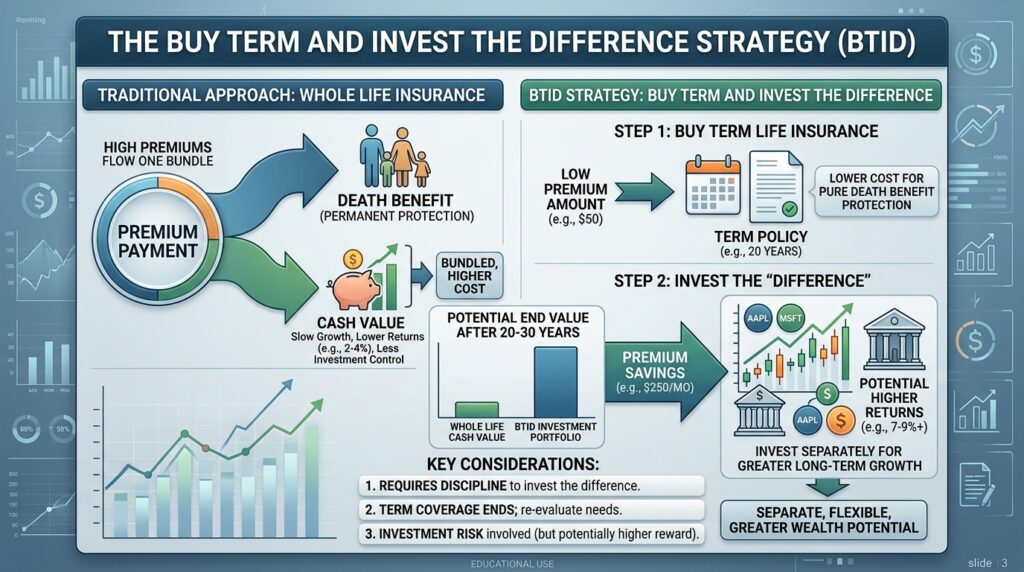
A commonly discussed strategy, particularly popular in the US, is often summarized as buy term and invest the difference. The idea is simple. Instead of paying the much higher premium for whole life insurance, you buy a much cheaper term policy for the same coverage amount, and then invest the monthly savings separately, typically in a retirement account or other investment vehicle.
The math behind this approach can be striking. Running the numbers for a 35 year old healthy non smoker with 500,000 dollars of coverage, some analyses suggest that investing the premium difference between term and whole life over the same period could result in an investment balance several times larger than the cash value that would have built up inside an equivalent whole life policy, assuming reasonable investment returns over that time frame.
This strategy is not automatically right for everyone though. It requires the discipline to actually invest the difference every single month rather than spending it, and it assumes reasonable investment growth over time, which is never guaranteed. It also means that once the term policy expires, if you still want life insurance coverage at that point, you will need to either renew at a much higher age based rate or go without coverage entirely, whereas a whole life policy would have simply continued.
When Term Life Tends to Make More Financial Sense

For the majority of people, particularly those in their working years with financial dependents, term life insurance tends to be the better value. It is generally well suited to the following situations.
You have a mortgage. A term policy, particularly a decreasing term policy in the UK where the coverage amount reduces roughly in line with your remaining mortgage balance, can be a cost effective way to make sure your mortgage would be paid off if something happened to you.
You have young or dependent children. Term life is commonly used to cover the years when children are financially dependent, typically until they become financially independent adults, at which point the need for a large death benefit often decreases.
You are working with a tight budget. Term insurance provides the highest amount of coverage for the lowest monthly cost, which matters a great deal for families who need substantial protection but cannot afford hundreds of dollars or pounds a month in premiums.
You want simplicity. Term life insurance is straightforward. You pay a fixed premium, you know exactly what it covers, and there are no cash value calculations, loan provisions, or investment performance to track.
You already have other investment vehicles. If you are already contributing to a pension, 401k, or other retirement account, term life paired with continued investing in those accounts often achieves better long term financial outcomes than folding your savings into a whole life policy.
When Whole Life Tends to Make More Financial Sense
Despite the higher cost, whole life insurance genuinely serves specific purposes that term insurance simply cannot cover, and for the right situation, it is worth the extra expense.
Estate and inheritance tax planning. This is one of the clearest use cases, particularly in the UK. If an estate is likely to face a substantial inheritance tax bill, a whole of life policy written in trust can provide the cash needed to pay that tax bill without forcing the family to sell off other assets. In the US, a similar approach applies for estates that exceed the federal estate tax exemption threshold, where permanent life insurance held inside an irrevocable trust can provide tax free liquidity precisely when it is needed.
A lifelong dependent. If you have a child or another dependent who will require financial support indefinitely, such as a dependent with a lifelong disability, a policy that never expires removes the risk of outliving your coverage at a point when the dependent still needs support.
Funeral and final expense coverage. Whole life, and in the UK specifically over 50s life cover, is commonly used simply to guarantee that funeral costs and other final expenses are covered no matter when death occurs, since these needs do not disappear as you age the way a mortgage or dependent children situation eventually does.
Business succession planning. For business owners, whole life insurance is sometimes used to fund buy sell agreements or key person insurance, where the permanent nature of the coverage matches the permanent nature of the business relationship being protected.
You have already maxed out other tax advantaged savings. For people who have already contributed the maximum to retirement accounts and are looking for additional tax deferred growth vehicles, the cash value component of a whole life policy can serve as one additional option, though it typically comes with higher fees and lower liquidity than standard investment accounts.
A Few Things Worth Checking Before You Decide
Before committing to either type of policy, a few practical steps can help you avoid an expensive mistake.
Look at conversion options on term policies. Many term policies include a conversion feature that allows you to switch to a whole life policy later, often without a new medical exam, typically within the first ten years or before a certain age. This can be valuable if your circumstances or needs change down the road, without needing to qualify for new coverage from scratch at an older age.
Consider combining both types. A common structure, especially for higher income families, is a larger term policy to cover temporary needs like income replacement or a mortgage, paired with a smaller whole life policy to cover permanent needs like final expenses or a modest inheritance.
Understand what happens to the cash value if the policy lapses. If you stop paying premiums on a whole life policy before it is fully paid up, you may lose some or all of the accumulated cash value, or the policy may lapse entirely depending on the terms. This is a serious consideration for anyone worried about affording the premium long term.
Put the policy in trust if inheritance tax is a concern. In the UK particularly, failing to write a life insurance policy in trust means the payout could become part of your estate and be subject to inheritance tax, as well as delayed by the probate process. Setting up a trust is usually free through the insurer and can save a meaningful amount for your beneficiaries.
Get quotes from multiple providers. Life insurance premiums vary considerably between insurers based on how each one weighs your age, health, occupation, and lifestyle factors. Comparing quotes across several companies, ideally through an independent broker, often reveals a meaningfully better rate than accepting the first quote you receive.
Final Thoughts
For most people, particularly those in their working years with a mortgage, young children, or other short to medium term financial obligations, term life insurance tends to provide considerably more value per pound or dollar spent, and pairing it with disciplined saving or investing elsewhere often produces a stronger overall financial outcome than folding everything into a whole life policy.
That said, whole life insurance is not simply an inferior product dressed up with a higher price tag. It solves specific, permanent problems, such as inheritance tax exposure, lifelong dependents, and guaranteed final expense coverage, that a policy with an expiration date cannot address. The right answer depends entirely on what you are actually trying to protect against, and for how long.
The most useful step before buying either type is to work out exactly what you need coverage for and for how many years that need is likely to last, then compare quotes for both types of policy based on that specific goal rather than a generic coverage amount. A clear picture of your actual situation will point you toward the option that saves real money rather than the one that simply sounds more comprehensive.
This article is for general informational purposes and is not financial or legal advice. Life insurance products, premiums, and tax treatment vary by provider, country, and individual circumstances, so it is worth speaking with a qualified financial adviser or licensed insurance professional before choosing a policy specific to your situation.