If you have started looking into investing, you have probably run into two terms over and over again, index funds and ETFs. They get mentioned constantly by financial writers, podcasts, and even friends who have started investing before you. But when you actually try to figure out the difference, things can get confusing fast, especially since the two options are more similar than people often explain.
This guide breaks it all down in plain language. By the end, you should understand what each one actually is, how they are alike, how they differ, and which one might make more sense for you as a beginner in the USA or the UK.
What Is an Index Fund
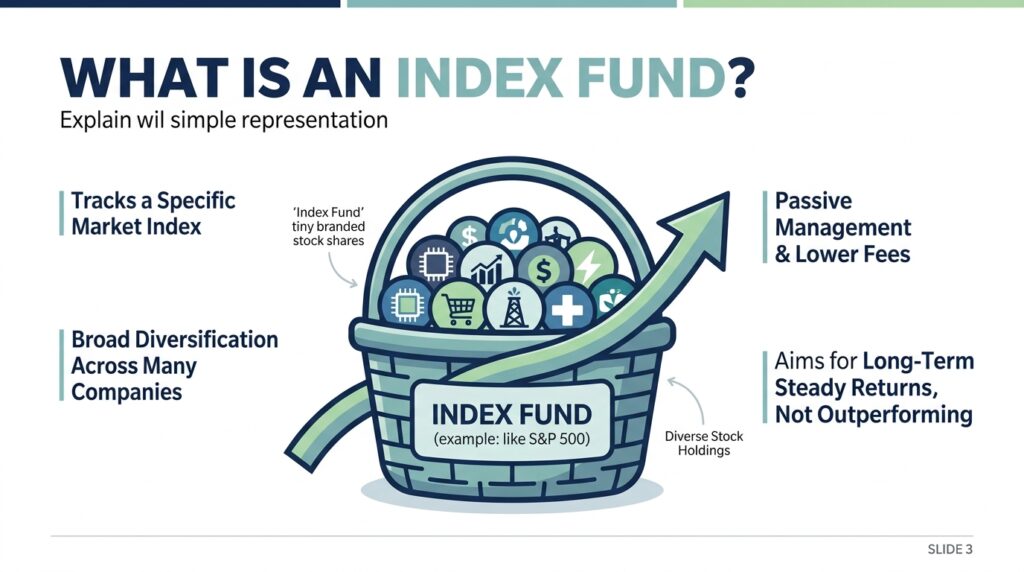
An index fund is a type of investment that tries to copy the performance of a specific market index. A market index is simply a list of companies grouped together to represent a section of the market. A well known example is the S&P 500 in the United States, which tracks five hundred of the largest companies listed on American stock exchanges. In the UK, a common example is the FTSE 100, which tracks the hundred largest companies listed on the London Stock Exchange.
Instead of trying to guess which individual stocks will do well, an index fund simply buys a little bit of every company in that index, in roughly the same proportion as the index itself. So if you invest in an S&P 500 index fund, you technically own a tiny slice of five hundred different companies, all through one single investment.
The appeal here is simplicity and broad exposure. Rather than betting on one or two companies, you are spreading your money across an entire section of the economy, which tends to reduce risk compared to picking individual stocks.
Traditional index funds are usually bought directly through a mutual fund company, or through your workplace retirement plan, and they are priced only once per day, after the market closes.
What Is an ETF
ETF stands for exchange traded fund. Just like an index fund, most ETFs also try to track a specific index, and many popular ETFs literally track the exact same indexes as popular index funds, such as the S&P 500 or the FTSE 100.
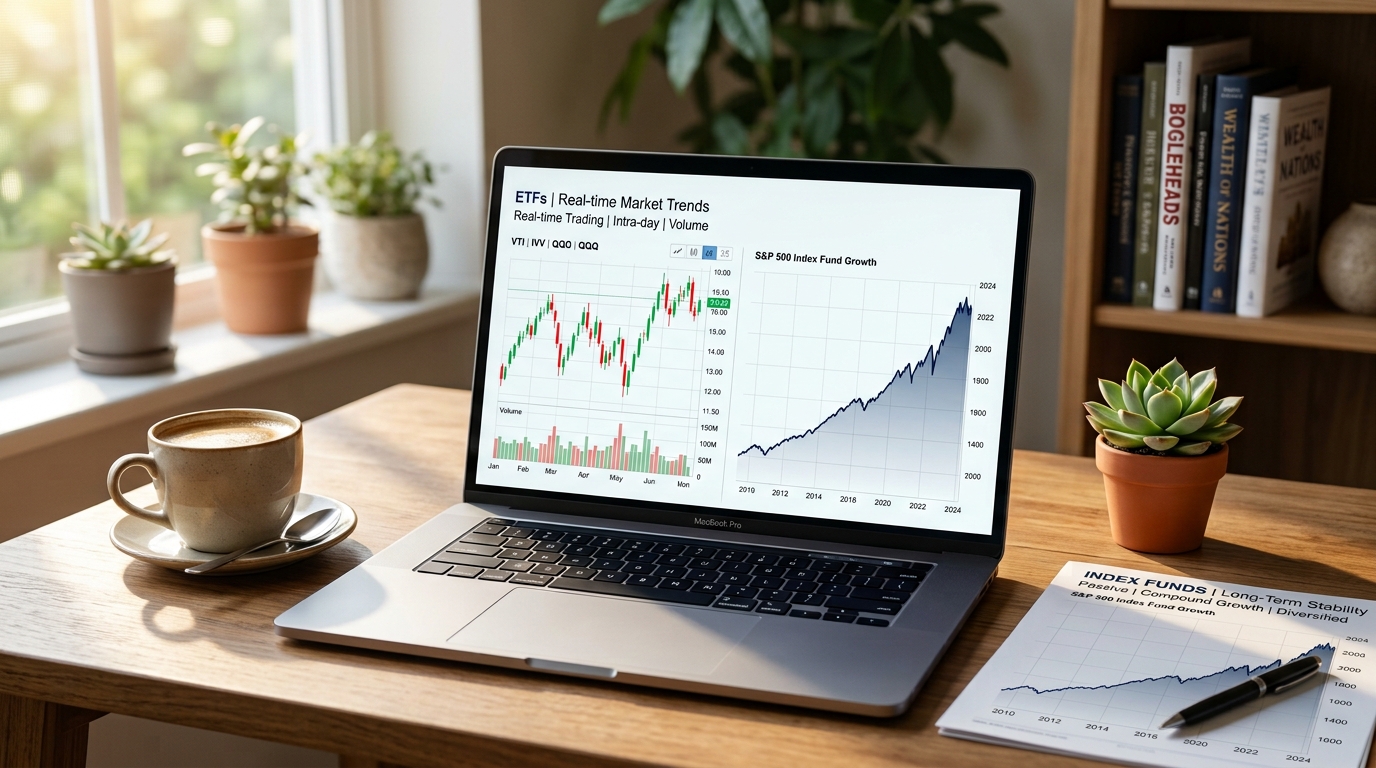
The big difference is how you buy and sell them. An ETF trades on a stock exchange throughout the day, just like a regular company share. You can buy or sell it any time the market is open, and the price moves constantly during the trading day based on supply and demand.
This means an ETF behaves like a hybrid. It gives you the broad diversification of an index fund, but it trades with the flexibility of an individual stock.
Because of this structure, buying an ETF usually requires a regular brokerage account, the same kind of account you would use to buy shares in a single company.
The Core Similarity Between the Two
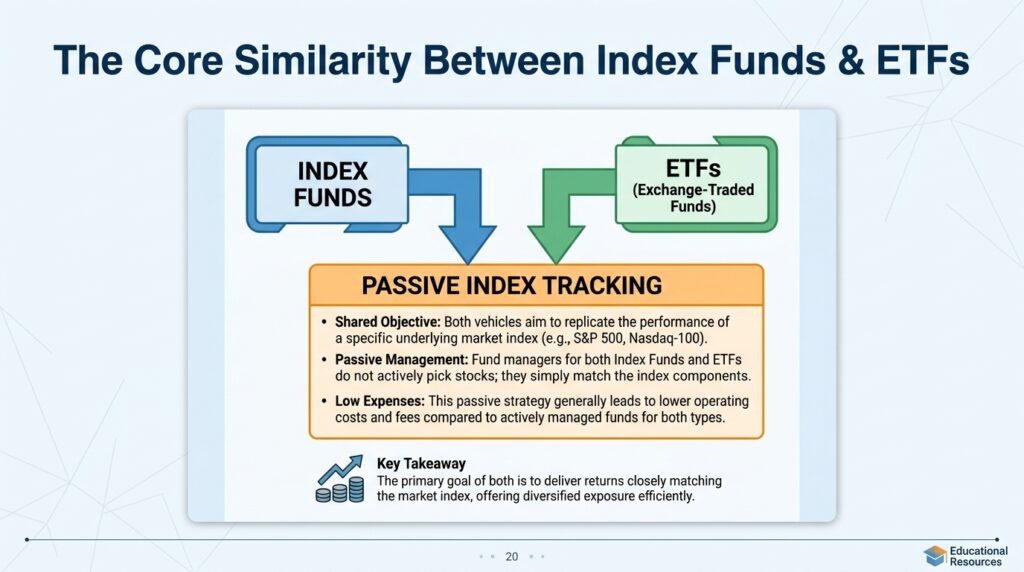
Here is the part that trips up a lot of beginners. In most cases, an index fund and an ETF that track the same index will hold basically the same investments and will perform almost identically over time. If you invest in an S&P 500 index fund or an S&P 500 ETF, you are essentially investing in the same five hundred companies either way.
This means the debate between index funds and ETFs is often less about performance and more about structure, cost, convenience, and how each one fits into your personal habits and goals.
Key Differences to Understand
Even though they are similar at their core, there are some real differences worth knowing about.
How They Are Traded
Index funds are priced once a day, after markets close, based on something called net asset value. When you place an order to buy or sell, it gets processed at that end of day price, regardless of what time you placed the order.
ETFs trade throughout the day at constantly shifting prices, just like a stock. This means you could technically buy in the morning and sell in the afternoon, capturing small price movements within a single day if you wanted to.
For most beginners who are investing for the long term, this difference does not matter much. You are not trying to time the market during the day. But it is worth understanding, since it explains why some people prefer one structure over the other.
Minimum Investment Amounts
Many traditional index funds require a minimum initial investment, which could be a set amount of money before you are even allowed to start. This minimum varies widely depending on the provider and the country.
ETFs generally do not have this kind of minimum. Instead, you simply buy however many shares you can afford, and many brokers now allow you to buy fractional shares, meaning you can invest even a small amount of money into an ETF that might otherwise cost more per share.
This makes ETFs particularly appealing for beginners who want to start small and add more money gradually over time.
Costs and Fees
Both index funds and ETFs are generally known for low costs compared to actively managed funds, but there can still be differences worth comparing.
Index funds charge something called an expense ratio, which is a small percentage of your investment taken each year to cover the cost of running the fund. Many popular index funds have very low expense ratios already, making them quite affordable.
ETFs also charge an expense ratio, and in many cases, this fee is just as low or even slightly lower than a comparable index fund. However, ETFs may involve a separate cost called a trading commission, which is a fee charged by your broker every time you buy or sell shares. Many brokers today offer commission free trading on ETFs, but it is worth double checking this with your specific broker before assuming it applies to you.
Index funds bought directly through a fund company sometimes avoid trading commissions altogether, since you are buying directly rather than through an exchange.
Tax Treatment
In the United States, ETFs often have a structural tax advantage compared to traditional index funds, particularly in a regular taxable brokerage account. This is due to the way ETF shares are created and redeemed behind the scenes, which tends to result in fewer taxable events being passed on to investors.
Index funds, particularly actively managed ones, can sometimes generate taxable capital gains distributions even if you did not sell any shares yourself, which can create an unexpected tax bill.
That said, this difference matters far less if you are investing inside a tax advantaged retirement account, such as a workplace pension in the UK or a retirement account in the US, since those accounts shield you from these yearly tax events regardless of which type of fund you choose.
Accessibility Through Retirement Plans
In the United States, many workplace retirement plans offer a limited menu of investment options, and this menu often includes index funds but does not always include ETFs. If most of your investing happens through a workplace plan, your choice might already be made for you, simply because ETFs are not available inside that particular plan.
If you are investing through a personal brokerage account instead, both options are usually available side by side, giving you full freedom to choose.
In the UK, both index tracker funds and ETFs are widely available through popular investment platforms, and many people build a portfolio using either one or a mix of both inside a stocks and shares individual savings account.
Which One Is Actually Easier for Beginners
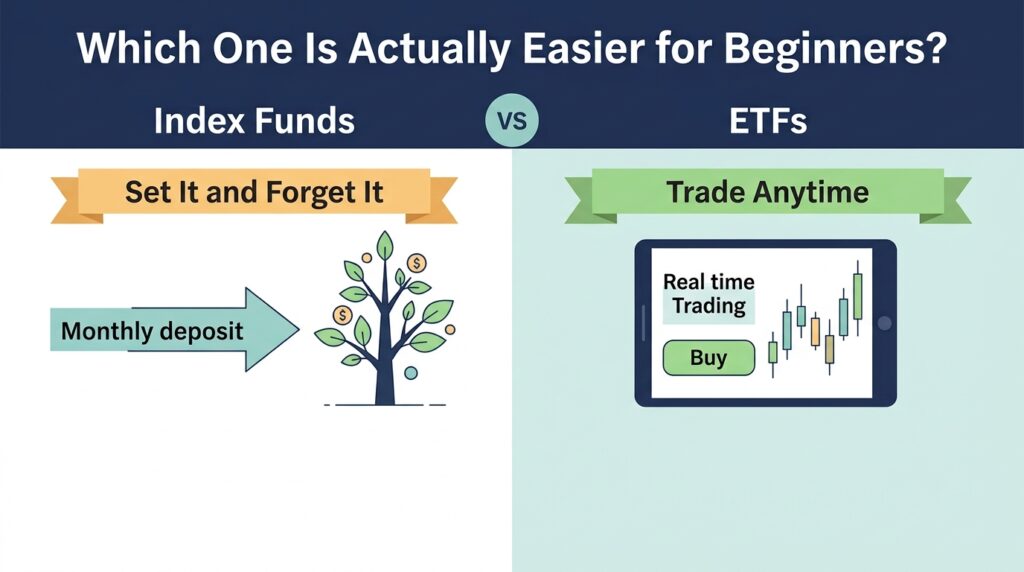
For someone brand new to investing, both options are genuinely beginner friendly, but each has slightly different strengths depending on your habits.
If you like the idea of setting up automatic contributions, where money is pulled from your bank account and invested regularly without you having to think about it, traditional index funds tend to make this a bit smoother, since many fund providers offer easy automatic investment plans built directly into their platforms.
If you prefer having full control over exactly when you buy, want to start with a very small amount of money, or want the flexibility of trading through a normal brokerage account alongside individual stocks, an ETF might feel more natural.
Neither choice is more advanced or more difficult than the other. The real complexity in investing comes from picking good, low cost, broadly diversified options in the first place, not from choosing between these two structures.
A Common Beginner Mistake to Avoid
One of the biggest traps beginners fall into is overthinking this decision. People sometimes spend weeks agonizing over index fund versus ETF, when the bigger decision that actually matters is choosing a broad, low cost, diversified investment in the first place, rather than something narrow, expensive, or overly complicated.
Whether you pick an index fund or an ETF that tracks the same broad index, your long term results will likely be very similar. The fees are usually small on both sides, and the underlying investments themselves are often nearly identical.
Instead of getting stuck on this choice, it is often more useful to focus your energy on other basics, such as making sure you are investing consistently, keeping your costs low overall, and giving your investments enough time to grow.
How to Decide for Your Own Situation
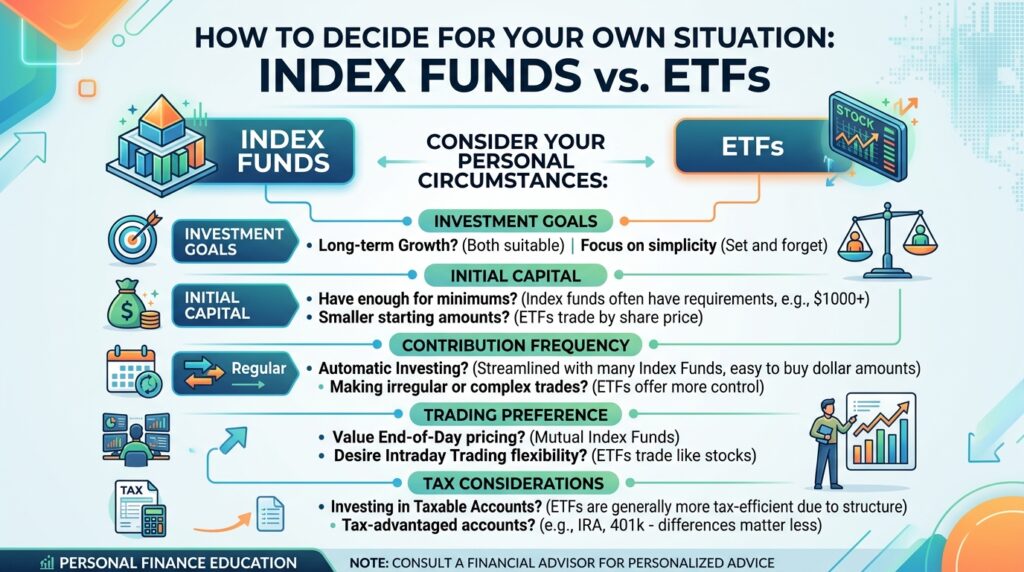
Since the two are so similar in outcome, here are a few simple questions that can help point you toward one or the other.
Ask yourself whether you already have a brokerage account or whether you are investing through a workplace retirement plan. If it is through a workplace plan, check what options are actually available to you first, since that may limit your choice already.
Ask yourself how much money you want to start with. If you only have a small amount to invest right now, an ETF with fractional share buying might let you get started immediately, rather than waiting until you save up to a fund minimum.
Ask yourself whether you want automatic recurring contributions set up without having to think about it regularly. If so, look into whether your chosen index fund provider makes this simple, since some do this more smoothly than typical ETF purchases.
Ask yourself whether you are investing inside a tax advantaged account like a retirement account or an individual savings account. If so, the tax differences between index funds and ETFs become far less important, freeing you to choose based on convenience alone.
Building a Simple Beginner Portfolio
For most beginners, the actual investment strategy can be refreshingly simple. A common approach is to choose one broad, low cost fund, whether an index fund or an ETF, that tracks a wide section of the stock market, such as a total market fund or a major index like the S&P 500 or FTSE 100.
From there, many people choose to add a second fund that tracks international markets outside their home country, giving them exposure to companies around the world rather than just one country.
Some beginners also choose to include a bond fund alongside their stock investments, which tends to be more stable, though usually with lower long term growth. The right mix between stocks and bonds often depends on your age, how soon you might need the money, and your comfort with market ups and downs.
Whatever mix you choose, the underlying principle stays the same. Pick broad, low cost, diversified funds, invest in them consistently over time, and try not to get distracted by short term market noise.
Final Thoughts
The debate between index funds and ETFs often gets more attention than it deserves, especially for beginners. In reality, both options can get you to the same destination, broad, low cost exposure to the stock market, just through slightly different paths.
Index funds tend to suit people who like automatic, hands off investing through a fund provider or a retirement plan. ETFs tend to suit people who want more flexibility, lower minimum amounts to get started, and the ability to buy and sell through a normal brokerage account.
Rather than spending too much time worrying about which one is technically better, the smarter use of your time as a beginner is choosing a broad, diversified fund you understand, setting up a habit of investing regularly, and letting time do the heavy lifting. Both index funds and ETFs are simply tools to help you get there, and either one, used consistently, can serve you well for years to come.
As with anything involving your money, it is worth doing a bit of your own research or speaking with a qualified financial professional before making decisions that fit your personal situation, since everyone’s goals, timeline, and comfort with risk are a little different.