

There is something genuinely appealing about the idea of your money paying you, without you having to do anything at all. You wake up, check your account, and a company you own a tiny piece of has just deposited cash into it, simply because you held onto your shares. That is the entire idea behind dividend investing, and it is one of the oldest, most straightforward ways to build a stream of passive income over time.
This guide will walk you through exactly how dividend investing works, why it appeals to so many long term investors, and how to actually build a portfolio that generates real income over the years. We will cover the practical details for both the United States and the United Kingdom, since tax rules and account types differ between the two, and those differences genuinely affect how much of your dividend income you actually keep.
Before we get started, an honest note. This article is meant to help you understand how dividend investing works so you can make better informed decisions. It is not personal financial or tax advice, and nothing here should be taken as a recommendation to buy any specific stock or fund. Always do your own research, and consider speaking with a licensed financial adviser about your specific situation.
What Is a Dividend, Really
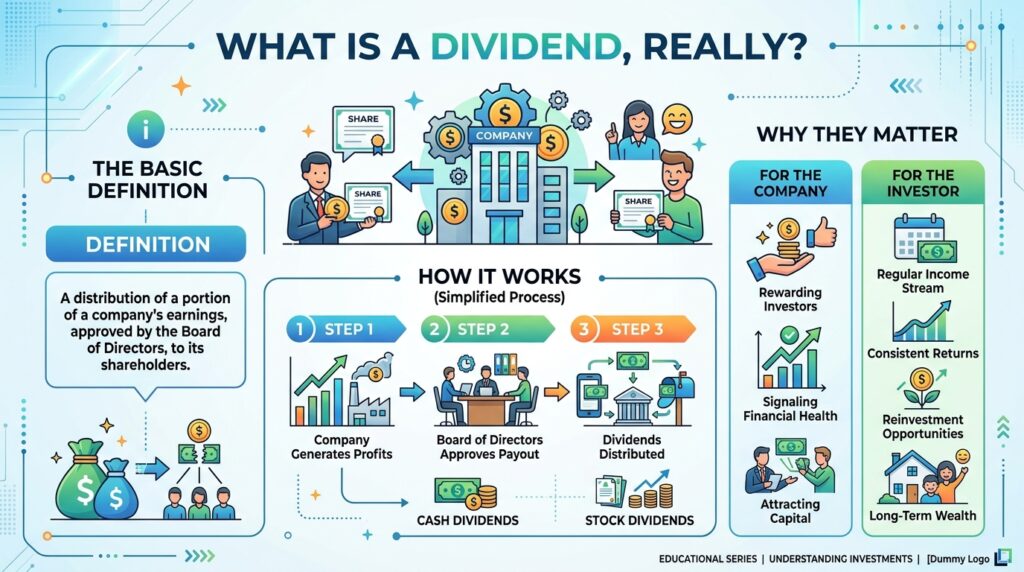
When a company earns a profit, its leadership has a choice to make. It can reinvest that profit back into the business, growing operations, opening new locations, or funding research. Or it can return some of that profit directly to shareholders in the form of cash payments, called dividends. Many mature, established companies do a bit of both, reinvesting enough to keep growing while returning a portion of profit to the people who own shares in the business.
A dividend is usually paid out per share, and it is typically paid every quarter in the US, though some companies pay monthly or semi annually, and many UK companies pay twice a year. If you own one hundred shares of a company that pays a dividend of fifty cents per share each quarter, you receive fifty dollars every three months, completely separate from whatever the share price happens to be doing that day.
This is the part that makes dividend investing so appealing to a lot of people. Your dividend income does not depend on you selling anything. The stock price can go up, down, or sideways, and as long as the company keeps paying its dividend, that cash keeps showing up in your account.
Why People Build Dividend Portfolios
There are a few genuinely good reasons dividend investing has stayed popular for generations, even as flashier investment trends have come and gone.
The first is that dividend income feels tangible in a way that unrealized stock gains do not. Watching a portfolio grow on paper is nice, but it does not put money in your pocket until you sell. A dividend payment is real cash, arriving on a schedule, that you can spend, reinvest, or save, without ever having to sell a single share.
The second reason is that companies which consistently pay and grow their dividends tend to be financially disciplined businesses. A company cannot fake a dividend payment for very long. It has to generate real, sustainable cash flow to keep sending money out the door quarter after quarter. This tends to filter dividend focused portfolios toward more established, financially stable companies, which many investors find reassuring, especially compared to chasing more speculative, unprofitable growth stocks.
The third reason is retirement planning. A portfolio that generates enough dividend income can effectively replace a paycheck, without you needing to sell down your underlying investments to fund your life. This is often described as living off the income rather than living off the principal, and it is a genuinely appealing goal for a lot of people planning for retirement or general financial independence.
Dividend Growth vs Dividend Yield
Before picking any dividend stocks or funds, it helps to understand an important distinction that trips up a lot of new investors. There is a real difference between a stock’s dividend yield and its long term total return.
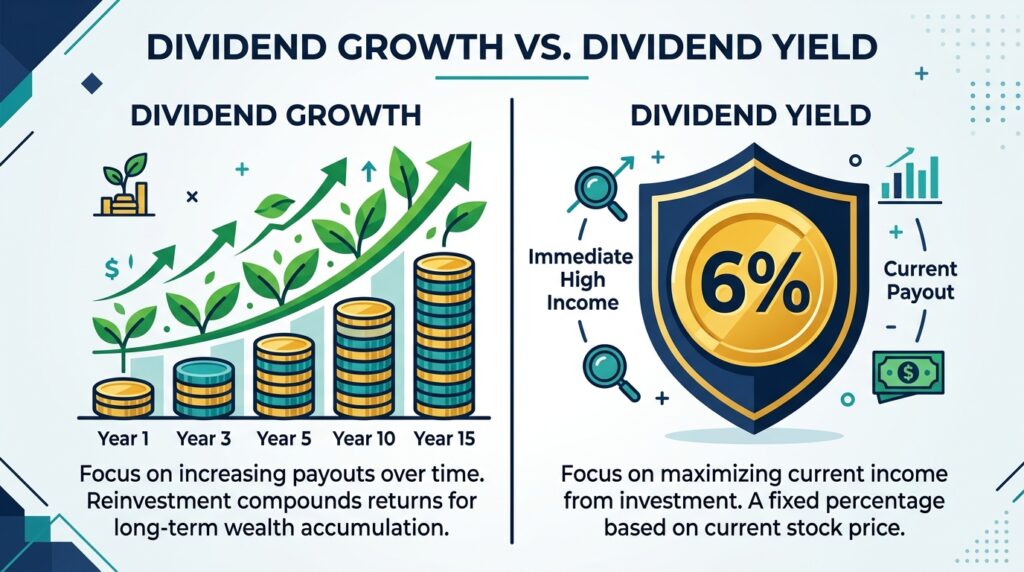
Yield is simply the annual dividend divided by the current share price, expressed as a percentage. A stock trading at one hundred dollars paying four dollars a year in dividends has a four percent yield. It is tempting to simply go shopping for the highest yield you can find, but this can be a trap. Extremely high yields are sometimes a warning sign rather than a bargain, since a falling share price mechanically pushes the yield higher even while the underlying business is struggling, and a company under financial pressure is exactly the kind of company that eventually cuts its dividend.
A more reliable long term approach many investors favor is dividend growth investing, which focuses on companies with a strong history of not just paying a dividend, but consistently increasing it year after year. A company that started at a modest two percent yield but has raised its dividend by eight percent annually for two decades can end up paying you far more relative to your original purchase price than a stock that started at a flashy seven percent yield but never grew, or worse, eventually got cut.
This is often described using a metric called yield on cost, which compares your current dividend income to what you originally paid for the shares, rather than to the current share price. Over long periods, dividend growth investors often end up with a yield on cost that dwarfs anything available from a new purchase today, simply because their income kept growing year after year while their original cost stayed fixed.
Dividend Aristocrats, Achievers, and Kings
You will likely come across these terms while researching dividend stocks, so it is worth knowing what they mean. A Dividend Aristocrat is a company within the S&P 500 that has increased its dividend every single year for at least twenty five consecutive years. As of 2026 there are roughly sixty six companies that hold this title, representing a relatively small slice of the overall index, which reflects just how demanding this level of consistency really is, surviving multiple recessions and economic downturns without ever cutting the dividend.
A Dividend King goes even further, representing companies that have raised their dividend every year for fifty consecutive years or more. Household names like Coca Cola, Johnson and Johnson, and Procter and Gamble are commonly cited examples of companies with this kind of remarkably long streak.
These lists are a genuinely useful starting point for research, since the underlying screening criteria, decades of uninterrupted dividend growth, tends to surface financially resilient businesses. That said, past consistency is not a guarantee of future performance, and it is still worth looking at each company’s current financial health rather than assuming a long streak alone is enough.
Individual Stocks vs Dividend Funds
Once you understand the basic idea, the next decision is how you actually want to build your dividend portfolio. Broadly, you have two paths.
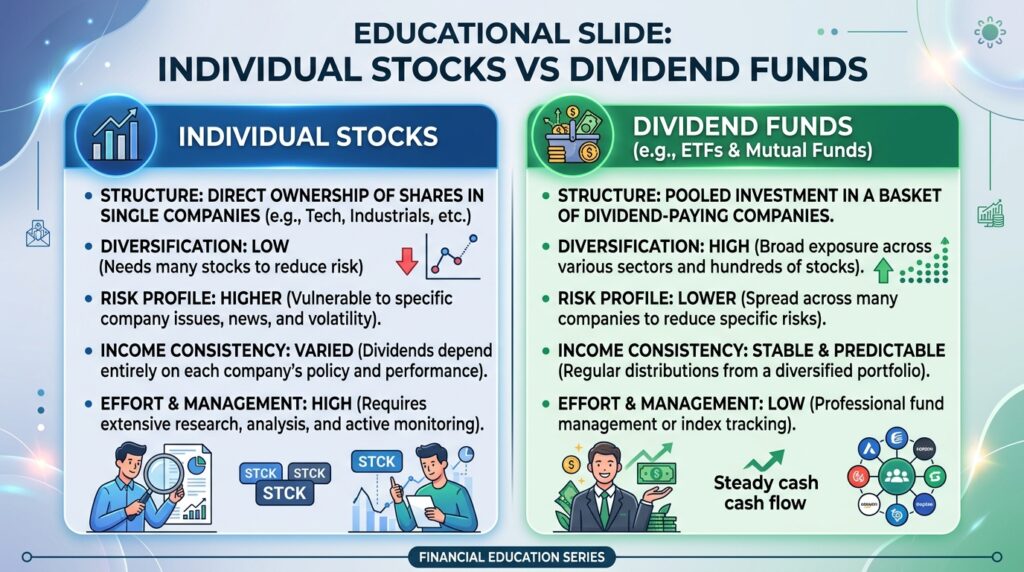
Picking individual dividend paying stocks lets you build a highly customized portfolio and potentially benefit from unusually strong dividend growth from a company you have researched carefully. The downside is that your income depends heavily on the health of each individual business, and a single dividend cut from one holding can meaningfully affect your overall income if that stock makes up a large chunk of your portfolio.
Dividend focused exchange traded funds, or ETFs, spread your money across dozens or hundreds of dividend paying companies at once, in a single purchase. This dramatically reduces the impact if any single company cuts its dividend, since it is now just one small piece of a much larger basket. Popular examples in the US include funds tracking dividend growth indexes or dividend aristocrat indexes, which hold the type of long streak companies described above. In the UK, similar income focused funds and investment trusts exist that track UK or global dividend paying companies, and many UK investors also gain income exposure through broad FTSE 100 tracker funds, since a large share of the index’s constituent companies are well known, consistent dividend payers.
For most people just starting out, a diversified dividend fund is usually the more practical starting point, since it removes the pressure of correctly picking individual winners and instead relies on broad, ongoing exposure to a large group of income generating companies.
Real Estate Investment Trusts
It is worth mentioning REITs, short for real estate investment trusts, separately, since they are a popular way to add dividend income to a portfolio without directly owning property yourself. REITs are companies that own and manage income producing real estate, such as apartment buildings, shopping centers, warehouses, or offices, and by law in the US they are required to distribute at least ninety percent of their taxable income to shareholders as dividends. This structural requirement tends to make REITs pay noticeably higher yields than typical dividend stocks.
The trade off is that REIT dividends are usually taxed as ordinary income in the US rather than receiving the more favorable qualified dividend tax treatment, which is worth factoring in if you are holding REITs in a regular taxable brokerage account rather than a retirement account. REITs can be a genuinely useful diversification tool within a broader dividend portfolio, since real estate income tends to behave a little differently than corporate earnings from other sectors, but they are best treated as one ingredient rather than the entire strategy.
Dividend Reinvestment, Often Called DRIP
One of the most powerful tools available to dividend investors is dividend reinvestment, commonly shortened to DRIP. Instead of taking your dividend payments as cash, you automatically use them to buy more shares of the same stock or fund, often without paying any trading fee at all.
The effect compounds over time in a way that can feel almost invisible at first, then surprisingly dramatic later on. Each reinvested dividend buys you a few more shares, which then generate their own dividend the following quarter, which buys even more shares, and so on. Over ten, twenty, or thirty years, this snowball effect can meaningfully outpace simply taking the cash and spending it, since your share count, and therefore your future dividend income, keeps growing on autopilot the entire time.
A common long term strategy is to reinvest dividends aggressively during your working years, letting your share count and income grow as large as possible, then switch off reinvestment once you actually need the income, at which point the dividends simply arrive as spendable cash instead of buying more shares.
How Dividends Are Taxed in the US
Understanding dividend taxation is genuinely important, since it directly affects how much of your dividend income you actually get to keep, and the type of account you hold your investments in matters just as much as which stocks or funds you choose.
In the US, dividends fall into two broad categories. Qualified dividends receive favorable tax treatment, taxed at the same rates as long term capital gains, which works out to zero, fifteen, or twenty percent depending on your overall income, rather than your regular income tax rate. To count as qualified, you generally need to have held the underlying stock for more than sixty days during the one hundred twenty one day period surrounding the ex dividend date, which is the cutoff date that determines who receives the next dividend payment.
Ordinary, or non qualified, dividends are taxed at your regular income tax rate, which can range anywhere from ten to thirty seven percent depending on your bracket. REIT dividends, as mentioned earlier, typically fall into this ordinary category, which is worth keeping in mind when deciding where to hold them.
Higher earners should also be aware of the Net Investment Income Tax, an additional three point eight percent tax that can apply to dividend income once your modified adjusted gross income exceeds two hundred thousand dollars for single filers or two hundred fifty thousand dollars for married couples filing jointly.
The single most effective way to avoid dividend taxes entirely in the US is to hold your dividend paying investments inside a tax advantaged retirement account, such as a Roth IRA, where qualifying withdrawals in retirement are completely tax free, or a traditional IRA or 401k, where the tax is simply deferred until you eventually withdraw the money. For many dividend investors, prioritizing these accounts before building a large taxable dividend portfolio makes a genuinely significant difference over the long run.
How Dividends Are Taxed in the UK
The UK system works differently, but the underlying logic of using tax advantaged accounts is just as important. Every UK taxpayer gets a dividend allowance, which sits at five hundred pounds for the 2026 to 2027 tax year. Dividend income up to that amount is tax free, regardless of your income tax band.
Above that allowance, the rate you pay depends on your overall income tax band. As of the 2026 to 2027 tax year, basic rate taxpayers pay ten point seven five percent on dividends above the allowance, higher rate taxpayers pay thirty five point seven five percent, and additional rate taxpayers pay thirty nine point three five percent. These rates rose by two percentage points from the previous tax year, following changes announced at the Autumn Budget, so it is worth double checking the current figures each year since these thresholds and rates can and do change.
By far the simplest way to avoid this tax altogether is investing through a Stocks and Shares ISA. Any dividends earned on investments held inside an ISA are completely tax free, no matter how large the amount, and they do not count toward your five hundred pound dividend allowance at all. The ISA subscription limit for 2026 to 2027 is twenty thousand pounds per person, which can be split across different types of ISAs, but once money is inside a Stocks and Shares ISA, the dividends it generates going forward are permanently shielded from tax, with no cap on how large that pot can eventually grow. Given how meaningful this benefit becomes over a couple of decades, using your ISA allowance is generally considered one of the smartest first moves any UK dividend investor can make, well before building a large dividend portfolio in a general investment account.
Pensions, including workplace pensions and SIPPs, work similarly, sheltering dividends from tax while the money remains inside the pension, with tax instead applying when you eventually withdraw funds in retirement.
How Much Do You Actually Need to Live Off Dividends
This is the question most people building a dividend portfolio eventually want answered, and the math is fairly simple once you have a target income in mind. If you want your dividends to cover a certain amount of your annual expenses, you divide that target by your portfolio’s average yield to get a rough idea of how large your portfolio needs to become.
For example, if you are aiming for forty thousand dollars a year in dividend income and your portfolio yields around three and a half percent on average, you would need roughly one point one million dollars invested to hit that target, before accounting for taxes. This is exactly why dividend growth matters so much over long time horizons. A portfolio built up over twenty or thirty years, reinvesting along the way, ends up with a much higher yield on cost than the current market yield would suggest, meaning you often need less total capital than a simple snapshot calculation implies, since your income has been compounding the entire time rather than starting fresh today.
It is worth running these numbers for your own specific goals rather than relying on someone else’s rule of thumb, since your required portfolio size depends heavily on your target income, your expected yield, and how long you have to build toward it.
Building Your Own Dividend Strategy, Step by Step
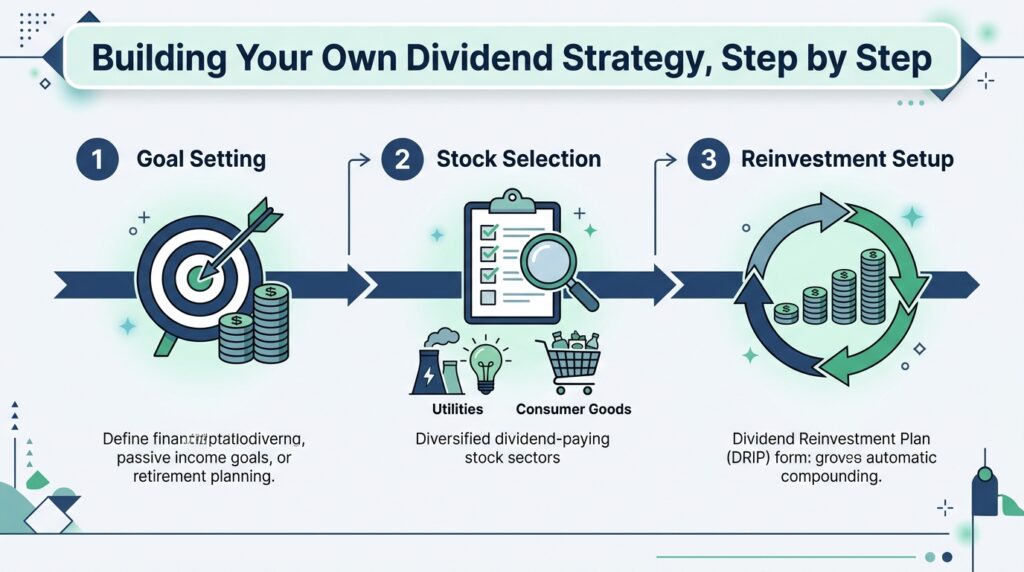
Start by deciding whether you are investing inside a tax advantaged account first, such as a Roth IRA or 401k in the US, or a Stocks and Shares ISA or pension in the UK, since this decision alone can meaningfully change how much of your income you actually keep over time.
Decide whether you want to build your portfolio through individual dividend stocks, diversified dividend funds, or a mix of both. For most beginners, starting with a broad, low cost dividend fund and gradually adding individual stocks as you gain confidence and research experience tends to be a sensible path.
Prioritize consistency and dividend growth over the highest available yield. A moderate, reliably growing dividend tends to outperform a flashy, unstable one over long periods, and it is far less stressful to hold through market downturns.
Turn on dividend reinvestment while you are still working and do not need the income yet, letting compounding do the heavy lifting for you over the years ahead.
Revisit your portfolio periodically rather than checking obsessively. Dividend investing rewards patience far more than it rewards constant tinkering, and some of the best long term dividend investors are famous for barely touching their portfolios for years at a time.
A Few Honest Things to Keep in Mind
Dividend investing is not magic, and it is not free of risk. Companies can and do cut their dividends during difficult periods, and even long standing Dividend Aristocrats occasionally break their streaks during severe economic shocks. A high yield alone is never a guarantee of safety, and it is worth looking at a company’s payout ratio, which measures how much of its earnings are being paid out as dividends, since a company paying out an unsustainably high share of its profits has much less room to weather a rough year without cutting its payment.
It is also worth remembering that total return, meaning dividends plus any change in share price, is what ultimately matters for your overall wealth, not dividend income in isolation. A stock with a small yield but strong consistent growth can genuinely outperform a high yield stock whose share price is stagnant or declining, so it is worth evaluating dividend investments as part of your broader long term returns rather than focusing purely on the size of the quarterly check.
Final Thoughts
Dividend investing rewards exactly the kind of patient, boring consistency that tends to work well in almost every corner of long term investing. Pick quality companies or funds with a genuine history of sustainable, growing payouts, use the tax advantaged accounts available to you, reinvest while you can, and give the whole process real time to compound. None of this requires predicting the market or picking the next big winner. It simply requires choosing solid, reliable businesses, being patient, and letting the years do the heavy lifting.
Building a meaningful stream of passive income through dividends is genuinely achievable for an ordinary investor willing to start early and stay consistent. It will not happen overnight, and it is not a shortcut to getting rich quickly, but for those willing to play the long game, it remains one of the most dependable ways to eventually have your investments quietly working for you in the background of your life.
This article is for general information only and is not personal financial, investment, or tax advice. Tax rates, allowances, and specific product details change over time and vary based on individual circumstances, so always confirm current figures and consider speaking with a qualified financial adviser before making investment decisions.