
If you are lying awake at night doing math on debts that never seem to shrink, you are far from alone. Millions of people in the US and the UK are carrying credit card balances, personal loans, and overdrafts that have quietly grown past the point where minimum payments actually make a dent. At some point, most people in that position start seeing ads for debt relief programs promising to slash what they owe, settle for pennies on the dollar, or wipe the slate clean entirely.
Some of those programs are genuinely helpful. Others are expensive, slow, and can leave you worse off than when you started. The honest truth is that debt relief is not one single thing. It is an umbrella term covering several very different approaches, each with its own costs, timelines, and consequences for your credit and your finances.
This guide will walk through exactly what debt relief actually means, break down the main options available in both the US and the UK, and help you think through which category, if any, might fit your situation. We will also cover the warning signs of predatory companies, since unfortunately this is an industry where scams and aggressive sales tactics are common.
One important note before we begin. This article explains how these programs generally work so you can ask better questions and make a more informed decision. It is not personal financial, legal, or credit advice. Your own debts, income, and goals matter enormously here, and speaking with a genuinely independent, nonprofit credit counselor or a qualified debt adviser before committing to anything is one of the smartest first steps you can take.
What Debt Relief Actually Means
Debt relief is a broad term for any structured approach to reducing, restructuring, or paying off debt that has become difficult to manage through normal monthly payments alone. It is not a single product. It includes everything from a free, informal repayment plan run by a nonprofit charity, all the way to formal legal processes like bankruptcy. Understanding which category a specific option falls into is the first step to figuring out whether it fits your situation.
Broadly speaking, most debt relief options fall into a few buckets. There is credit counseling and debt management, which focuses on repaying what you owe in full but on better terms. There is debt consolidation, which combines multiple debts into one, ideally at a lower interest rate. There is debt settlement, which negotiates to pay back less than the full amount owed. And there are formal legal processes, bankruptcy in the US, and several distinct routes in the UK, which offer legal protection and, in some cases, complete debt forgiveness under specific conditions.
Each of these comes with real trade offs. None of them are free in the sense of costing you nothing at all, whether that cost shows up as fees, a damaged credit report, tax implications, or simply years of your life spent working through a structured plan.
Credit Counseling and Debt Management Plans
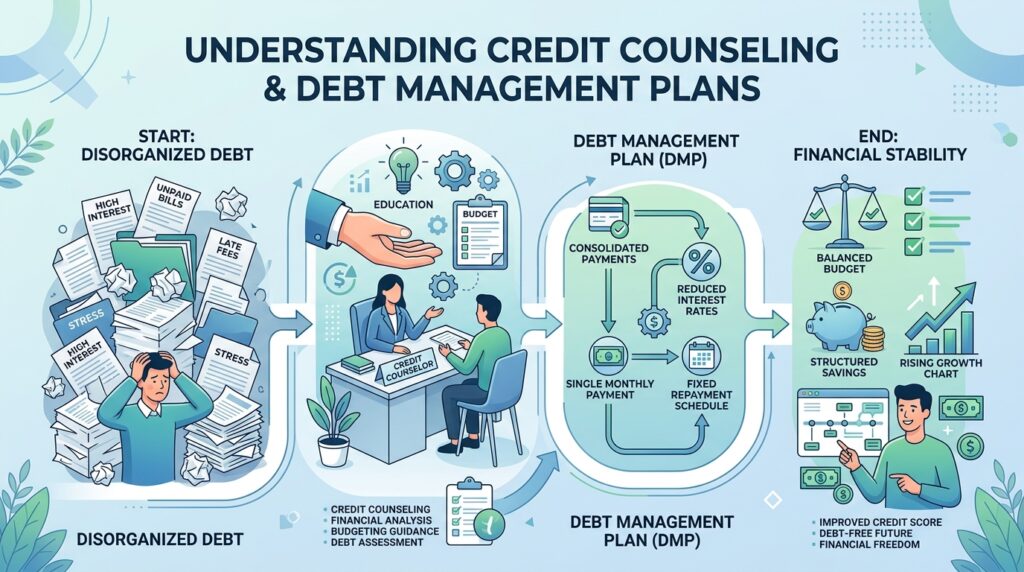
This is usually the gentlest and least risky starting point, and it is genuinely worth exploring before considering anything more drastic.
In the US, nonprofit credit counseling typically starts with a free session, often thirty to sixty minutes, where a certified counselor reviews your income, your debts, and your monthly budget. Reputable agencies are accredited through organizations like the National Foundation for Credit Counseling or the Financial Counseling Association of America, and this initial session does not cost anything or affect your credit at all.
If the counselor believes a structured plan would help, they may recommend a Debt Management Plan, often shortened to DMP. Under a DMP, the agency negotiates directly with your creditors to lower your interest rates, sometimes down into the single digits, and consolidates your various debts into one single monthly payment that you send to the agency, which then distributes the money to each of your creditors. Crucially, you are still repaying the full amount you originally owed. You are simply doing it on friendlier terms, with lower interest and one simplified payment instead of juggling several.
Because you continue paying back everything you owe, credit counseling and DMPs tend to be gentler on your credit report than settlement or bankruptcy. Your accounts generally continue reporting as current rather than delinquent, as long as you keep up with the plan. The setup and monthly administration fees charged by a legitimate nonprofit agency are usually modest, often capped well under one hundred dollars a month.
In the UK, the equivalent structure is also called a Debt Management Plan. It is an informal agreement to repay your debts in full at a reduced monthly payment, and it comes with no fixed time limit, since you simply keep paying until your debts are cleared. Genuinely free DMPs are available through well known charities such as StepChange Debt Charity and National Debtline, and these free services generally produce the same outcome as a paid commercial provider, which is exactly why UK debt advisers consistently recommend using a free option rather than paying a company for the same basic service.
A DMP in either country tends to suit people who have decent income relative to their debt, want to simplify multiple payments into one, and can realistically commit to repaying everything owed over a period of several years, just on friendlier terms than their original agreements.
Debt Consolidation
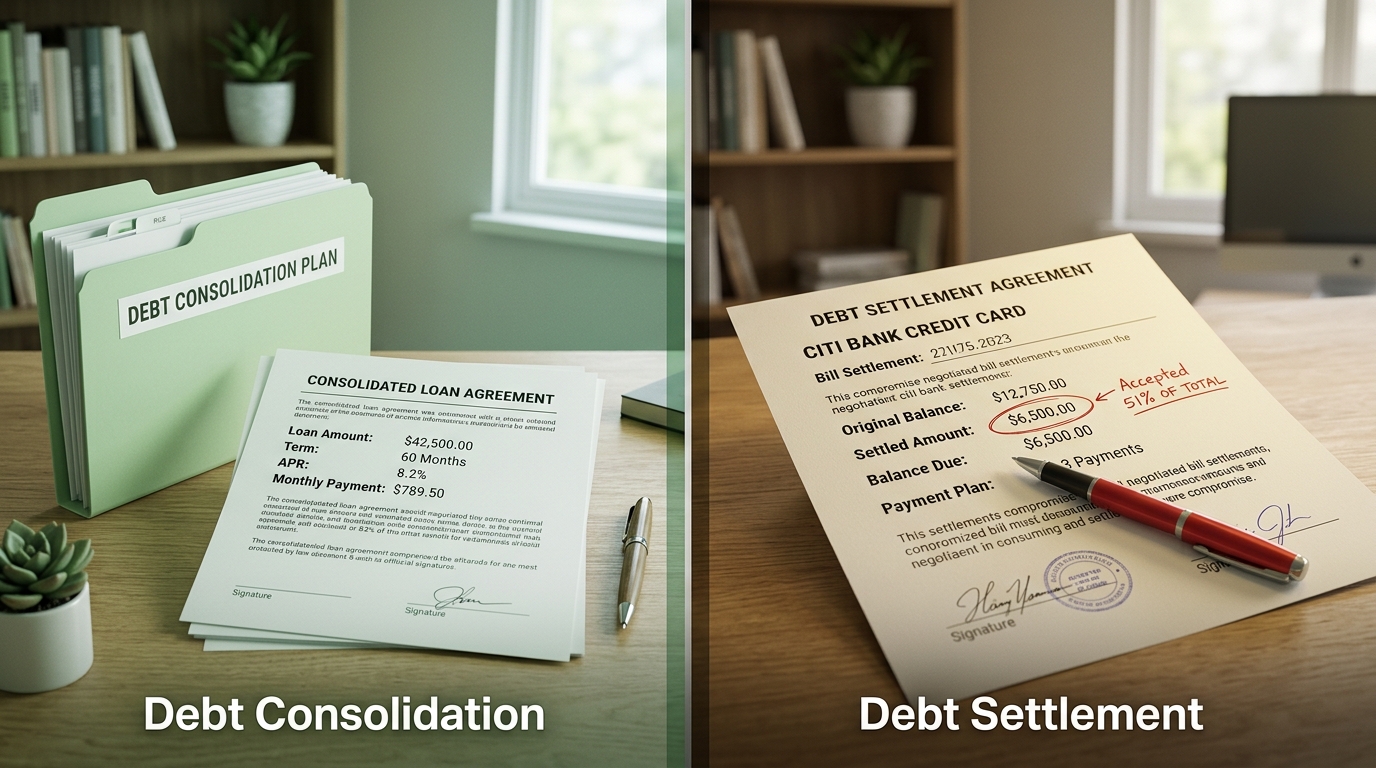
Debt consolidation works on a similar principle to a DMP, combining multiple debts into one, but it does so through a new loan rather than a negotiated arrangement with your existing creditors.
A debt consolidation loan pays off your existing debts entirely, replacing them with a single new loan, ideally at a lower interest rate than what you were paying across your various cards and loans. This can genuinely save you money and simplify your monthly bills, but it depends heavily on actually qualifying for a meaningfully better rate, which usually requires reasonably good credit to begin with. If your credit has already taken a hit from missed payments, you may only qualify for a consolidation loan at a rate similar to, or even higher than, what you are already paying, which defeats the purpose entirely.
A balance transfer credit card is a related option, particularly popular for people with good credit, allowing you to move existing credit card balances onto a new card offering a low or zero percent introductory rate for a limited period, often twelve to eighteen months. This can be a genuinely powerful tool if you can realistically pay off the balance before the promotional period ends, but it can backfire if the balance is still sitting there once the standard, much higher interest rate kicks back in.
Because consolidation involves paying back the full amount you owe, it generally has a smaller impact on your credit than settlement or bankruptcy, and it may even help your score over time if you make consistent, on time payments on the new loan.
Debt Settlement
This is where things get considerably riskier, and it deserves careful attention since it is heavily advertised and often misunderstood.
Debt settlement companies negotiate with your creditors to accept less than the full balance you owe, often settling for somewhere around half of the original amount, though outcomes vary significantly and there is genuinely no guarantee any specific creditor will agree to a reduced payoff at all. In the US, most debt settlement companies require a minimum debt load, often around seven thousand five hundred to ten thousand dollars, and typically only work with unsecured debt, meaning credit cards and personal loans rather than anything backed by collateral like a car or a house.
Here is the part that trips a lot of people up. Debt settlement companies generally do not pay your creditors directly from month one. Instead, you make monthly payments into a dedicated savings account, building up a lump sum over time, which the company then uses to negotiate a settlement once enough funds have accumulated. During this entire buildup period, you are typically not paying your original creditors at all, which means your accounts are actively becoming delinquent, your credit score is dropping, and you may face collection calls or even lawsuits from creditors who have not yet agreed to settle.
This is exactly why debt settlement carries some of the most significant credit damage of any option on this list, generally on par with bankruptcy in terms of the hit to your score. There is also a genuine tax wrinkle worth knowing about. In the US, any forgiven debt over six hundred dollars is generally reported to the IRS as taxable income, meaning you could owe taxes on the amount that was settled away, which comes as an unwelcome surprise to a lot of people who assumed a settlement simply made the debt disappear entirely.
If you do decide to explore debt settlement, it is worth specifically looking for a company accredited through organizations like the American Fair Credit Council and holding a strong rating with the Better Business Bureau, and reading every fee disclosure carefully, since fees are typically charged as a percentage of either your total enrolled debt or the amount actually saved through settlement, and these fees can add up to a meaningful chunk of whatever savings the settlement produced in the first place.
Debt settlement tends to make the most sense as something closer to a last resort, for people who genuinely cannot afford their current payments, do not qualify for a consolidation loan, and would otherwise be heading toward bankruptcy anyway. For people with only a moderate amount of debt who could realistically pay it off through a DMP or consolidation instead, settlement is usually not the better choice, given the credit damage and tax exposure involved.
US Bankruptcy
Bankruptcy is a formal legal process, and while the word carries a lot of stigma, it exists precisely because sometimes debt genuinely cannot be repaid through any of the options above, and the law recognizes that people deserve a structured, legally protected path to a fresh start.
Chapter 7 bankruptcy, sometimes called liquidation bankruptcy, can wipe out most unsecured debt relatively quickly, often within a few months, though it may require selling certain non exempt assets to partially repay creditors, and it works best for people with little in the way of valuable assets and mostly unsecured debt to begin with.
Chapter 13 bankruptcy instead sets up a court supervised repayment plan lasting three to five years, based on a portion of your income, and it can offer meaningful legal protection, for example giving you breathing room to catch up on a mortgage while stopping foreclosure proceedings in their tracks.
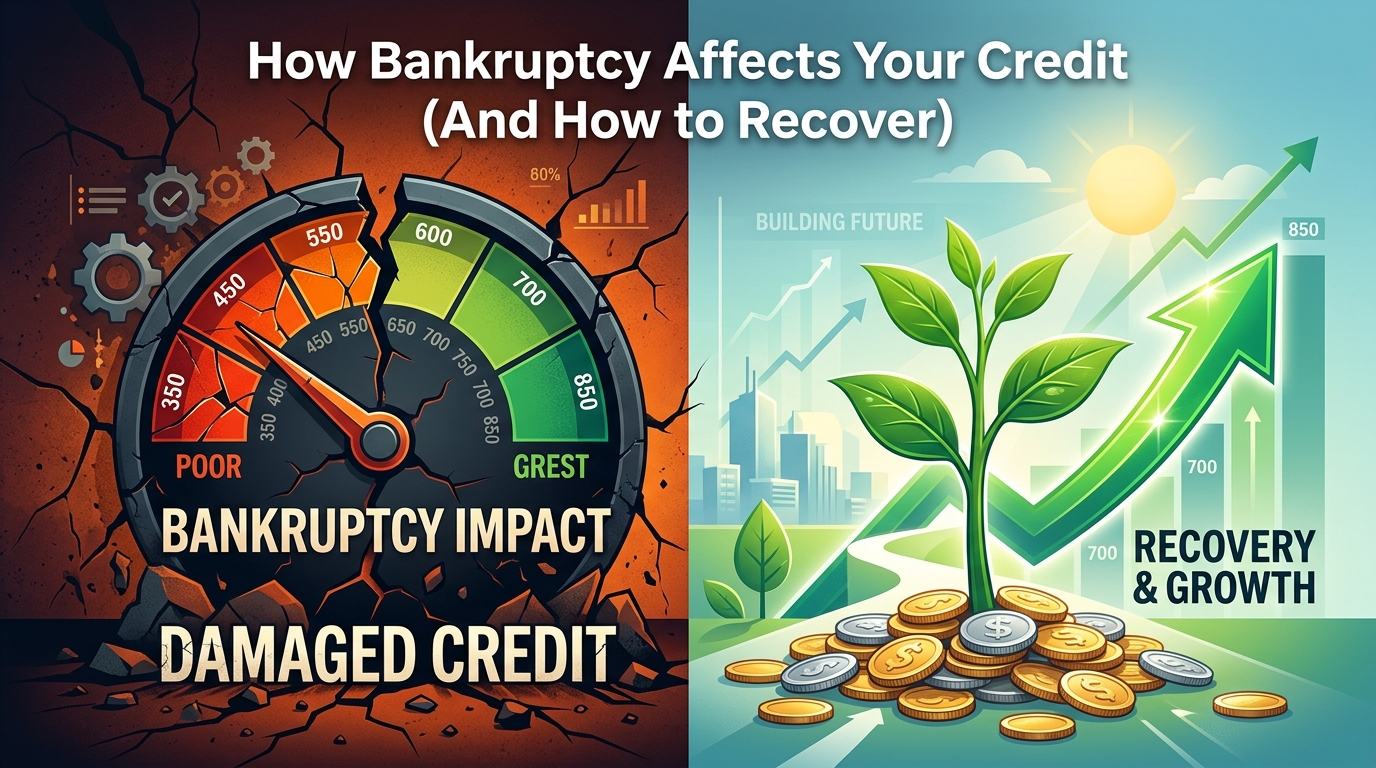
Bankruptcy causes a significant, long lasting hit to your credit report, generally the most severe of any option covered here, and it comes with real restrictions and consequences worth understanding fully before filing. That said, for people with overwhelming debt relative to their income and few realistic alternatives, it can also be the fastest, most legally certain path to genuinely starting over, with legal protections that voluntary arrangements like settlement simply cannot offer.
The UK’s Formal Debt Solutions
The UK has its own set of formal, legally recognized routes that work quite differently from the US bankruptcy system, and it is worth understanding all of them since choosing the wrong one can genuinely mean losing assets unnecessarily or spending years in a plan that was never the best fit.
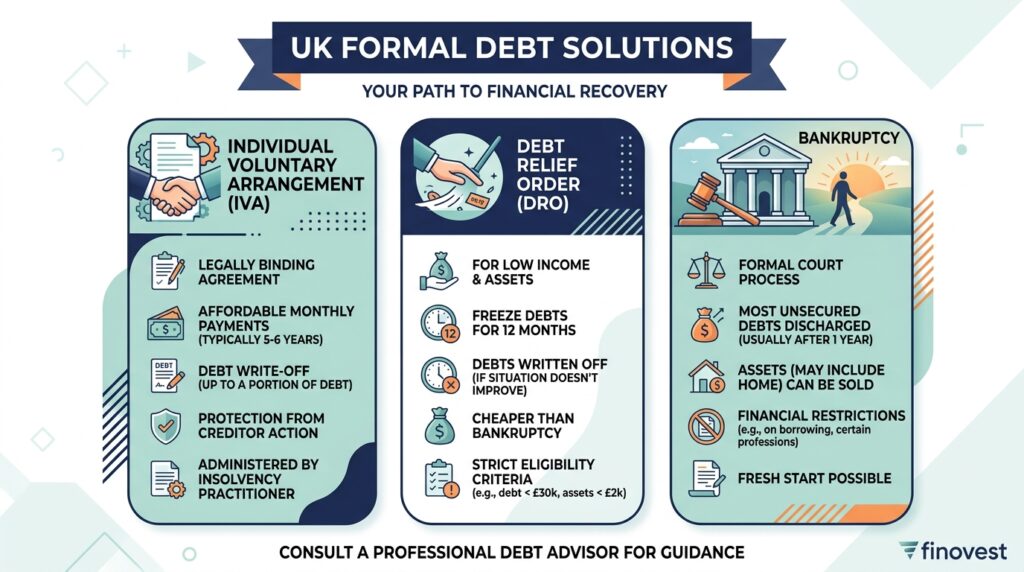
A Debt Relief Order, often called a DRO, is the lightest formal option, designed specifically for people with low income, minimal assets, and relatively modest debts. Eligibility limits have been increased in recent years, with the qualifying debt ceiling raised to fifty thousand pounds and the allowable vehicle value doubled, though it is worth checking the current thresholds directly since these limits can change. A DRO freezes your qualifying debts for twelve months, during which creditors cannot chase you for payment, add interest, or take enforcement action, and if your financial situation has not meaningfully improved by the end of that period, the debts are written off entirely. You cannot apply for a DRO directly. You need to go through an approved intermediary, typically a trained adviser at a free debt advice service such as Citizens Advice or National Debtline, and the application fee itself is modest, often around ninety pounds, a fraction of the cost of formal bankruptcy.
An Individual Voluntary Arrangement, commonly called an IVA, is a formal, legally binding agreement between you and your creditors, managed by a licensed insolvency practitioner. You make an affordable monthly payment, typically for five years, sometimes six if you own property with equity, and at the end of the term, any remaining unsecured debt is legally written off. To enter an IVA, creditors holding at least seventy five percent of your debt by value need to approve it, though once approved, it becomes binding on the vast majority of your unsecured creditors, even those who initially voted against it. IVAs generally suit people with steady income who can commit to consistent monthly payments over several years and who have enough debt, usually at least ten thousand pounds, to make the formal process worthwhile.
Bankruptcy in the UK remains an option for people with significant debts and little realistic prospect of repaying them through any other route. It typically costs around six hundred eighty pounds to file and can result in the sale of valuable assets, including potentially your home if there is meaningful equity in it, though many essential possessions are protected. It is generally considered a last resort compared to a DRO or IVA, given the impact on assets and the record it leaves.
Whichever formal route you are considering in the UK, both IVAs and bankruptcy stay on record for six years from the start date, while a DMP does not leave a single formal marker in the same way, though any missed payments or defaults along the way can still appear on your credit report until the underlying balances are cleared.
How to Think Through Which Option Fits You
With all of these options laid out, here is a simple way to work through your own situation.
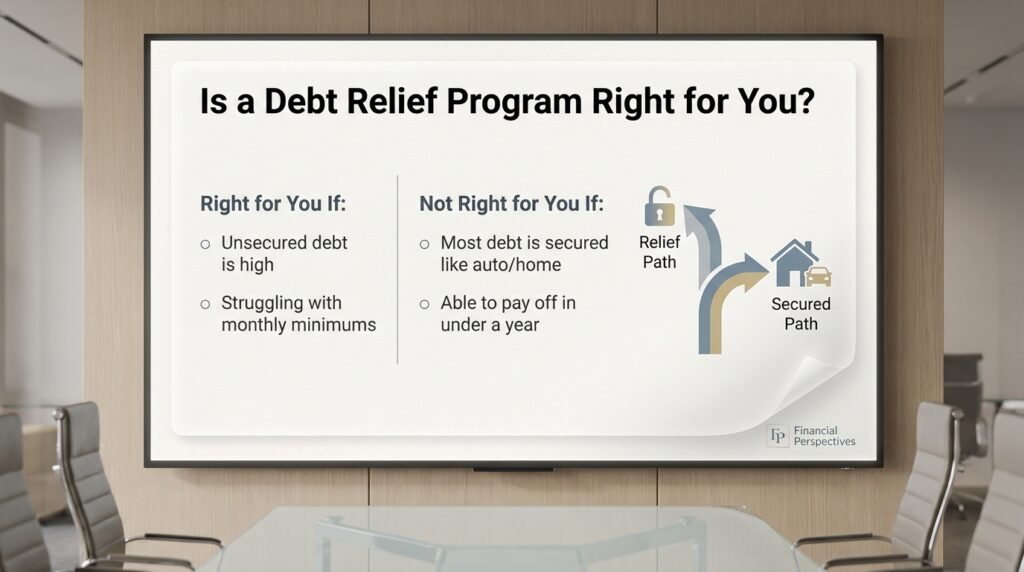
If your main problem is that you have several debts at different interest rates and would genuinely benefit from simplifying them into one manageable payment, while still being able to repay everything you owe over time, a Debt Management Plan or a consolidation loan is usually the right starting point, and it carries the least risk to your credit and your finances overall.
If you have decent credit and can qualify for a meaningfully lower interest rate elsewhere, a consolidation loan or a balance transfer card can genuinely save you money without much downside, provided you have a realistic plan to pay off the balance rather than simply moving the same problem to a new account.
If your income genuinely cannot support repaying the full amount you owe, even on improved terms, and you have significant unsecured debt with no real assets at stake, debt settlement or a formal insolvency route like bankruptcy in the US, or an IVA or DRO in the UK, becomes worth exploring, ideally with guidance from a free, independent debt adviser first.
If you have very low income, minimal assets, and modest debt, a DRO in the UK or a straightforward Chapter 7 filing in the US, where eligible, can offer the fastest, cleanest path to a genuine fresh start.
Warning Signs of a Predatory Debt Relief Company
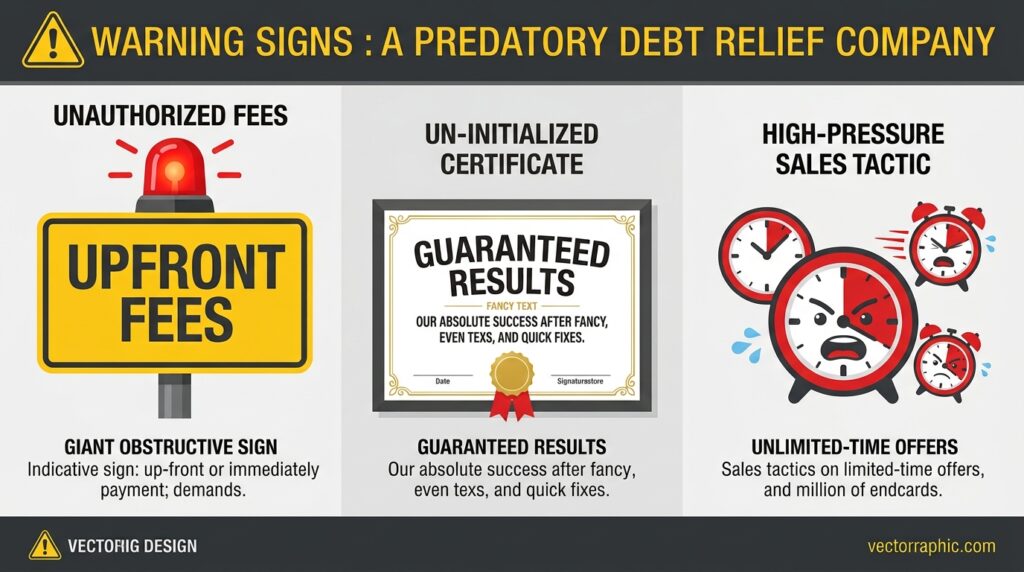
Unfortunately, this is an industry where aggressive marketing and outright scams are common, so it is worth knowing the warning signs before you sign anything or hand over any money.
Be wary of any company that asks for large upfront fees before doing any actual work on your behalf, since legitimate debt relief services, particularly nonprofit credit counseling agencies, generally charge modest fees only after setting up a plan, not large payments before anything has actually happened.
Be skeptical of guarantees. No legitimate company can promise your creditors will agree to a specific settlement amount, since creditors are never obligated to accept any offer at all. Promises of a guaranteed percentage reduction should be treated as a red flag rather than reassurance.
In the UK specifically, be cautious of aggressive advertising for IVAs in particular, since misleading advertising in this space has been significant enough that the Advertising Standards Authority has taken direct action against companies for false claims. A genuinely independent debt charity, rather than a company that profits directly from steering you toward a specific product, is generally a safer first stop for advice.
Always check whether a free, nonprofit alternative exists before paying anyone for a service. In both countries, genuinely free, high quality debt advice and debt management services exist, run by charities and nonprofits rather than for profit companies, and using one of these first costs you nothing and can clarify which paid option, if any, is actually necessary for your situation.
Final Thoughts
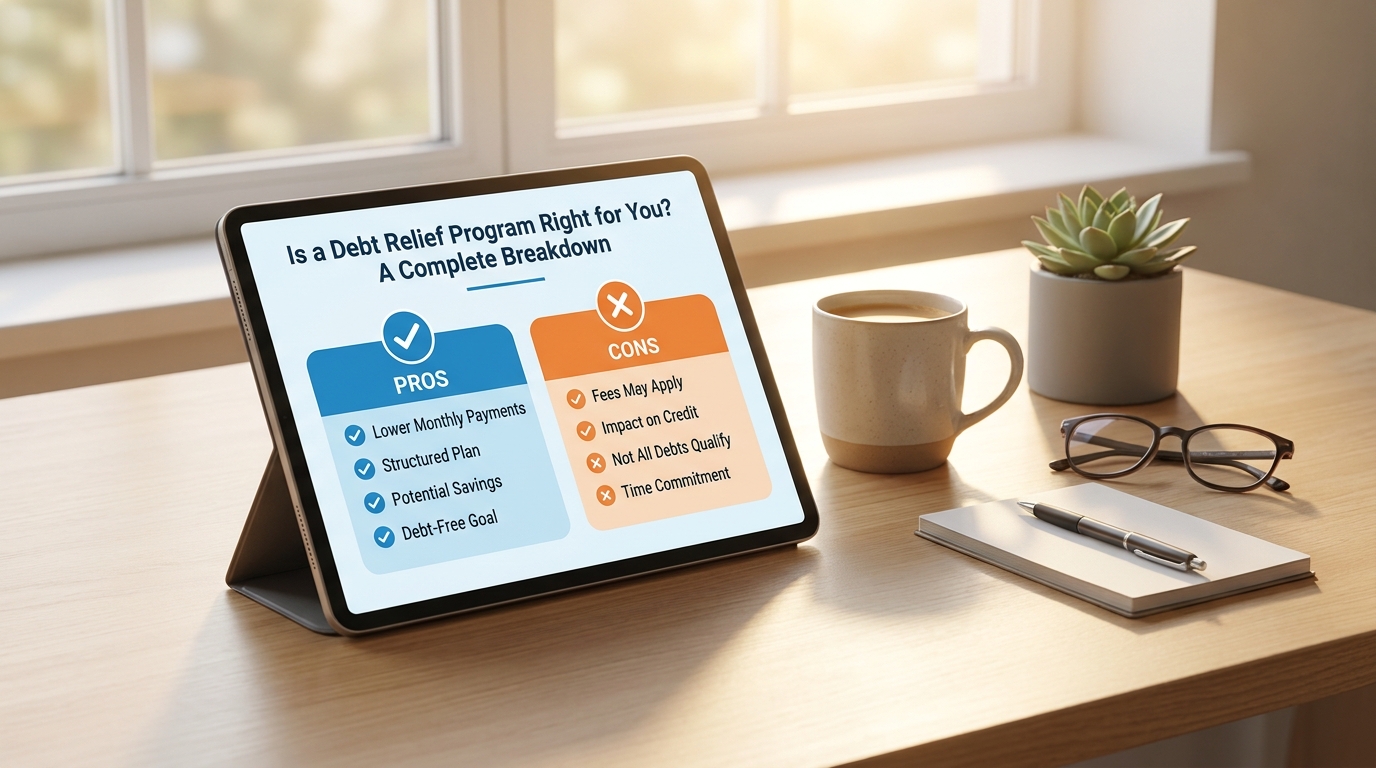
There is no single right answer to whether a debt relief program is right for you, since the honest answer depends entirely on your income, the size and type of your debt, and how much risk to your credit and your assets you are willing to accept in exchange for a faster path forward. What is true across every situation is that starting with a free, genuinely independent source of advice, a nonprofit credit counseling agency in the US, or a charity like StepChange or National Debtline in the UK, is almost always the smartest first move, since it costs nothing and gives you an honest read on your options before you commit to anything more serious.
Debt that feels overwhelming today does not have to stay that way forever. There is a structured path out for nearly every situation, whether that path is a simple repayment plan, a formal legal process, or something in between. The most important step is simply reaching out for genuine, independent guidance before the situation worsens, rather than waiting until your options have narrowed.
This article is for general information only and is not personal financial, legal, or credit advice. Debt relief rules, thresholds, and program details vary by provider and change over time, so always confirm current details directly with a licensed, nonprofit credit counselor or a qualified debt adviser before making decisions about your specific situation.