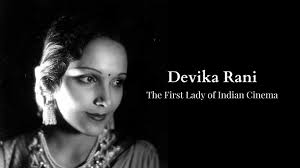

Devika Rani Biography: The First Lady of Indian Cinema
When you think of the golden era of Indian cinema, one name shines brighter than most — Devika Rani. Often called “The First Lady of Indian Cinema”, her journey from an elegant artist to a pioneering actress and studio head is nothing short of legendary. So, who was Devika Rani? Let’s peel back the curtain on her fascinating life — filled with glamour, guts, and groundbreaking achievements.
Early Life: A Star Was Born
Devika Rani Choudhuri was born on March 30, 1908, in Vishakhapatnam, India. She hailed from an elite Bengali family with a flair for the arts and intellect. Fun fact — she was the grandniece of the Nobel Laureate Rabindranath Tagore. That artistic DNA clearly ran strong in her veins.
From a young age, Devika had a curious mind and a taste for creativity. She pursued her education in London, studying textile design and architecture at the Royal Academy of Dramatic Arts (RADA). Not bad for a young Indian woman in the 1920s, right?
Her time in London was transformative — she immersed herself in theater, learned the nuances of acting, and fell in love with art in every form. Little did she know, those years abroad would shape her destiny in cinema forever.
Love and Partnership: Devika Meets Himanshu Rai
While in England, Devika crossed paths with Himanshu Rai, a lawyer-turned-filmmaker who would become both her professional partner and husband. Their shared love for cinema blossomed into romance, and soon, the duo tied the knot.
Together, they worked on the film “A Throw of Dice” (1929), a silent classic that gained international acclaim. But that was just the beginning. The couple’s dream was to bring Indian stories to the global stage, and with that passion, they laid the foundation for Bombay Talkies in 1934 — one of India’s first and most influential film studios.
Think of Bombay Talkies as the Yash Raj Films of its time — glitz, innovation, and a pipeline for new stars. And at the heart of it all? Devika Rani, the powerhouse actress and visionary.
The Rise to Stardom: Breaking Barriers
Devika Rani’s debut came with “Karma” (1933), a film that stirred quite a storm. Why? Because it featured one of Indian cinema’s first on-screen kisses — between Devika and her husband, Himanshu Rai. This bold move shocked traditional audiences but also made her a symbol of modern, fearless womanhood.
Her acting was subtle yet expressive — a rarity in that era of melodrama. Films like “Achhut Kanya” (1936), “Jeevan Naiya” (1936), and “Izzat” (1937) turned her into a household name. “Achhut Kanya,” in particular, was groundbreaking — a social drama where she played an untouchable girl who falls in love with a higher-caste man. The film not only challenged social norms but also cemented Devika’s place as a performer with purpose.
She wasn’t just a pretty face on screen — she was a woman ahead of her time, choosing roles that carried meaning and message.
Bombay Talkies: The Birthplace of Legends
Now, let’s talk about Bombay Talkies — the empire that Devika Rani and Himanshu Rai built together. Established in 1934 in Mumbai, this studio became the cradle of Indian film talent.
Under her leadership, Bombay Talkies produced hit after hit, introducing actors who’d go on to become legends — Ashok Kumar, for instance, made his debut opposite Devika Rani in “Jeevan Naiya.”
After Himanshu Rai’s sudden death in 1940, many expected Devika to fade away from the scene. But she didn’t. Instead, she took over the reins of Bombay Talkies — as the first female studio head in Indian cinema.
Imagine that — a woman running one of India’s biggest film studios in the 1940s! It was unheard of. Yet, Devika did it with grace and determination, proving that talent and leadership know no gender.
The Artistic Touch: Devika Beyond the Screen
What made Devika Rani special wasn’t just her acting; it was her artistic soul. She had a refined sense of aesthetics, from costume design to set decoration. Her background in art and design gave her films a visual flair that was far ahead of its time.
She wasn’t just an actress — she was a creator, a producer, a designer, and a dreamer. Her approach blended Indian storytelling with European sophistication, making her films both culturally rooted and globally appealing.
Retirement and Later Life
After years of trailblazing success, Devika Rani decided to step away from the limelight in the late 1940s. In 1945, she married Svetoslav Roerich, a Russian painter and the son of renowned artist Nicholas Roerich. Together, they moved to Bangalore, where they lived a peaceful life surrounded by art and nature.
Even in retirement, Devika Rani remained a figure of fascination and respect. She received the Padma Shri in 1958 and the Dadasaheb Phalke Award in 1969 — India’s highest honor in cinema. These awards weren’t just accolades; they were recognition of her immeasurable contribution to shaping Indian film history.
She passed away on March 9, 1994, leaving behind a cinematic legacy that continues to inspire generations of filmmakers and actors.
Legacy: The Woman Who Built an Industry
Devika Rani wasn’t just an actress — she was a pioneer, producer, and pathbreaker. She broke glass ceilings before the term even existed. Her courage to portray complex women, lead a film studio, and stand tall in a male-dominated industry paved the way for countless actresses after her.
Every time a strong female character graces the Indian screen today, a little bit of Devika Rani’s spirit lives on. She proved that cinema wasn’t just entertainment — it was a form of empowerment.
Fun Facts You Probably Didn’t Know
- Devika Rani was fluent in English, Hindi, Bengali, and German.
- She once designed costumes for films before becoming an actress.
- She was awarded the Padma Shri for her contributions to Indian cinema.
- “Karma” was among the first Indian films to receive international attention.
- She ran Bombay Talkies successfully for nearly a decade after her husband’s death.
Conclusion: Devika Rani — The Queen Who Ruled with Grace
Devika Rani’s story isn’t just about fame or films — it’s about courage, creativity, and conviction. From London classrooms to the heart of Bombay Talkies, she carved a path no woman had dared to walk before.
She was elegance personified, with a vision as vast as the silver screen itself. In a time when women were rarely seen behind the camera, Devika Rani owned the studio. She didn’t just act in films — she shaped Indian cinema’s identity.
Her legacy continues to shimmer through every era of Bollywood, reminding us that true stars don’t just shine — they spark revolutions. 🌟